Double Vision at the Medina Triennial

Historic Medina High School. Courtesy of the Medina Triennial. Photo: Mark Thomas Duggan.
I graduated from Medina High School in the personally and politically pivotal year of 2016. We were using a combination of Microsoft Word and MS Paint for our brand-new digital design class—this, twenty-six years after the release of Photoshop 1.0. These rudimentary computer programs weren’t ideal, but they got the job done. My classmates and I all MacGyvered our way through clunky design assignments, and we didn’t really know any better.
In a moment when AI-generated art, microdramas, speed painting, corporatized immersive experiences, and other such spectacles dominate the visual landscape, the last thing I expected to grace my rural hometown was a triennial from one of the highest strata of the contemporary art world. I’m simultaneously delighted and shocked that the Medina Triennial, this large-scale, recurring art exhibition staged throughout the village of Medina, came to fruition. Co-curated by Kari Conte and Karin Laansoo, the inaugural edition, titled All That Sustains Us, features thirty-nine artists and collectives from around the world.

Artist AKI INOMATA inside the Medina Triennial Hub. Courtesy of the Medina Triennial. Photo: Mark Thomas Duggan.
For many of the locals I have engaged with, an exhibition of this scope and ambition arriving in Medina feels like opening Photoshop for the first time after only ever attempting graphic design with MS Paint and Word. It’s a whole different set of tools, a brand-new language to learn suddenly right in front of you. The symbols, at first, are nearly hieroglyphical. Besides a collection of individuals I can count on my fingers, I don’t typically associate residents of my hometown with a hankering for contemporary art. In 2018 and 2019, there had been Play/Ground—a weekend-long exhibition initiated by members of the Buffalo arts community occupying the same hundred-year-old Medina High School featured in the Triennial. But otherwise there has never been a lick of contemporary art in Medina, let alone the rest of Orleans County. Having grown up there, this Triennial feels like an alien entity—but one I can only hope continues to flourish. We’ve already cleared the biggest hurdle: actually getting it here. But in an area that simply isn’t a draw for the visual arts, can it sustain itself? As both a Medina native and a contemporary artist, I wanted to find out more and to try to provide a perspective on this geographically unprecedented exhibition.
Medina has a population of approximately 6,000. Orleans County has a population of approximately 40,000 and a total land area of 251 square miles, making it the ninth smallest of New York’s sixty-two counties. Our varsity sports athletes would often have to join forces with those from neighboring towns to have enough players to field a competitive team. This still happens. For comparison, the University at Buffalo, my alma mater, has a combined student, faculty, and staff population of more than 40,000. There’s a chance that as many people frequent UB on a busy day as live in the entirety of Orleans County.

(left to right): Harun Farocki, In Comparison (2019); Cathy Lu, Pile (2022); and Mierle Laderman Ukeles, MANIFESTO FOR MAINTENANCE ART 1969! (1969), All That Sustains Us, Medina Triennial 2026. Courtesy of the Medina Triennial. Photo: Mark Thomas Duggan.
Medina is also notably out of the way. A round trip to and from Buffalo or Rochester will require around two hours of your day—perhaps not totally unreasonable, if you have access to a private vehicle. If you don’t, your best bet is to coordinate a carpool of some sort. There is no train or bus that can take you there from larger towns and cities in the region. There’s a small chance you could get to Medina via the most expensive Uber trip of your life, but good luck finding a long-haul rideshare back. If you’re flying, taking a train, or bus into either Buffalo or Rochester, your only options for the final leg into Medina are renting a car or commissioning an independent taxi service. To put it mildly, accessibility is tricky.
A friend and fellow artist, Julia Dzwonkoski, traveled to Medina for the first time to see the Triennial. She mentioned to me that Medina reminded her of the well-kept towns dotting the Hudson Valley. This similarity might help to partially explain why Medina was chosen for such a grand display of contemporary art in the first place: it has the vibe. Put more eloquently by Kari Conte in the Medina Triennial Guidebook, “We quickly understood that Medina could hold together forms of knowledge too often separated in the United States: agricultural, industrial, ecological, civic, artistic, and historical.”
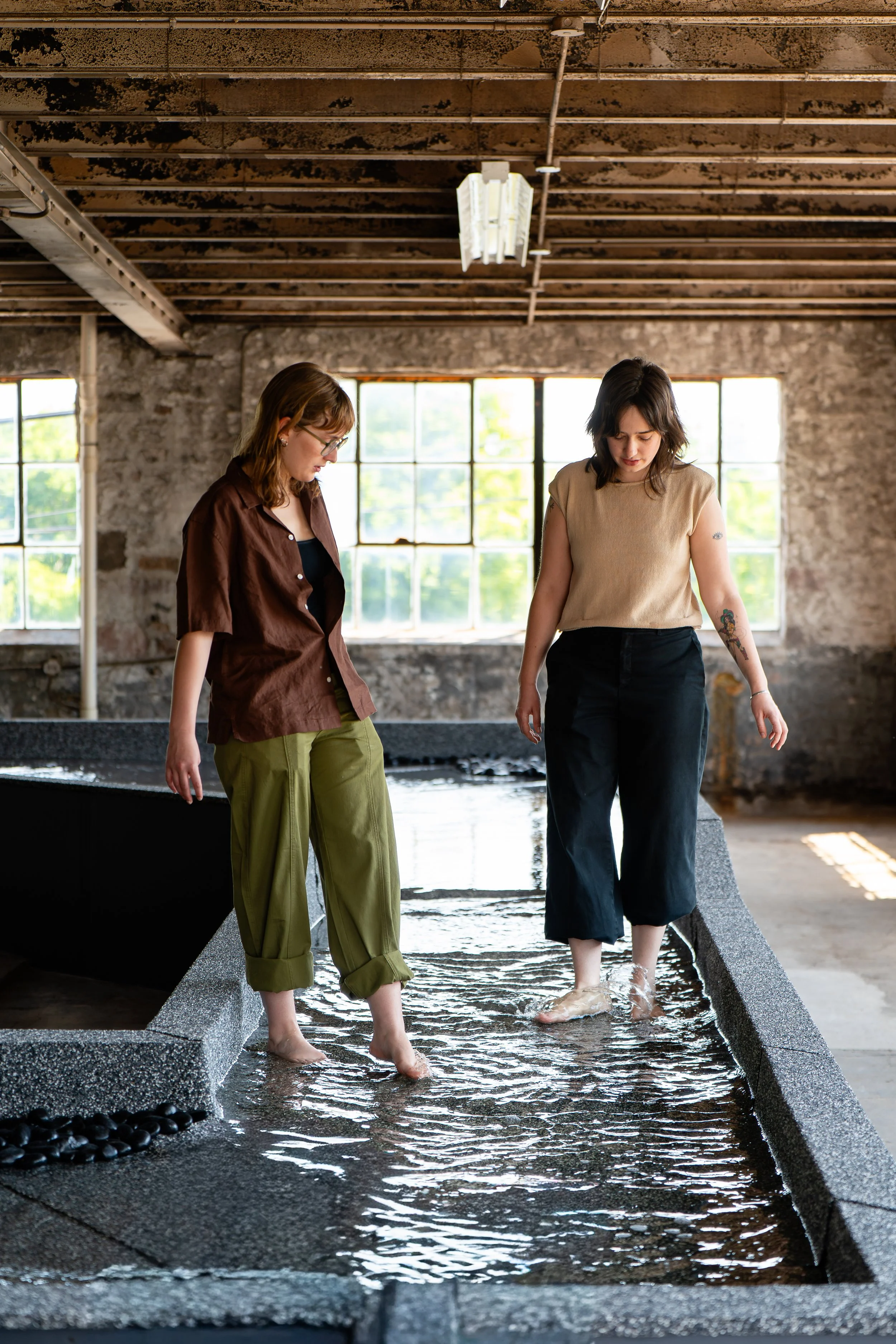
Participants walking in Asad Raza’s Reflection (2026). Courtesy of the Medina Triennial. Photo: Mark Thomas Duggan.
As someone who has spent significant time in both Medina and the small towns of the Hudson Valley, they check similar boxes, at least superficially. The charming and historically rich village of Medina, anchored on the Erie Canal, is reminiscent of the Hudson River villages of Catskill, Hudson, Saugerties, etc. In some ways, I’m surprised this Triennial didn’t end up closer to those municipalities, located in a hotbed for contemporary art that is, maybe more importantly, a relatively quick Amtrak trip from New York City. The Medina Triennial is a long, five-hour drive from the burgeoning Upstate Art Weekend that has occurred every June around the Hudson Valley since 2020. It feels like you could have the same kind of rural experience in Medina that you might have in the Hudson Valley, but that’s simply not the case. Unlike Orleans County, the Hudson Valley is splattered with a consistently surprising volume of artists, academics, and engaged patrons of the arts. There, you can smell New York City's deep influence, but you can’t catch a whiff of it in Medina. Orleans County is one of New York's most conservative counties; 70% of its residents voted in favor of the Republican Party in the last presidential election. This is not the political demographic you would expect for the home of a vast new contemporary art showcase. Trump-affiliated yard signs and flags and lifted pickup trucks are common phenomena. I fear local Facebook feeds. The main industries are agribusiness and manufacturing. I grew up with corn-harvesting combines groaning, ATVs zooming, and horse-drawn carriages click-clacking down my road. The Medina Triennial distinguishes itself from the art industry’s tendency to concentrate itself in left-leaning, highly educated, major metropolitan areas. In the United States, has there ever been a major art triennial in a county with an active Amish community?
It is fitting, then, that Mary Mattingly’s Floating Garden (2026), has become a cornerstone work of the exhibition. Moored in Medina's downtown Erie Canal harbor, this decommissioned and retrofitted industrial barge serves as an interactive community garden. Floating Garden has become a pillar of this triennial's programming ethos by adopted multiple different modalities of engagement equally well-suited to its form and place. Reclaiming the barge from an uncertain future, working with area residents to source plants, collaboratively releasing monarch butterflies—it’s the most accessible work of the whole show and the one that most convincingly engages with the Erie Canal, a significant motivation for the Triennial’s presence here in the first place.

Futurefarmers, Undigging, a participatory activation of their installation 48 Encounters, Erie Canal, 2026. Courtesy of the Medina Triennial. Photo: Eleri Ever.
I did expect more fresh and direct artistic engagements with the waterway itself and its rich histories of engineering and labor and the changing geography of industrial capitalism. Instead, we get Reflection (2026), a variation on Asad Raza’s previous work, Diversion, shown at Portikus in Frankfurt, Germany, in 2022. Both consist of path-like structures raised above shallow flowing water that you walk through barefoot. For Reflection, the water was originally pumped in from the canal. The drab vessel looks like an expanded version of the kind of infrastructure you might expect to find inside a data center or crypto mining facility, except we’re frolicking through it. Its industrially banal appearance meshes seamlessly with the rugged atmosphere of the reclaimed site, previously an auto parts machine shop. In Reflection, we all become participants in the factory's processes. The third most direct engagement with the canal is Futurefarmer’s 48 Encounters, Erie Canal (2026), which haphazardly cobbles together some Medina canal lore with local organic specimens and some Medina sandstone as the cherry on top. Besides a neat oblong artist’s book taxonomizing Futurefarmer’s gatherings, I can’t help but think the project looks like the remnants of a high school biology class with a storytelling kick. As two of the most conceptually and geographically connected projects to the Erie Canal (besides Mattingly’s barge) and housed in the room attached to the Triennial Hub—the recommended starting point for a visitor’s experience of the Triennial—these two works could have been a more visually gratifying introduction. Instead, one feels hastily displaced into a new context, and the other, hastily executed in concept and finish—low points in the exhibition to me.

Tania Candiani, Two Waters, 2026, installation view, All That Sustains Us, Medina Triennial 2026. Courtesy of the Medina Triennial. Photo: Mark Thomas Duggan.
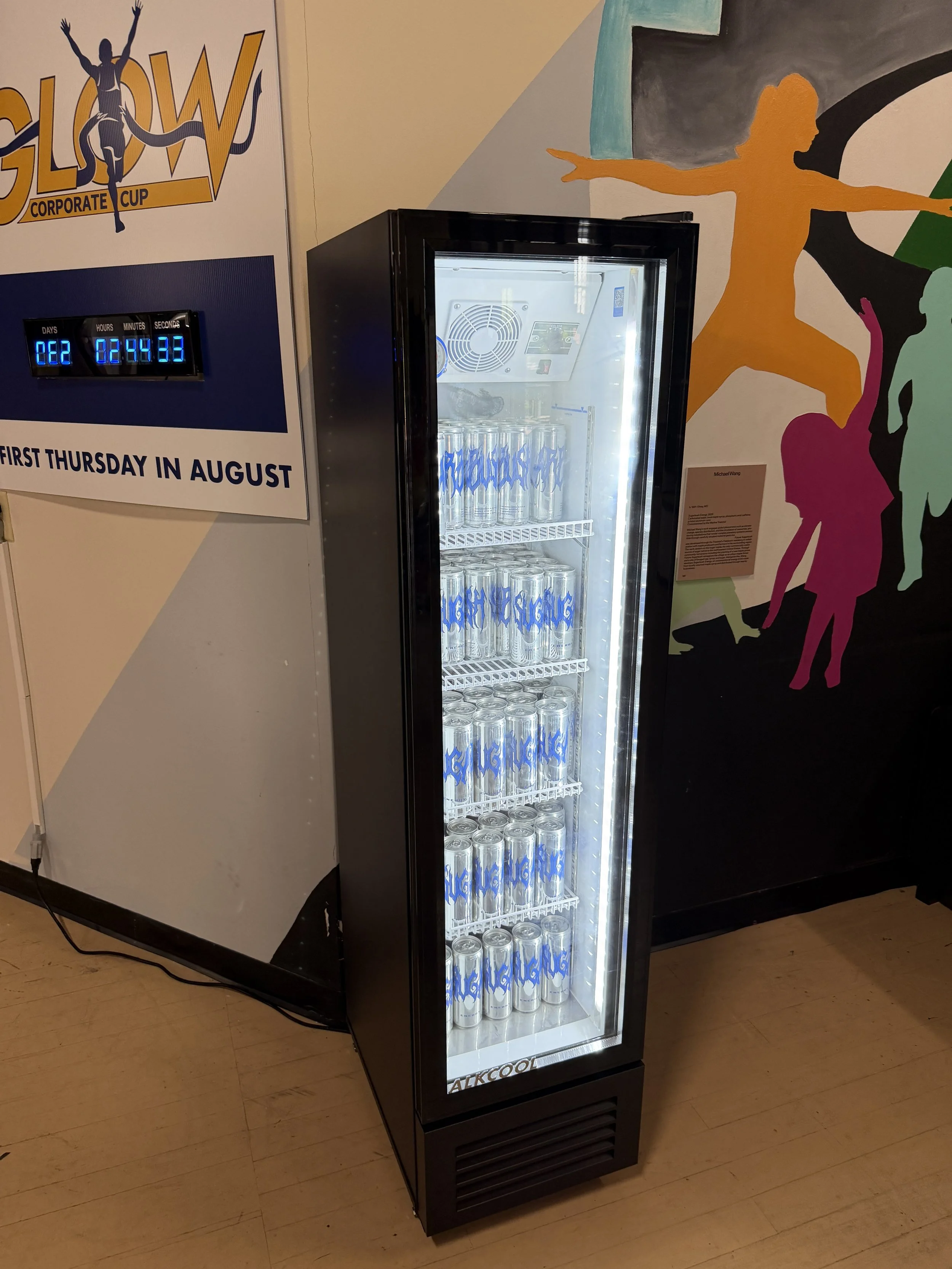
Before departing the Triennial Hub, you can pick up a maple leaf–embossed token, which you can exchange for a homebrew energy drink made with local maple syrup, an artwork titled Sugarbush Energy (2026) by Michael Wang from the YMCA or Monte Alban grocery store. I’m a Zoomer who grew up interlocked within the rapid growth of the energy drink industry, so naturally I’ve already drunk four of them. Not only is Sugarbush Energy a compelling, relevant format, the energy drink itself is the best I’ve ever tasted. When I asked Michael in passing what inspired him to pursue an energy drink as an artwork, he told me he had been “thinking a lot about energy.” I was thrilled by that explanation, brief and concise as it was. With an active data center battle occurring fewer than ten miles south of downtown Medina, I think many residents are also thinking a lot about energy.
You may need a caffeinated boost for the Triennial’s epicenter, the historic Medina High School, which features the work of twenty-nine of the participating artists and collectives. It’s feasible to spend most of your visit inside this building: the installation is museum-like in scale and caliber. There are numerous powerful and immersive video works, such as Alice Bucknell's otherworldly Staring at the Sun (2024–2025) or Jane Jin Kaisen’s haunting yet enchanting Dokkaebi (2024), but a distinctive standout is Tania Candiani’s Two Waters (2026): a confrontation with collectively generated sound. This is another work that perfectly binds together Medina’s aquatic foundations and the present-day community. It was inspired by the aqueduct that separates the Erie Canal and Oak Orchard Creek. The artist divided the community members who answered the invitation to participate into two vocal bodies in the auditorium and directed each side to collectively emit different sounds reminiscent of water. As a viewer sitting in the same auditorium seats, it’s disorientingly evocative. You initially have no idea what is actually going on; the soundtrack warps your senses as you try to interpret how it is being achieved, all while under the ominous gaze of the aurally swaying crowd on the screen in front of you.

(left to right): Gözde İlkin, The Majority of Accent, 2018–2024 and Jean Shin, Everyday Monuments, 2009/2026. All That Sustains Us, Medina Triennial 2026. Courtesy of the Medina Triennial. Photo: Mark Thomas Duggan.
The prime movers behind this whole operation and the repositioning of Medina as a destination for cultural tourism are the New York Power Authority and New York State Canal Corporation. These two government agencies may be detached from the pipeline of contemporary art and its complex innerworkings, but they are keenly aware of its potential cultural, civic, and developmental value at a time of generally increased interest in land with easy access to water for cooling. Looking to highlight the historically rich and now frequently neglected communities on the Erie Canal, these two government agencies landed on Medina as an ideal fit for their ambitious triennial plan. Despite the significant public investment in the project, there were some hiccups. These two agencies gave the curators, boots-on-the-ground coordinators, producers and installers, and the artists themselves extraordinarily limited time. A massive operation like this typically requires three to four years to execute; the curators could only begin curatorial research in November 2024. What they were able to achieve on such an expedited timeline is the most remarkable feat of the exhibition. Even though life moves slower in Medina, the inescapable crunch of strained deadlines has been omnipresent since early spring.
The major public backing combined with the harried timeline, give the Triennial an air of having been strategically plopped in Medina from the outside—regardless of local interest in contemporary art. Despite the tight timeframe, the curatorial staff succeeded in guiding artists to bare relationships in their work that are pertinent to Medina’s identity and character. Contemporary art is foreign to most Medina residents, and the Triennial’s curators conscientiously attempted to maintain just enough connection to the local community’s histories and ecologies to keep it narratively afloat for locals. Ultimately, the Triennial’s location and founding circumstances are a precarious, teetering foundation: appeal to the global art audience or lean into the local population, either way you’re bound to rock the boat.
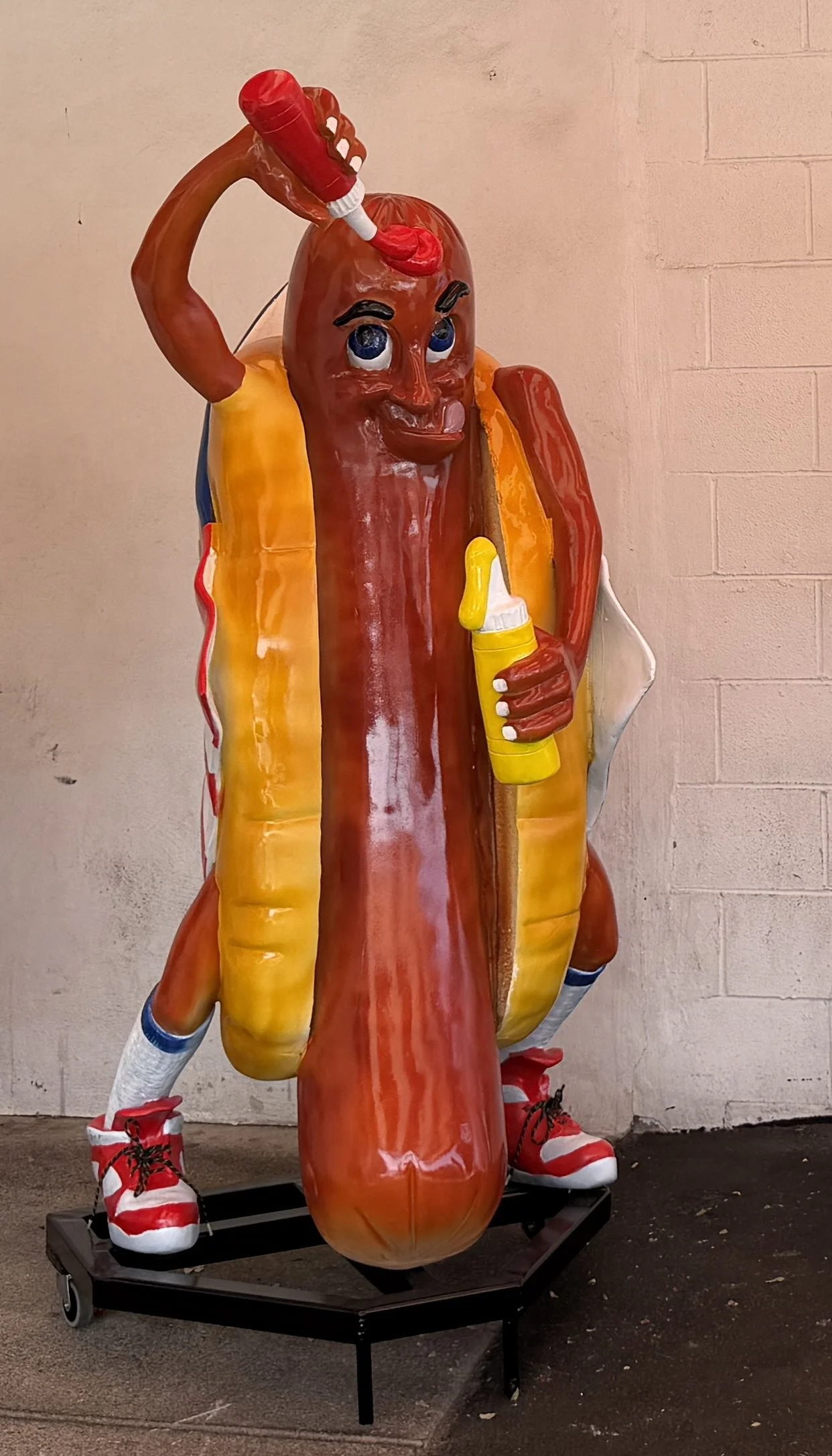
left:
Artist unknown, Frank, 2008. Sculpture outside Rudy's Diner in Medina, NY. Photo: Lucas Cook.
right:
Micheal Wang, Sugarbush Energy, 2026.
Carbonated water, local maple syrup, phosphoric acid, caffeine, printed aluminum cans. Photo: Lucas Cook.
In the process of developing this article I interviewed Tom Rivers, founder and editor of Orleans Hub, the area's only dedicated online news platform. Founded in 2013, the website averages about 8,000 unique daily visitors, and it still possesses the charm of the internet of old. I still check it on the regular. There are few individuals who are as in tune with the goings-on around Orleans County as Tom, so I thought he’d be a good source for some insight. He had steadily been publishing articles about the Medina Triennial since its announcement. We met at Rudy’s Diner in the center of downtown Medina and had a fruitful conversation over some classic diner fare. We talked about the Triennial’s logistics and circumstances, and he mentioned that Everyday Monuments (2009/2026) by Jean Shin really resonated with him. The installation in the former Medina High School gymnasium reimagines the stock figures found on ubiquitous youth sports trophies as adults partaking in everyday tasks and various forms of unacknowledged labor. From what I’ve gathered, Everyday Monuments might be a local favorite. My meeting with Tom at Rudy’s coincided with the reinstallation of Frank (2008), a giant anthropomorphic fiberglass hot dog pouring ketchup onto itself that has long sat outside the diner. This local icon had just come back from a major restoration. I can clearly recall the hot dog from my childhood as one of the few public sculptures in Medina prior to the Triennial. Tom mentioned to me he was planning on writing an article about the six-foot-tall hot dog’s “triumphant” return to the public view. He told me he expected far more engagement on the article about the hot dog sculpture than any press he’s done on the Triennial.
When I last lived in Medina in 2018, I could tell you more about hot dogs than I could about whatever contemporary art is. If you asked me again in 2021, I would probably still be able to tell you more about hot dogs. It took a while for me to wrap my head around contemporary art; I needed real life engagement, learning the valuable nooks and crannies before fully embracing its broad capabilities. The Medina Triennial is certainly in uncharted territory, geographically and culturally. Regardless of this unfamiliarity, the exhibition has been an overwhelmingly positive experience on all fronts. I just hope the Medina community embrace this bizarre new language and learn about what it has to offer, so we can hopefully maintain this unparalleled infrastructural service for generations to come.
by Lucas Cook
Lucas Cook is an artist based in Buffalo, New York, and originally from a rural area outside Medina. Found object transformation and social practice shaped his recent engagements. A curiosity for history, geography, and the quirks of global acceleration inform his practice. He is a founding member of BICA School and co-organizer of its experimental music programming.