Grid 🤝 Scroll
Grazing on Sara Cwynar’s Baby Blue Benzo Beta at the Museum of Contemporary Art Toronto
OUR ANNUAL GALA IS 8 DAYS AWAY
In his landmark essay, “The Ontology of the Photographic Image” (1945), André Bazin diagnoses representational art with a “mummy complex’—a plastic defense against the endless flow of time. Susan Sontag, in a similar spirit, likens a snapshot to a stultified souvenir in “In Plato’s Cave” (1973). A souvenir allows its beholder to clutch a single moment, a compression that tellingly stretches across time. Bazin’s and Sontag’s observations rest on a contrapuntal understanding of time’s infinitude against the finite preservation of a photograph.
But as the smorgasbord of visual delights served at Sara Cwynar’s Baby Blue Benzo Beta reveals, this is an outmoded—and, in fact, inverted—logic.
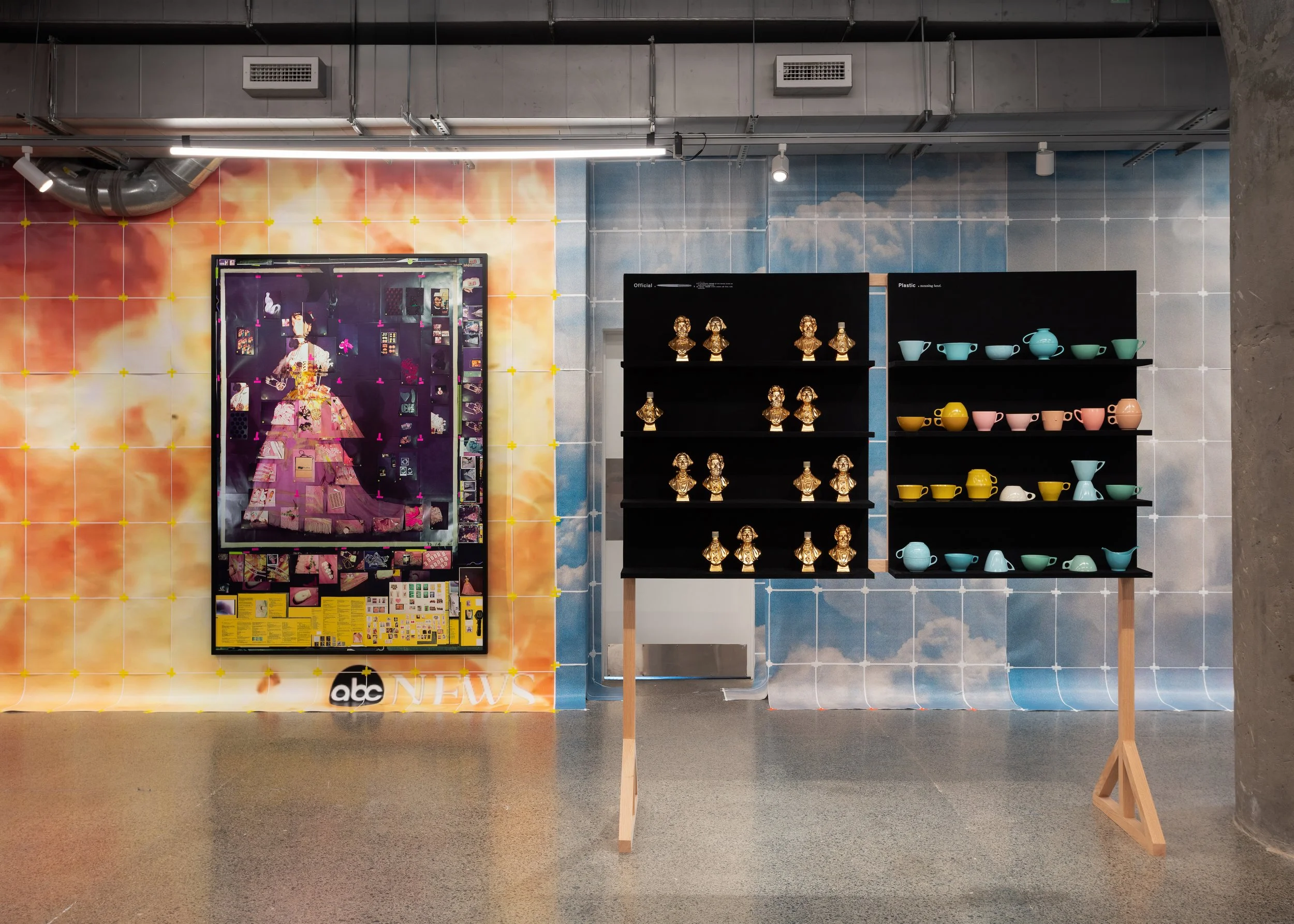
Sara Cwynar, Doll Index, 1865, 2024, Alpha/Alphabet, 2025–2026, Baby Blue Benzo Beta, installation view, MOCA Toronto, 2026.
Courtesy of the artist, Cooper Cole, Toronto, and The Approach, London. Photo: LF Documentation.
Look behind the prodigious double pane panel screening Baby Blue Benzo (2024)—the exhibition’s dizzying filmic namesake—and you will see a tessellate grid upholding it. Baby Blue Benzo remains visible from the rear, its eruption now boxed into neat rectangles dictated by this sturdy, practical frame.
While Bazin’s and Sontag’s assessment of images as weapons against time remains evergreen, the flow of preciousness seems to have reversed: here images are infinite, immeasurable, superfluous. It is now time—diffused through our limited attention and ability to take in all these images—that is precious and increasingly experienced as an insufficient resource.
The grid, then, is a solid heuristic device.
On a recent visit to Carol Bove’s retrospective at the Guggenheim New York, I encountered her Second Cartesian Sculpture (2014), a suspended geometric metal frame constructed using chain links that hang between the other artworks in the retrospective. Its grid “interrupts the architectural space, dividing it into two fields that the viewer must navigate,” reads the wall text. Like a viewfinder, it altered my perception of the scene at hand.
The grid enforces a naive gestalt: it refocuses the mind’s eye and invites us to contemplate the parts and their relationship to the whole.
The grid is everywhere at Baby Blue Benzo Beta. Splayed across all its surfaces, its square fractals repeat interminably. This reliable geometry shepherds me around the otherwise overflowing exhibition.
Now look up: the screening room is wallpapered with the image of a blue sky as radiant as the infamous Microsoft Windows XP background. Unlike the false heavens plastered across pavilions in Las Vegas or Dubai, the hyperreal rendition at the gallery draws attention to its status as an illusion via another grid, whose straight lines are formed by the empty margins on the individual sheets of printed paper audaciously (but meticulously) cross-taped to the wall.
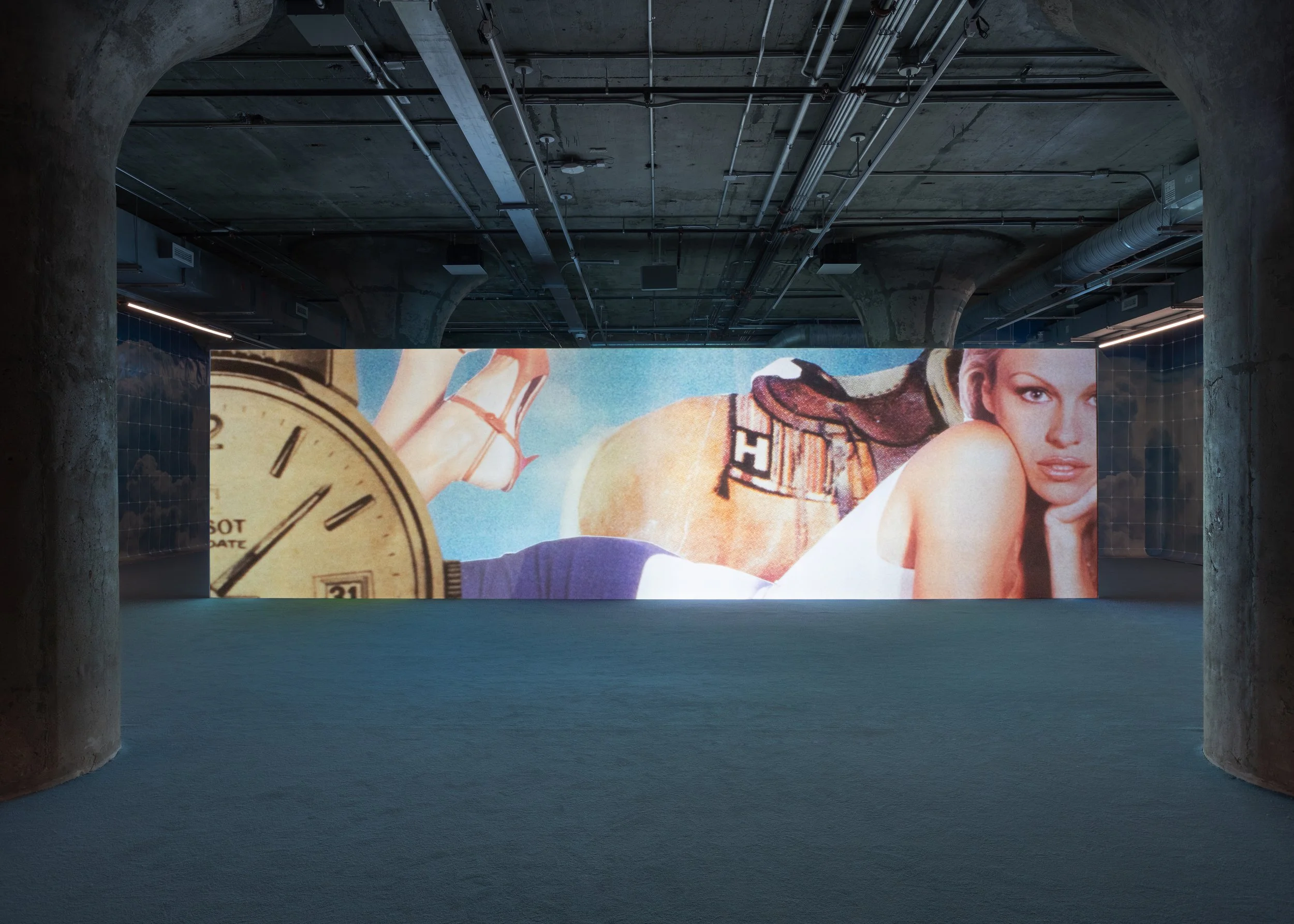
Sara Cwynar, Baby Blue Benzo, 2024, Baby Blue Benzo Beta, installation view, MOCA Toronto, 2026.
Courtesy of the artist and 52 Walker, Cooper Cole, Toronto, and The Approach. Photo: LF Documentation.
A similarly constructed grid bedizens the walls of the room dedicated to Alpha/Alphabet (2025–2026), a compendium of enlarged personal photographs and selections from online stock catalogs. Here, the grid invites me to scan the scene methodically, obliging me to contemplate both the blown-up pixels and the larger whole they construct.
In one case, the x-axis draws my eyes across the sumptuous gradient of amethyst and ruby, while the y-axis shifts my gaze away from these rudimentary visual pleasures and up toward the grand spectacle of rising flames, a disaster made unidentifiable by its massive scale. Though my senses remain activated, the combination of magnification and compaction (through dodgy quality) makes the anonymous tragedy more palatable—this way, the violence is easier on my eyes.
Though I cannot feel the heat of its flame, the paper used to construct the scene begs to be touched upon. Cwynar’s longstanding photography-focused collage practice is notable for its incorporation of printed resources that often act as commentary on the process of image-making itself. The few more traditional instances of collage, works like Uniform (2024), Billboard (2024), and Armor (2017), are presented as flat scans, encrypted behind tempered glass. Cwynar does not erase gridlines, claw clips, creases, and other details that betray human intervention from the final product—the blemishes are part of their beauty. Any texture, dimension, or general sensuous tactility that may have been lost to the process of digitalization are summoned through the naked use of paper across the walls.
The grid, then, is like the string on a balloon: a way of ensuring what is floating doesn’t fly away. It tangibly tethers the immaterial, affixing it down to earth. Its presence acts as a reminder of what is lost.
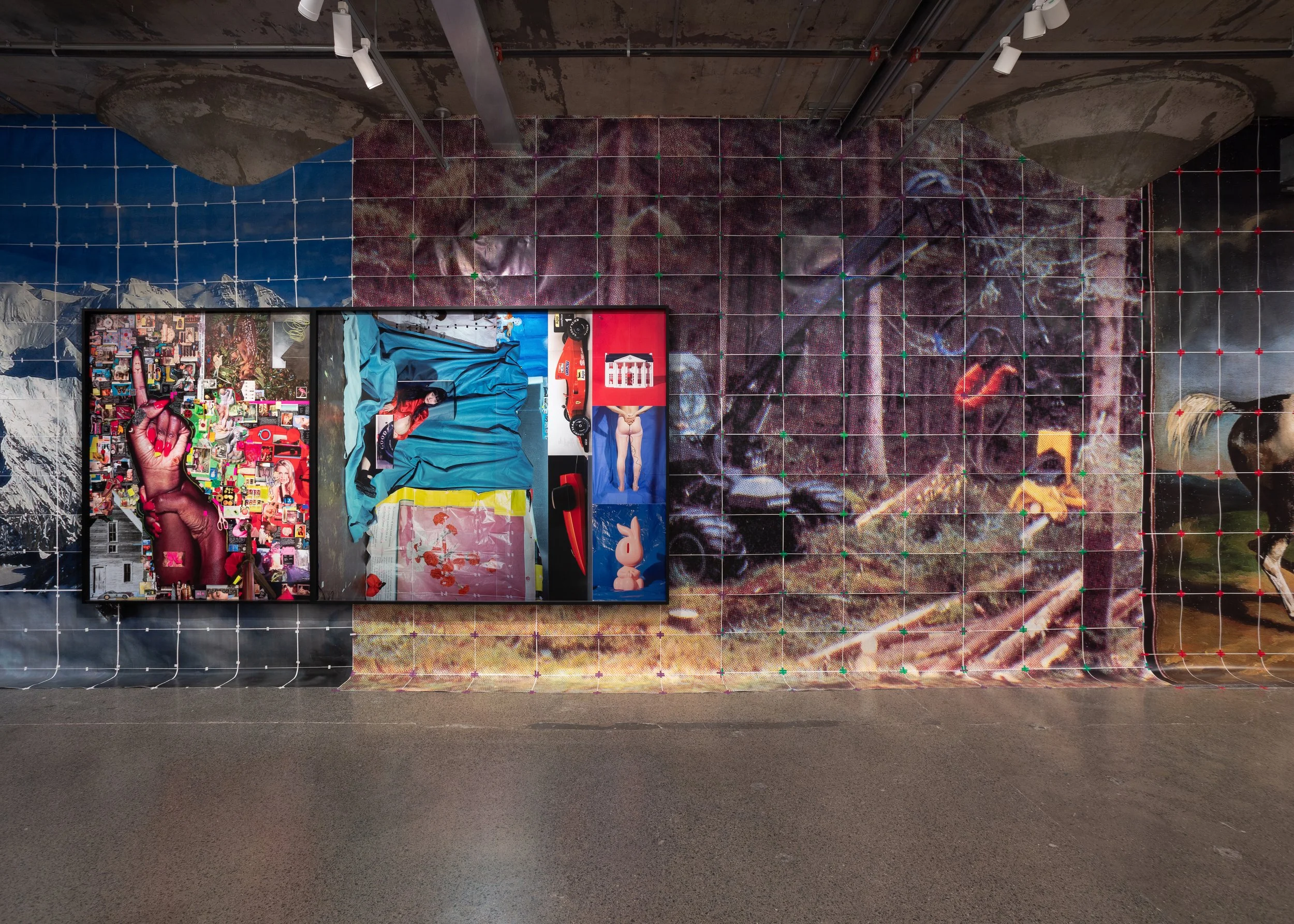
Sara Cwynar, Billboard (Tracy Pregnant, Leticia Hand), 2024, Baby Blue Benzo Beta, installation view, MOCA Toronto, 2026.
Courtesy of the artist, 52 Walker, Cooper Cole, Toronto, and The Approach, London.Photo: LF Documentation.
The boards in the Alpha/Alphabet series too are primarily constructed from paper. Titles like Surface, Youth, and Ferrari idiosyncratically label the entries. The size of the panels remains constant, but their contents span from object to image to video to word to symbol to representation. For example J is for the panel Judge and sports an enlarged x-ray of Marilyn Monroe’s chest accompanied by tiny pictograms of four fish. K is for Knowledge and contains heaps of Cwynar’s research along with one rather opaque riddle.
If we extend the metaphor of the graph, we can understand these individual tiles as vagrant quadrants of a mystifying whole. Like pages torn from an unknown book, any time I spent trying to understand them, uncover an underlying meaning or logic felt wasted.
The series, loosely inspired by Aby Warburg’s unfinished Mnemosyne Atlas (1924–1929), purportedly organizes around search engine history, condensing the artist’s personal annals and those of the internet’s users at large into a single mass. At best, this reads as a gimmick. Like the wanton overvaluation of artificial intelligence, it relies on the fetishization of both information and technology. If this parallel is an intentional product of the artist’s scrutiny, then it is too slight to stand against what seems to have now ossified into the dominant, and automatic, approach to artificial intelligence.
My phone addiction interrupts my visit on several occasions; I have the need to cleanse my palate with a sour sucker, the kind that singes your taste buds instead of soothing them. As I trudge through a landscape that trades wholly and openly on my attention, the question the exhibit raises is one I continually stumble into: how much appreciation can I muster for a contrivance that does capture me? (or: How I Learned To Stop Worrying and Love the Grift).
On our phones, the grid—the enigmatic non-linear feed—is a framework through which time and attention are maneuvered. If the grid is the map, we must ask: What is the territory?
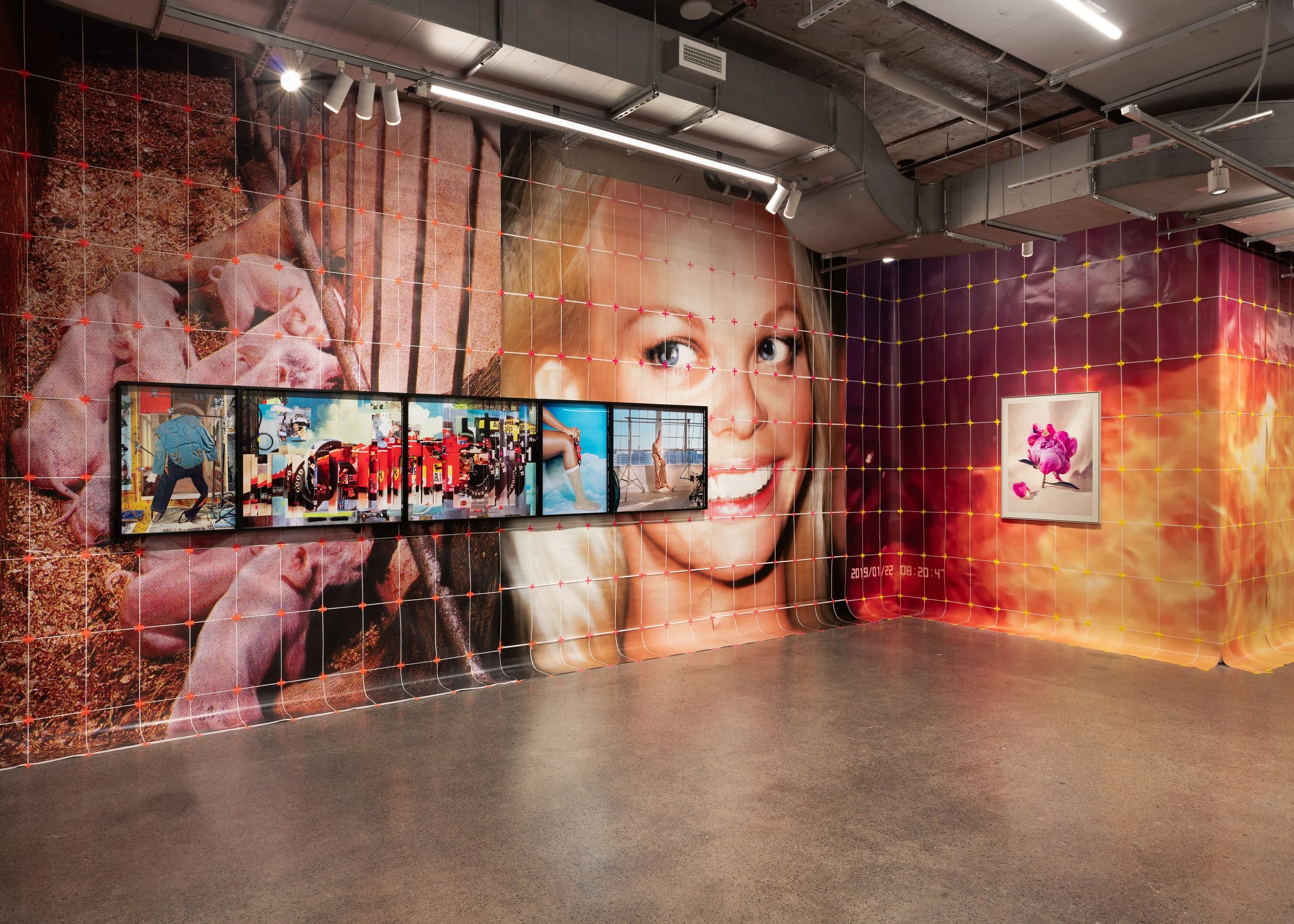
Sara Cwynar, Western Costume, Suit (band), Lt.Blu, Right Shoulder Missing Button;Ferrari from MoMA Collection II; Stocking on Sky; Prop in LA (Strip), 2024, Peony, 2024, Baby Blue Benzo Beta, installation view, MOCA Toronto, 2026.
Courtesy of the artist, 52 Walker, Cooper Cole, Toronto, and The Approach, London. Photo: LF Documentation.
Surveying Baby Blue Benzo left me breathless. There is its beauty but also its sheer breadth. Like an engorged organ, the film purges itself onto the extra-wide screen. The artist is sick of her own consumption, and the flurry of images, their volume and velocity, induces the same nausea in the viewer. Cwynar is notorious for recycling her own work, and the film is also an aggregate of the material expenditure of her artistic practice.
The artist reprises the clever formula she devised for Rose Gold (2017). In this earlier film, the sensuality of a singular commodity is used to puncture a hole in the discourse of capital: the excess it mandates, the vestiges it must fabricate to justify its value and the disappointment one faces when the spell wears off— in her own words, it is the “attrition of the fantasy.” In Baby Blue Benzo, her latest and longest film, the then-new iPhone is traded in for a 1955 Mercedes-Benz 300 SLR, notably the most expensive car ever sold at auction. The proprietary value in each commodity rests in its unique color. This extends the ever-encroaching notion of ownership to abstract qualities, following a precedent set by NFTs, image copyright, and art dealing itself.
“I can't relate to philosophers who wrote about visual representations like they were private property,” whispers Cwynar on the dreamy and poetic soundtrack, masterfully composed by Kieran Adams. “We saw it, that was good enough.” Though the film continually teeters between object and representation, possession and spectatorship, reality and its mere simulation, it never breaks from the logic it sets out to criticize. The imperfections in Cwynar’s artwork, the so-called cracks, are seemingly only superficial.
Cwynar’s brand of anti-consumerist sentiment is relatable rather than revolutionary; it even risks being blasé. Like a Hollywood blockbuster, what makes Baby Blue Benzo exceptional is not its upright virtue but rather its scale. Perhaps the all-American maxims of bigger being better, of more being more are proven true after all.
Cursors, screen recordings, and minimized tabs play hide and seek throughout the video installation, but the artist literally and metaphorically dwarfs these techniques pioneered by desktop documentaries. This is a form of filmmaking that, as the prolific Kevin B. Lee puts it, “treats the computer screen as both a camera lens and a canvas.” 1 The form popularized the soft montage, which brings images together simultaneously through split screens and superimposition rather than simply putting them in successive relation.
The analog staging of the soft montage, which involves the artist physically stratifying images between sheets of acetate, speaks to Cwynar’s fidelity to her materials. The product is a multitude of representations hovering alongside one another. Like a crackpot evidence board, this concurrent display encourages superfluous meaning-making. In my head, invisible lines begin to string together images—the cherry red Ferrari, the graceful ice skater, and the panoptic camera dolly all spinning on a concentric axis—but they do not linger long enough for any narrative to solidify.
This is the logic of a traditional video essay: images appear and sounds (usually words) guide us in their interpretation. The soft montage extends this capability—as Lee articulates in Interface 2.0 (2012), his remix of Harun Farocki’s Schnittstelle (1995)—by allowing images to comment on images. Authorship, though present, is dispersed. In Cwynar’s film, a male narrator lends the artist his voice, Pamela Anderson acts as her body doubles, and the script is a collage of ideas courtesy of an extensive list of thinkers named in the end credits. In place of a single author, the images amass an influence of their own. But, as film critic Serge Daney has pointed out, “cinema isn’t a technique of displaying images; it's an art of showing, and showing is a gesture.” 2
The gesture that defines Baby Blue Benzo is the scroll: the continuous movement of images, both horizontal and vertical, that disappear as quickly as they appear. If a raised palm denoting the STOP sign indicates a threshold or limit, the swiping motion of the scroll ushers in its transgression. More is more.
Kevin B. Lee, “Transformers: The Premake,” alsolikelife, https://www.alsolikelife.com/transformers-the-premake.
Serge Daney, Postcards from the Cinema, trans. Paul Grant (Berg, 2007), 78.
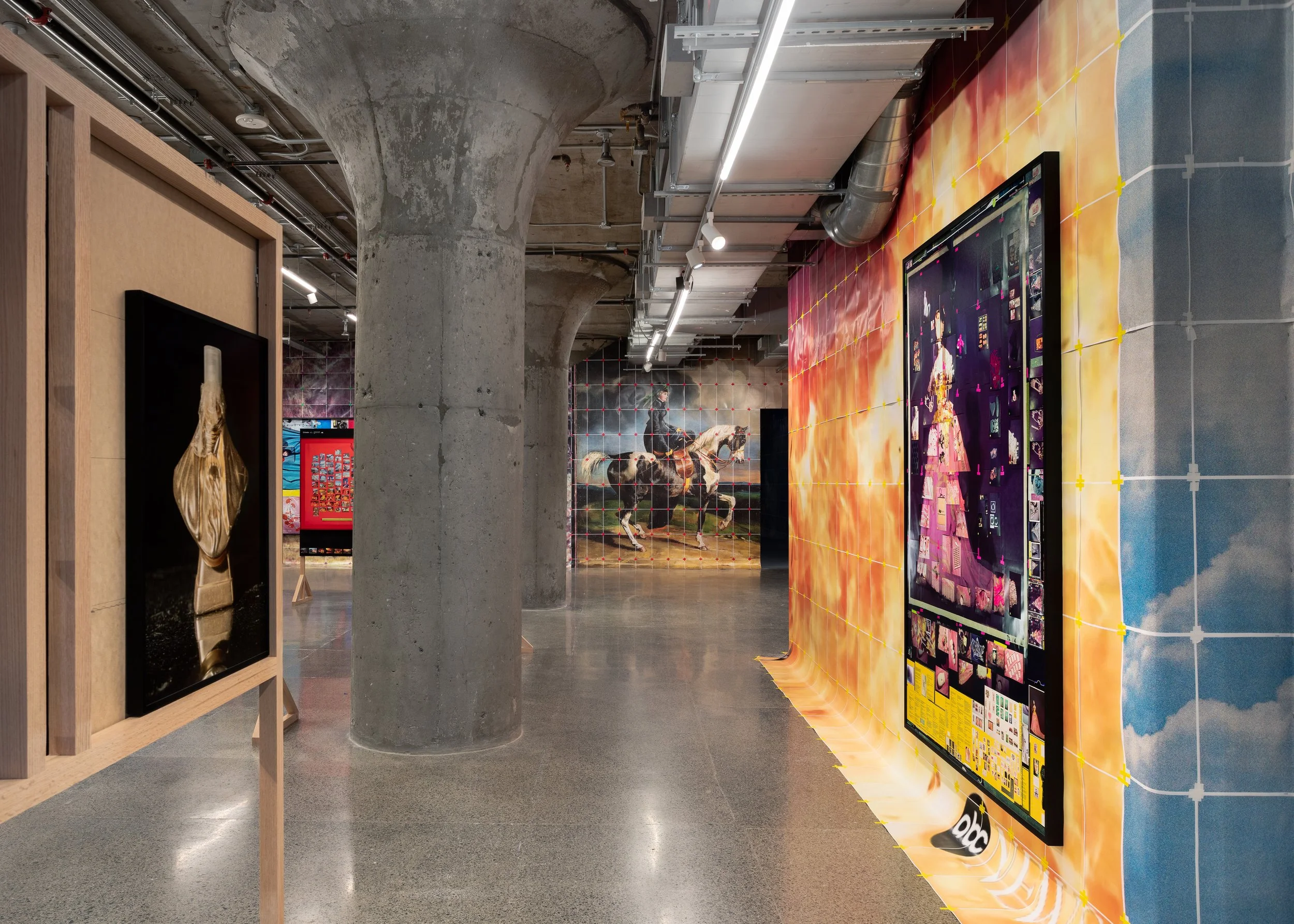
Sara Cwynar, Baby Blue Benzo Beta, installation view, MOCA Toronto, 2026.
Courtesy of the artist, Cooper Cole, Toronto, and The Approach, London. Photo: LF Documentation.
Like innumerable points of data on a graph, the overabundant images we encounter through the scroll yearn for a consciousness to interpret them. Cwynar does not fully commit to this role, does not feign control. Instead, she surrenders both the duty and pleasure that accompany freedom to us, the spectators. This is where the exhibition is at its best: It captures more than the aesthetic experience of technocapital and attempts to distill its ontology, wildly gesturing toward the dasein of it all.
Despite its gestures, Baby Blue Benzo does not yield to its meta-textuality—value is not totally deconstructed, the object does not dissolve or resolve into its representation. Here, Cwynar departs from Harun Farocki and his fellow semioticians (this is fine by me; I find a certain level of self-referentiality to be both fatigued and fatiguing). Despite knowing better, one still leaves seduced by the commodity.
If the arrow points, the scroll swats: meaning is brushed aside, narrative is dismissed.
The dense credits that cap Baby Blue Benzo extend commodity logic to knowledge itself, treating it like something one can own or tally. This is a self-reflexive posture I am guilty of adopting myself. Cwynar’s impulse is to cover the most surface, cast the widest net, and catch them all. But in our contemporary landscape, this very abundance demotes knowledge to information and tarnishes our ability to discern. This is the thesis of Byung-Chul Han’s latest book, The Crisis of Narration, where he laments:
Narration and information are counteracting forces. Information intensifies the experience of contingency. . . . Information lacks the solidity of being. . . . Being and information are mutually exclusive. A lack of being, a forgetfulness of being, is thus immanent to the information society. Information is additive and cumulative. It is not a bearer of sense.
In the absence of sense, we turn to appetitive pleasures to restore feeling. In an existence that runs like a conveyor belt, the function of anti-modern practices—practices like art and literature and philosophy that resist the optimization of industry—is to restore a presence inaccessible to us in the everyday. I want to make a single moment last longer. I want a reprieve from temporality. Baby Blue Benzo Beta only offers an intensification.
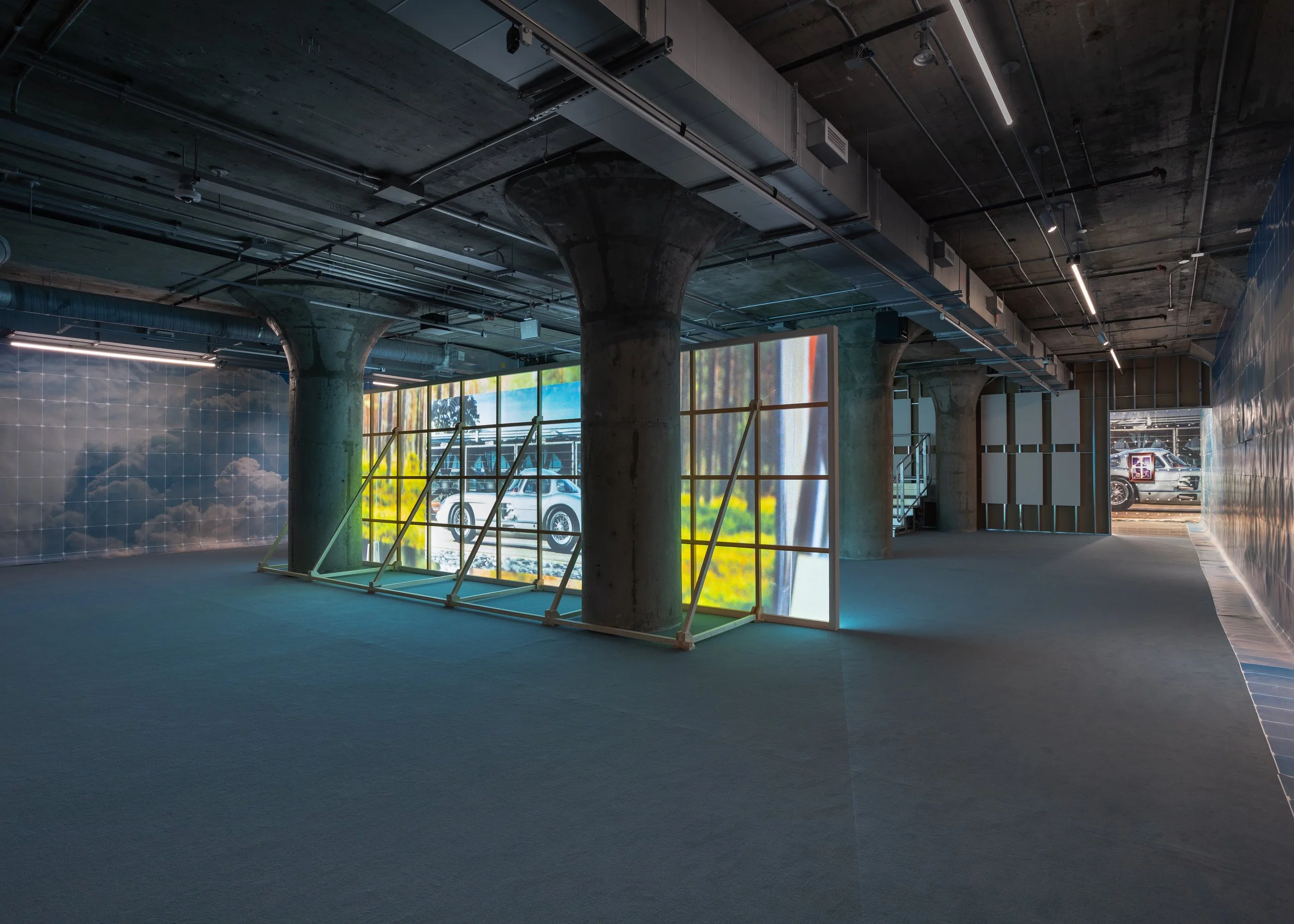
Sara Cwynar, Baby Blue Benzo, 2024, Baby Blue Benzo Beta, installation view, MOCA Toronto, 2026.
Courtesy of the artist and 52 Walker, Cooper Cole, Toronto, and The Approach. Photo: LF Documentation.
by Namah
Namah (she/her) is a writer currently residing in Toronto. She is interested in examining embodied forms of the internet, along with the hystericization of the contemporary subject. Her writing can be found in Little White Lies, C Magazine, and In The Mood.