Searching for a New ‘New Topographics’ in Western New York’s Landscape
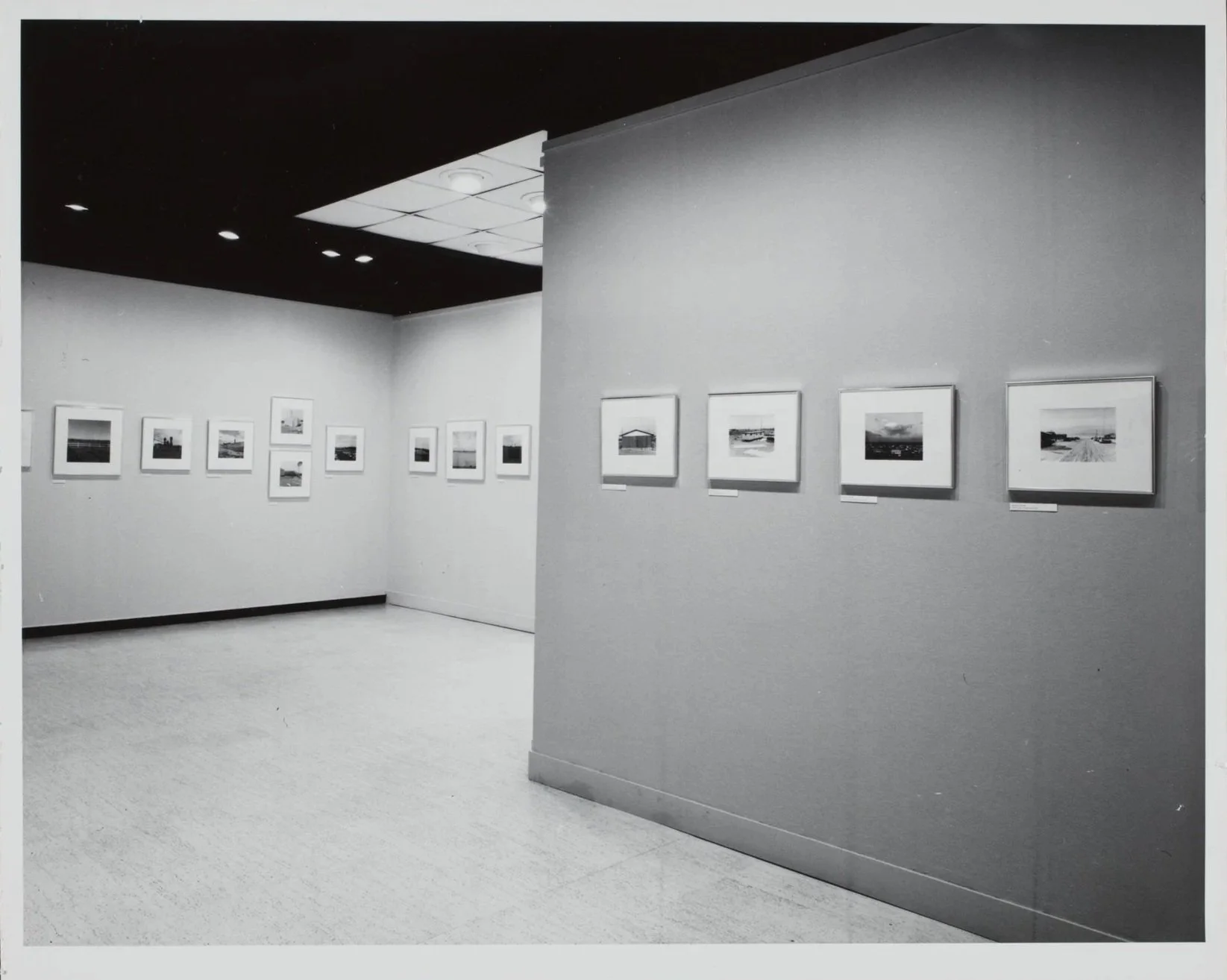
New Topographics: Photographs of a Man-Altered Landscape, 1975, installation view, George Eastman Museum.
Courtesy of the George Eastman Museum.
Moving through Western New York often feels like traversing a landscape that is behind the times or, perhaps more accurately, outside of time. Ours is a landscape stuck in a state of continual decay and endurance. Observing the bones of an industrial past extending toward Lake Erie’s horizon, it’s easy to find in this geography reminders of New Topographics: Photographs of A Man-Altered Landscape, now half a century since its 1975 debut at Rochester’s George Eastman House (now George Eastman Museum).
Assistant Curator William Jenkins brought together recent landscape photography by Robert Adams, Lewis Baltz, Bernd and Hilla Becher, Joe Deal, Frank Gohlke, Nicholas Nixon, John Schott, Stephen Shore, and Henry Wessel Jr. linked by a look and feel of dispassionate distancing, a style aspiring toward styleless documentary. What was conceived as a modest exhibition, with many of the artists never seeing the final installation themselves, has since firmly established its foothold in photography’s history.
When I set out to write this piece for the show’s fiftieth anniversary, I reached out to William (Bill) Jenkins. I wanted to ask about not only the original exhibition but also what kind of landscape and photographic thinking might emerge from today’s Western New York. Our conversations on photography, the state of the country, and contemporaneity were sandwiched between photos texted daily from our respective neighborhood walks: his in sunny Arizona, mine on damp Oxford streets. These small exchanges became a study of microtopographies, echoing the show’s attention to the ordinary.
Correspondence with Bill and additional research shifted my views of New Topographics considerably. I set out to write about the show and its photos. Instead, I came to focus on how it might serve as a guide for understanding our present moment and landscape. Many authors have written about the exhibition. As Bill explained to me, it “has served as a platform for very smart people to perform theoretical gymnastics.” I am less interested in adding to these somersaults than the legacy of New Topographics as it is reflected in the physical, cultural, artistic, and political landscapes of today’s Buffalo.
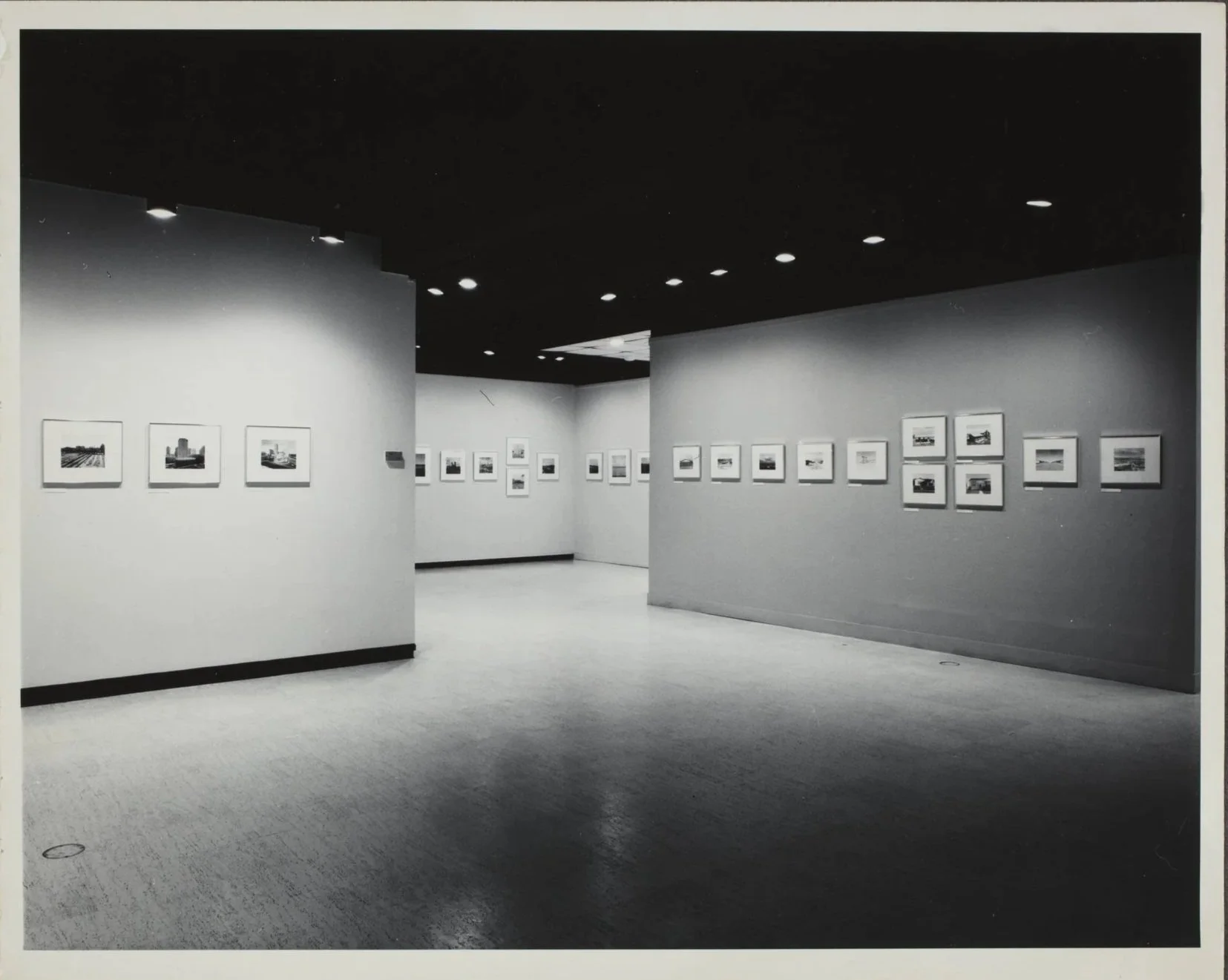
New Topographics: Photographs of a Man-Altered Landscape, 1975, installation view, George Eastman Museum.
Courtesy of the George Eastman Museum.
New Topographics offered a distinct vision of America: tract houses, shuttered main streets, parking lots. It captured landscape not as wilderness (à la Ansel Adams) but as infrastructure, amassing an archive of use, banality, and expansion that nodded to the “documentary style” of Walker Evans. The subtitle “Photographs of a Man-Altered Landscape” announced a posture of distanced neutrality.1
This claim to neutrality and its connection to style were themselves polemical. The exhibition catalogue opens with a Jorge Luis Borges excerpt—“I would write a book—I won’t say in somebody else’s style—but in the style of anybody else”—setting up the show’s frustrating ambivalence to style and refusal to commit to a definitive curatorial statement.2 Perhaps the modifier “Man-Altered” is as close as we can get to an exhibition-wide thesis on the artists’ relationships to and opinions of what is documented. The outlier to this is Adams, with his clearly solemn judgment on the environmental degradation of the West. Jenkins expressed later regretting including Adams, but his presence underscores the exhibition’s deep commitment to each photographer’s right to their own independence and theories. This insistence on artistic independence functions as an additional layer of ambivalence and means of maintaining a claim to neutrality.
Initial critics and visitors dismissed the show as affectless. Today, that affectlessness feels prophetic. “Neutral” photographs—from Google Street View to security footage—have become the dominant mode of visual output. The distance inherent in AI image generation far outstrips that pursued by the New Topographics photographers. The conceptual, Minimalist distance Jenkins identified now reads as a premonition of the datafied gaze, the photography of life by reCAPTCHA image.
Yet in the context of 1975’s Rochester, you could locate a certain openness or optimism in this photographic neutrality. Kodak’s chemical empire still buoyed the city, and a lack of widespread knowledge of the incipient climate crisis meant the idea of documenting human transformation of the land didn’t yet carry the apocalyptic weight it does now. Much of the exhibition imagined Colorado, California, New Mexico, and other points west as endless and vast.
While outside the scope of this text, the “Man” in the subtitle and inclusion of only one woman feels important to acknowledge, even just in passing.
The full quote, originally published in Borges’s “Post-Lecture Discussion of His Own Writing,” Critical Inquiry 1, no. 4 (1975) reads: “I should try to tell, in a straightforward way, plain stories, so that I will try to get away from mazes, from mirrors, from daggers, from tigers, because all of those things now grow a bit of a bore to me. So that I will try to write a book, a book so good that nobody will think I have written it. I would write a book–I won’t say in somebody else’s style–but rather in the style of anybody else.”
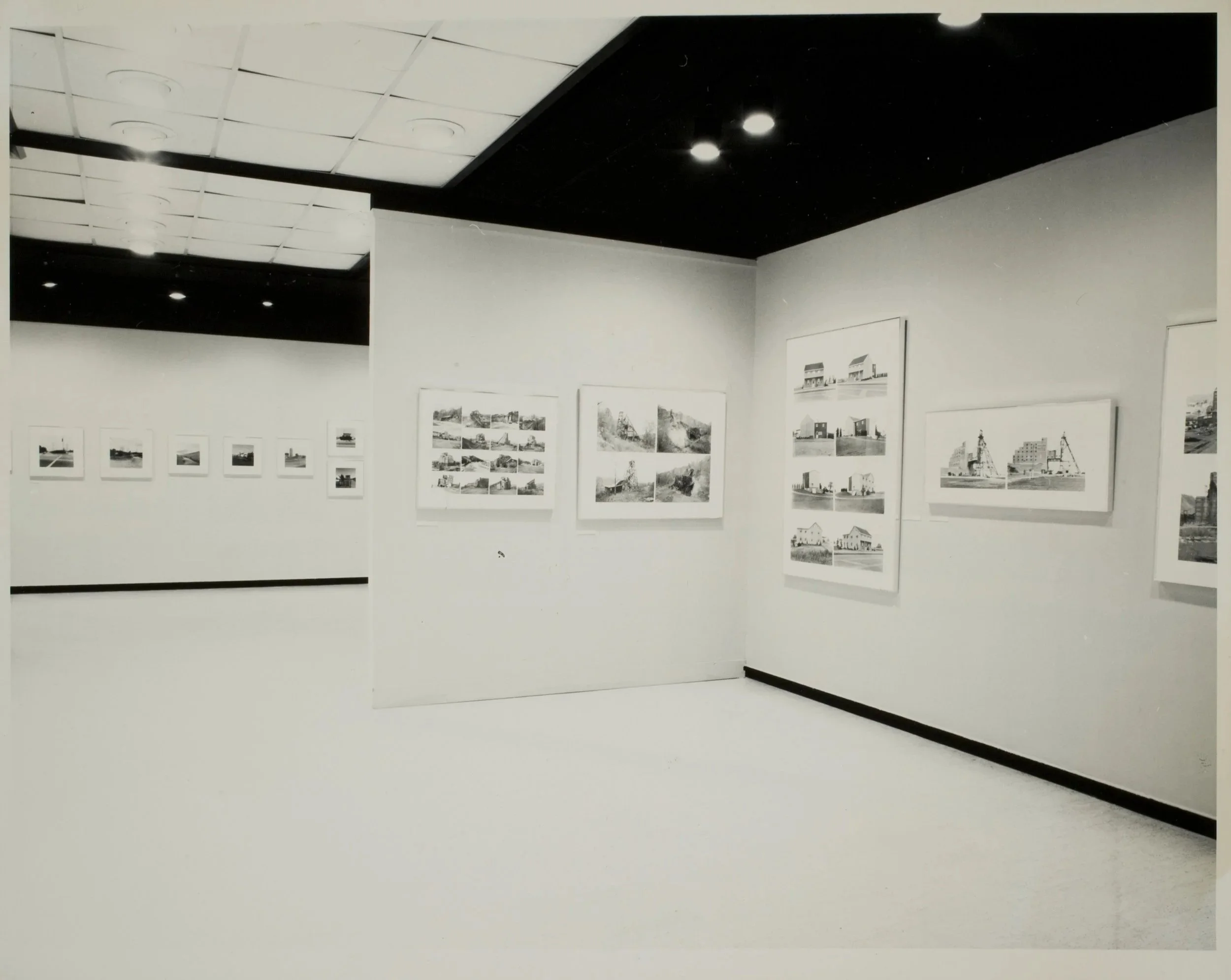
New Topographics: Photographs of a Man-Altered Landscape, 1975, installation view, George Eastman Museum.
Courtesy of the George Eastman Museum.
And so, to reread New Topographics through Western New York is to invert its geography. Much of the exhibition pictured emergent tract homes and other new developments, the West with a capital W. Present day Buffalo illustrates what follows: de-development. Our vernacular landscape is built around subtraction, a core emptied of industry and by suburban flight. Parking lots, one of the most striking motifs of the exhibition, persist as emblem and epitaph. A parking lot is a place without place one only experiences on the way to someplace else, the way a visitor might experience Buffalo enroute to Niagara Falls.
Buffalo and its downtown of parking lots was once a transportation hub for rail and the Erie Canal (also celebrating an anniversary this year). Buffalo’s decline is thus inseparable from the automotive and information economies that remade the postwar United States. At the moment of New Topographics’s conception, the forces that would diminish Buffalo and Rochester were already gathering: a macro shift from industrial to financial capital (what David Harvey might refer to as a movement from a regime of “rigid” to one of “flexible” accumulation) and with foreign steel manufacturers undercutting domestic production. The automotive industry simultaneously hastened suburban flight, reduced the importance of barge and rail, and reshaped the urban landscape to facilitate car dependence.
The people responsible for the human-altered environments that fill the photos of New Topographics are themselves paradoxically absent. Shore is the exception to this rule, but even within his work people are made into miniatures, decoration incidental to the landscape as these images’ real subject. Walking through downtown Buffalo, there is an uncanny mirroring of the absence of people in New Topographics. Yet, the city center, hollowed out by suburban flight, still feels alive with potential. It is a living diagram of New Topographics’ conceptual deceit: a human landscape from which the human has receded. On a deeper level, the commitment to a detached style in New Topographics results in images that are stylistically empty, ghostlike in their countenance. This is reflected in the ghostliness of Buffalo and Western New York at large, a region haunted by infrastructure designed for a much larger population. If the exhibition rendered people as background, Western New York’s landscape has rendered them as memory.
3. Nixon’s photographs of Boston do contain people but tiny as ants and totally anonymized.
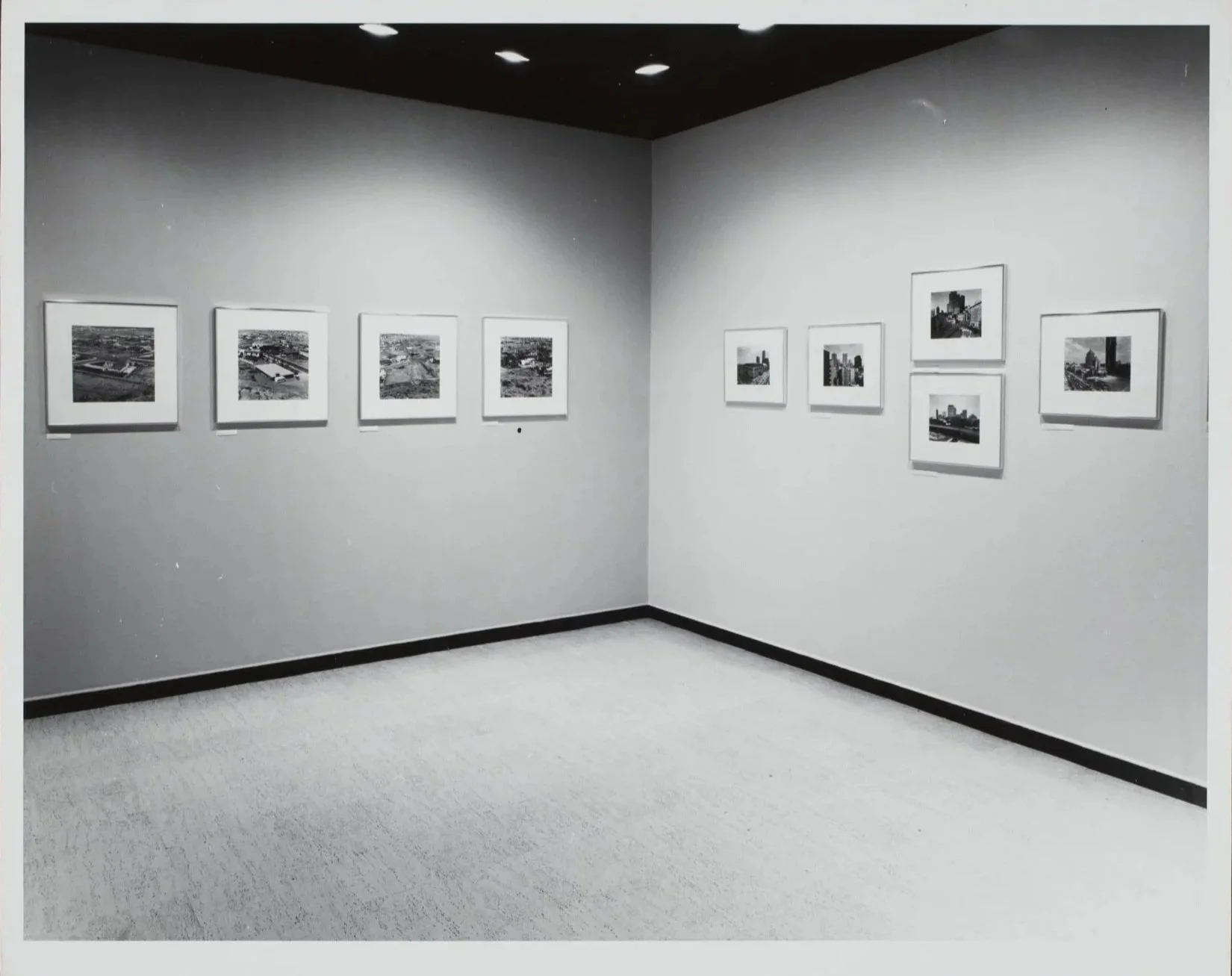
New Topographics: Photographs of a Man-Altered Landscape, 1975, installation view, George Eastman Museum.
Courtesy of the George Eastman Museum.
In both 1975 and 2025, photography stood and stands at an inflection point. In the 1970s, photographers had to negotiate the democratization of color photography as popular pastime and the medium’s relationship to Conceptual art. In our current moment, images proliferate beyond the human hand, and the sheer number of photos produced complicates our notions of the medium. In the 1970s, photography had a power and implicit trustworthiness that is now impossible. It’s hard to imagine a single photograph impacting public opinion like Stuart Franklin’s or Robert Capa’s once did. While the New Topographics photographers sought to erase style, AI image slop and the output of surveillance state infrastructure seek to erase authorship itself.
The question I find myself asking is not whether we need a New New Topographics but whether photography is still the right medium to document a “man-altered” world at all. Surveillance and drone cameras produce an unceasing and mostly invisible topography of data, a landscape of automated looking without seeing. Perhaps this is the logical, if unsettling, successor to New Topographics’ neutral eye, to speak nothing of the digital topographies produced by our data driven lives.
Amid this saturation, Buffalo provides a countercurrent. There is a strange sort of fertility in its slowness and resistance to change. It is this very stasis that creates the conditions for another kind of innovation. Artists remain in Buffalo because they can afford to. Against the churn and pricing out in larger cities and art centers, Buffalo’s inertia fosters a fertile landscape for various underground scenes and avant-garde artistic creation. And in Buffalo and beyond, there has been a generational return to slowness, with younger artists reviving analog processes and the Polaroid in particular. What might appear at first to be nostalgia instead functions as resistance, a reclaiming of tactility and limited production in an age of frictionless image flow.
-
By 1975, the economic grounds beneath our country’s cities were already shifting. New York City’s fiscal crisis and its ensuing state-corporate bailouts marked one of neoliberalism’s first explicit acts: the creditors, never the debtors, would be remade whole. The frame of neoliberalism and New Topographics’ inadvertent visualization of this transition may explain some of its sticking power as a magnet of academic fascination. Its tract homes and offices are early symptoms of a nation reorganizing around finance, energy, and information. The exhibition’s dedication to a neutral gaze captured, perhaps unconsciously, the spatial logic of a new economic order.
Western New York was to become one of its first casualties. Its postindustrial emptiness materially records the changing capital flows and economic circumstances traced by the New Topographics photographers. This is turbo-capitalist geography made visible, an image of the neoliberal landscape.
Writing from Oxford, I find curious affinities between this city’s centuries-old endurance and Buffalo’s post-industrial persistence. Both landscapes insist on staying put. They remind us that time’s passage is uneven and that sometimes the past has a stickiness. The “newness” of New Topographics was temporal as much as aesthetic. Lewis Baltz’s images of suburban developments, for example, explicitly document a great deal of recent construction. Western New York, conversely, keeps the present looking like the past.
Our temporal lag is not merely economic; it is ontological. As Doreen Massey wrote, space is “a simultaneity of stories-so-far.”4 In that sense, Buffalo’s stubborn old buildings and monuments to bygone eras are not ruins but narrative densities. They are accumulations of unfinished stories. To photograph them with a New Topographic distance of faux-neutrality would be dishonest; to photograph them sentimentally would be redundant to lived experience. What is needed is a mode of seeing that acknowledges both endurance and exhaustion. If we are to remain with photography, perhaps our search should begin with the generations of students coming out of the Bechers’ classrooms at the Kunstakademie Düsseldorf and expand from there to Patricia Layman Bazelon to Taryn Simon, Victoria Sambunaris, Anastasia Samoylova, and beyond.
4. Doreen Massey, For Space (Sage Publications, 2005), 32.
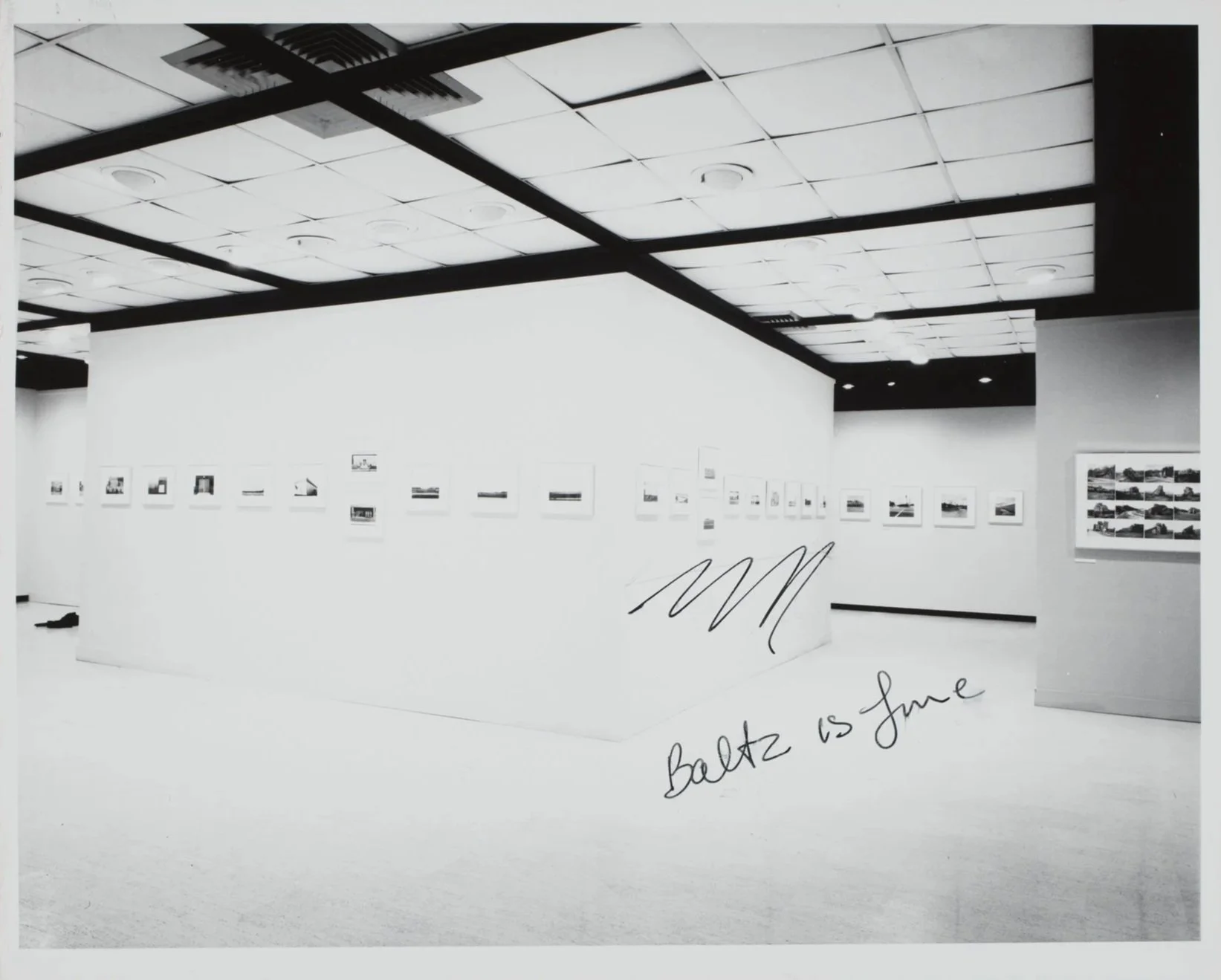
New Topographics: Photographs of a Man-Altered Landscape, 1975, installation view, George Eastman Museum.
Courtesy of the George Eastman Museum.
A New New Topographics ought not expunge the human, it should foreground our entanglement with the climate, data, and capital systems we’ve built. If the first exhibition charted suburbia’s growth, a sequel might map the infrastructures of capitalistic purgatory: the logistics warehouse, the server farm, the shuttered mall. But it must also reckon with alternative landscapes, including the psychic and virtual terrains where contemporary life largely unfolds. Like the placeless anywhere parking lots pictured in New Topographics, the virtual sphere defines a topography of placelessness that touches everywhere.
As Bill put it, “a photograph doesn’t so much represent (re-present) the thing photographed as it invites us to imagine it.” Western New York is indicative of broader capitalistic patterns and, for all its economic fatigue, offers a fertile ground for reimagining approaches to topography and photography. Our stagnation is not purely decay but a pause, a long exposure in which the latent image continues to develop. Perhaps our task is to record the invisible infrastructures and topographics of a world in hesitation. Our landscape’s resistance to change, its staying power, may be what allows us to root down, weather this storm, and come out on the other side ready to engage our creativity. It is then that we can find a topographic approach that honors the landscape, artists, and systems of Western New York and beyond.
By Alexa Kanarowski
Alexa Kanarowski is an artist and photographer whose practice is concerned with intersections of landscape, craft, and time. She loves Buffalo, which has been her home for the past three years. She is currently an MFA student at Oxford University’s Ruskin School of Art and holds a BFA from Cornell University.