The Pre-Degraded Image
A Shortcut to History
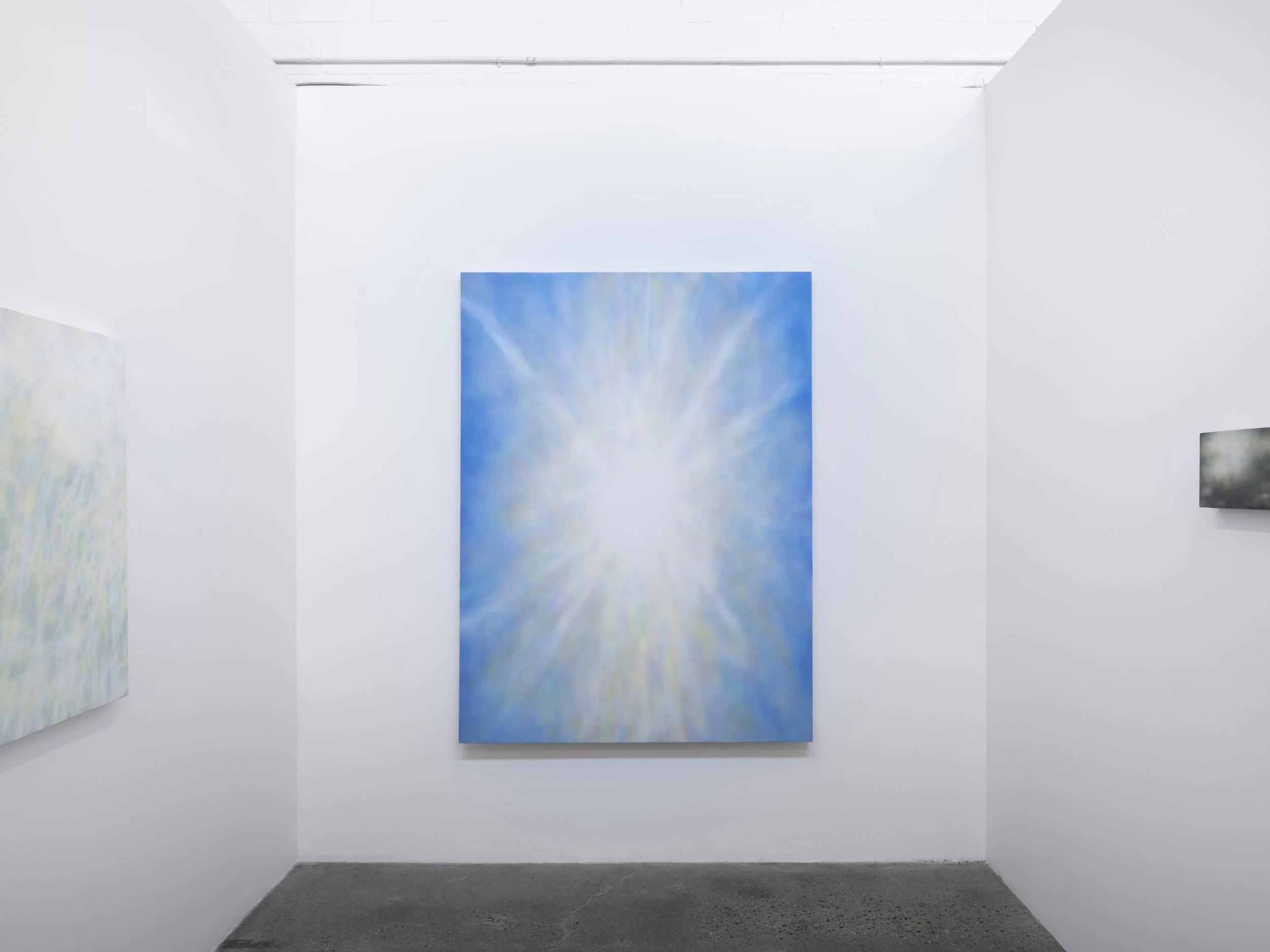
Connor Rothe, I Felt Your Shape, 2024, installation view, You Made It Feel so Real (please keep your promise), 2024, Blouin Division, Toronto.
Courtesy of Blouin Division, Toronto. Photo: Darren Rigo.
October 6, 2025. Mondays I work from home, wallowing in my bedroom as I toggle between the blue light of my monitor and my phone. By the time my lunch hour finally arrives, I’ve grown restless and I flee the house to escape the deluge of images that cascade across my screens, my vision weary with the weight of the spectacle. I walk to 24hratmlotto, a new laneway gallery just down the street, out of a desperate desire to cash out of the internet’s economy of images, to confront something new or perhaps something old—just something substantive. The white walls are a relief, clarifying like the open air. I take off my dirty glasses to examine the artwork, but my eyes can’t quite focus and my vision remains blurry and distorted. Like everything these days, they lack definition.
The quaint garage is currently housing a smattering of works from Megan Bierman-Brophy, easy to disregard as haphazard paraphernalia for those not in the know. I draw closer, intrigued by work that lies somewhere between half-erased cave painting, scratched out street graffiti, and low-effort shit post. Its crudity evokes the primeval and the contemporary all at once. Rough-hewn ceramics are strewn across the floor, and a vulgar half mandorla of the Virgin Mary nailed to the wall blesses the space. Earlier in the year, I remember chuckling at a text-based work by Bierman-Brophy on view in Agnes Wong’s I want you to see this at Xpace, a variant of I Steal (2023) that sardonically confronted this degeneration. “The walls are alive like screens,” reads the iphone screenshot exhibition text. Whether the gallery is satirizing or merely conceding to the way we digest information today is becoming hard for me to tell.
For a while, the relationship between art and technology was uncomplicated—they marched toward the same horizon. For a while after that, we had fun complicating it. But now, the boundaries we sought to invert have long dissipated, and so, the betrothal of the fine art object to the digital relic no longer possesses the same avant-garde punch it once did. If there are new things to say, we are struggling to find them.
Hito Steyerl’s 2009 essay “In Defense of The Poor Image” is a love letter to that former complication. Of poor images, she says:
They express all the contradictions of the contemporary crowd: its opportunism, narcissism, desire for autonomy and creation, its inability to focus or make up its mind, its constant readiness for transgression and simultaneous submission. Altogether, poor images present a snapshot of the affective condition of the crowd, its neurosis, paranoia, and fear, as well as its craving for intensity, fun, and distraction.1
Steyerl lauds the errant nature of poor images and their disruptive influence on the contemporary hierarchy that fetishizes sharpness, resolution, richness. The poor image, compressed and crumpled as a jpeg, slips through the annals of global capital and traverses dubious channels to find itself resurrected on our screens. They are rogue entities: for everyone to produce and distribute, for no one to own.
While Bierman-Brophy seeks to thematize our descent into a cybernetic existence, there are those who take a more literal approach. That Friday, I attend a half-party half-art show thrown by rebel collective PLSDONTMAKEMEGETAJOB where the hyperfashionable drink lukewarm Whiteclaws and puff out candy-scented vapor. Their art, like their clothes, are a reflection of their youth, the profuse nature of their algorithmic desires made concrete. I refuse to acknowledge the elephant in the room—a cast-aluminum labubu by Riley Midroni—and instead find my own techno-fatigue mirrored in Erica Gibbs’s Self-Portrait With Old Filter (2025). The painting declares its own futility in impact font, boxing itself into instagram create mode. In See Thru Ur eyes (2025), the self is similarly distorted, refragmented through various reflective surfaces.
Hito Steyerl, “In Defense of the Poor Image,” e-flux journal #10 (November 2009): 89.
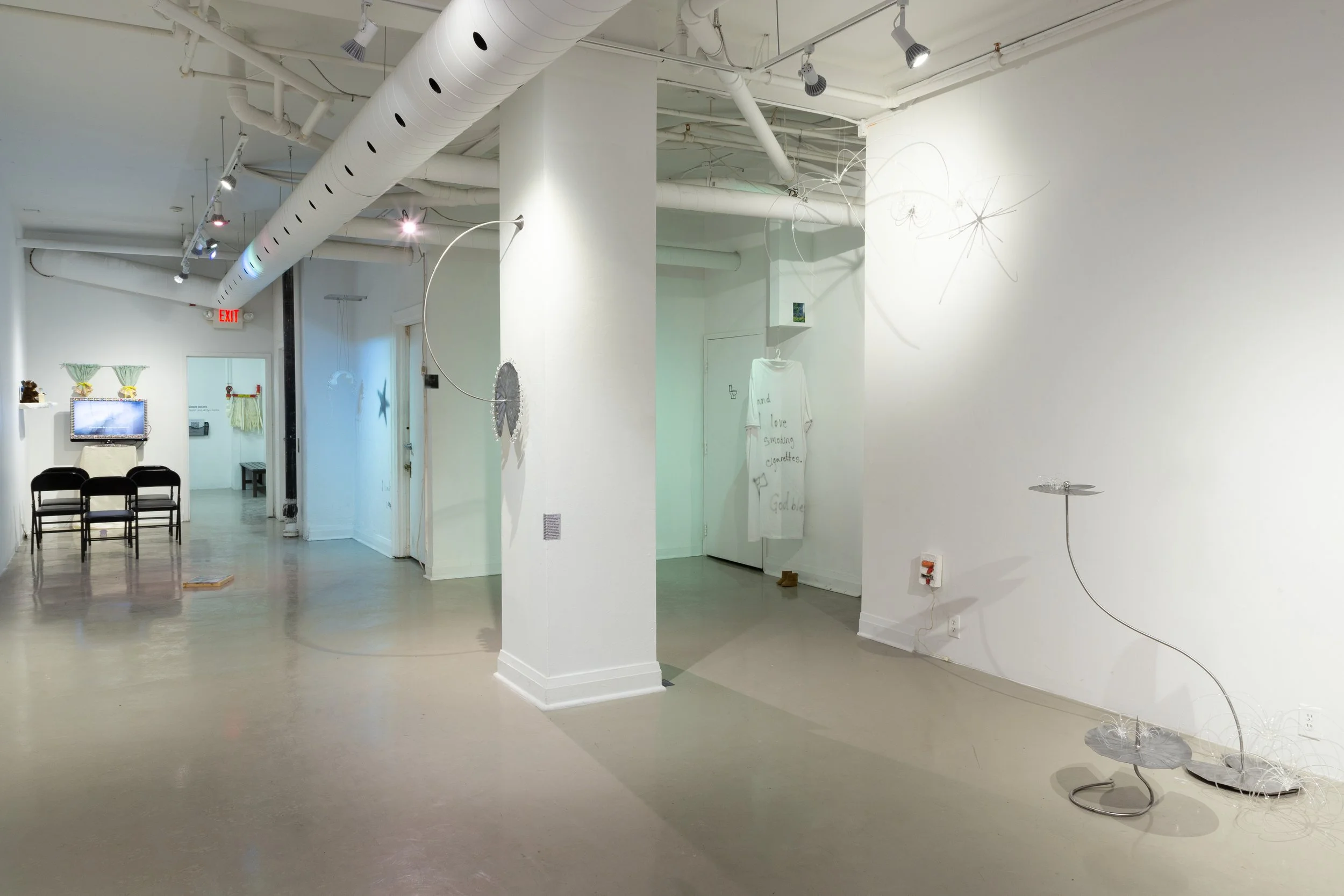
I Want You To See This!, 2025, installation view, Xpace Cultural Centre, Toronto. Photo: Alison Postma.
This distortion present across the PLSDONT’s studio space is reflective of a deep existential confusion. I am sympathetic—to be disgruntled is the prerogative of the young, and I prepare to be punched in the face by their rage and grief and to feel the anarchy of their estrangement. But the show is less the howl of a bastard son and more the static-y radio transmissions of a baby monitor, a humdrum proof of life. The art—which evidently situates itself within an “Internet culture” whose distinction from “culture” grows waterier week by week—captures something substantive about what it means to be alive and online right now. But these transmissions lack the clarity to express anything acute. “To laugh is to take down an authority,” declares the curatorial statement, which may not be true, but neither is it misguided—the collective humor is a welcome shred of vitality within the atmosphere of self-defeat and obsolescence.
Most of the works on view play with ideas of spectatorship, the passive role we all find ourselves slipping into like a second skin. Julia De Ruiter’s Return to Form (2025) depicts the algorithmically proliferated AI apple, while Return to Womb (2025) reproduces its antecedent from the Annoying Orange web series. The apple that once bejeweled so many lush still-life arrangements is now a lost referent, not rotted but resurrected as something hyperreal. To shed my own eyes-glazed-over post-irony and engage with De Ruiter’s work sincerely means I have already lost the battle. As Tara Burton has explained, “the ideological anarchy inherent in shitposting . . . tends to defy analysis. Shitposters, who are bound by nothing, set a rhetorical trap for their enemies, who tend to be bound by having an actual point. . . . Shitposting can’t be refuted; it can only be repeated.”2 It is this repetition, rather than any credo, that gives Internet-age art its meaning.
If “part of what makes the classical avant-garde interesting and radical is that it tended to shun social communication, excommunicating itself through incomprehensibility,” as Seth Price posits in his manifesto Dispersion, then the mimesis of today’s Internet-conversant art places it at odds with the avant-garde. Conceptualism’s interrogative impulse is forgone for pop art’s affirmation—in the room, I find that meaning is readymade and easily amenable. I get the reference; I saw it on my phone. I do not have to work for it and so I walk away. This is not to deny De Ruiter’s technical proficiency—the apple’s cheeky little tongue glistens as if still wet with spit—but this very technical proficiency undermines the democratic promise of new media as a way to liberate the means of image-production.
In the age of oversaturation, it can’t just be about the image as an image anymore. California artist Jack Boucher, the only non-local artist in the mix, circumvents this by remixing familiar IP. In I want Spider-Man (2025), a crudely airbrushed rendition of the trademarked superhero trudges along with a wheelbarrow, while No marked bills (2025) taints a precious corporate commodity by placing the now-pervasive Ghostface mask at the scene of armed robbery. Compared to De Ruiter’s fruitless quest to place her finger on the pulse, Boucher’s nostalgic approach may prove to have a greater archival half-life. But despite his subversive rejigging, the work remains structurally reliant on knowledge of hegemonic culture and on the semiotic operator of capital to imbue the symbols with meaning.
The ubiquity of these symbols raises the question of whether it is possible to recuperate anything from the mighty wave of capital whose flow engulfs us all, never ebbing to ask for permission. Steyerl issued a prescient warning: “While the territory of poor images allows access to excluded imagery, it is also permeated by the most advanced commodification techniques. While it enables the users’ active participation in the creation and distribution of content, it also drafts them into production.”3 Inconspicuously, the artist becomes an agent of capital whose attempts at destabilization only buttress it. While early digital art seemed interested in understanding itself as resistance, or acknowledging the limitations of its resistance, the fine art object seems to be comfortable in its own futility.
2. Tara Isabella Burton, “Apocalypse Whatever,” Real Life, December 2016, https://reallifemag.com/apocalypse-whatever/.
3. Steyerl, “In Defense of the Poor Image,” 89.
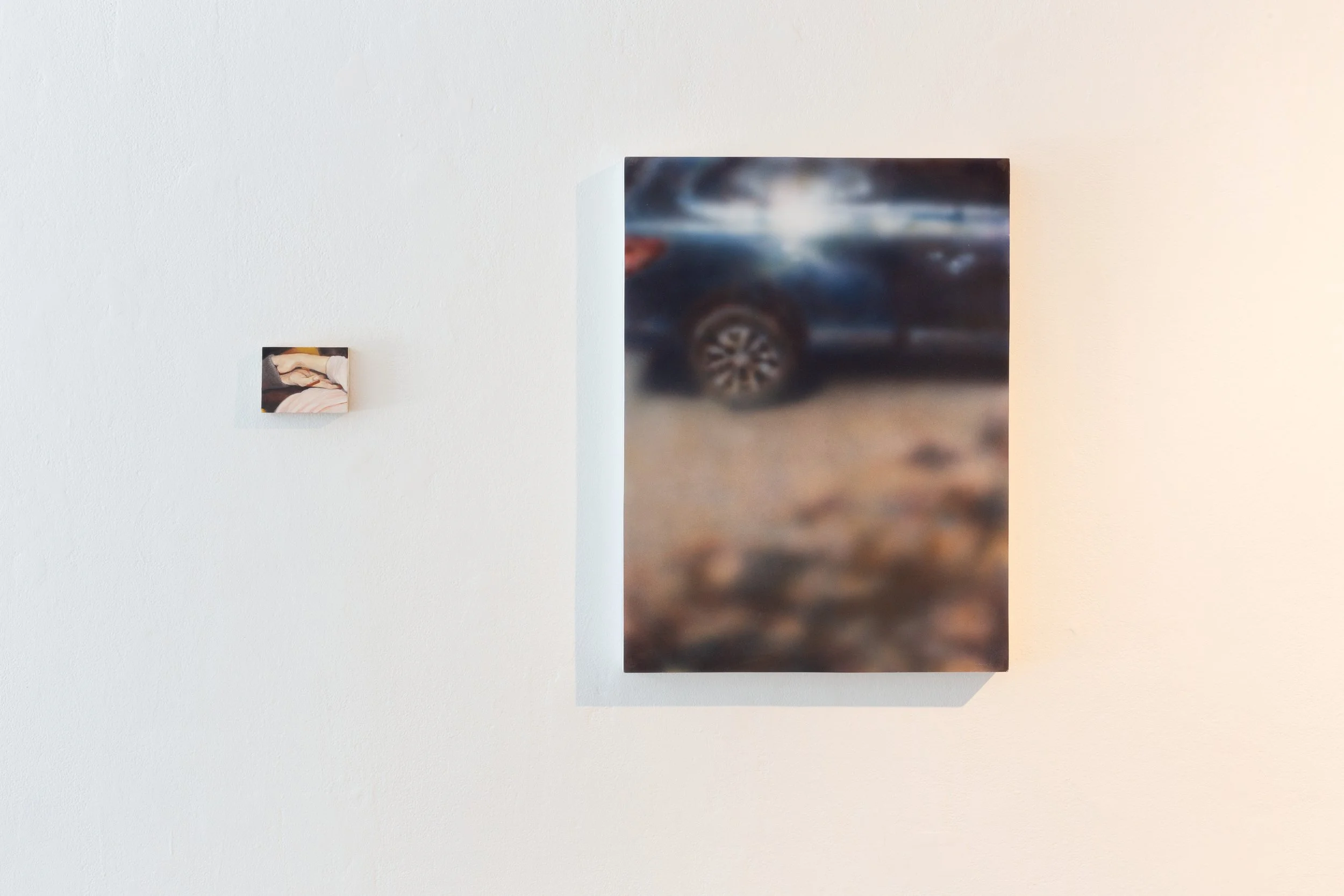
Left: Laaya Tabei, Entwined, 2025. Oil on wood
canvas, 3 x 4 inches.
Courtesy of the artist.
Right: Jake Santos, take care, 2024. Acrylic ink on wood panel, 18 x 24
inches.
Courtesy of the artist.
Connective Tissue, 2025, installation
view, Xpace Cultural Centre, Toronto. Photo: Alison Postma.
The ossification of the immaterial on the gallery wall “reaffirm[s] the paradoxical compromise wrought by contemporary art when confronted with new media: the endless variability and modulation of the digital image is belied by the imposition of a ‘limited’ edition and an aesthetics of the precious one-off,” Claire Bishop pointed out now more than a decade ago.4 Marshal McLuhan's refrain of trying to do today's job with yesterday's tools and yesterday's concepts rings true and keeps on ringing. No one knows how to answer the call. Has “the medium is the message” not achieved axiomatic status? I spare new media experiments like Angela Rose Cabarios’s video art my scrutiny for there seems to be an interest in progression, some sincere belief in the liberatory and utopian potential of technology.
Unbounded by time and space, the allegedly disruptive value of digital art lay in its opposition to the traditional art object and so, one’s outlook on the rapid conflation of the two becomes a question of perspective—perhaps Paglia was right in proclaiming that Pop art killed the avant-garde, or maybe it is Benjamin’s belief that the utopian potential of a medium is only realized at the very moment its obsolescence reigns supreme. Tell me viewer, is the snake that eats its tail ushering its own rebirth or is it simply devouring itself?
I maintain incredulity toward the artists’ motivations—does it begin and end with physical archivability? While it is true that more and more of life’s pure activity finds itself online, rendering the ephemeral physical is definitionally regressive, a willing recession into the tomb-like slumber of the archive and decapitation from the fast culture that imbues objects with their life force. In contrast, the poor image is damaged, but it is not dead. Its degraded form is not carefully crafted but accumulated through a lifetime of travel, production, and reproduction. Its circulation makes it forgo some of its definition, but it “recovers some of its political punch and creates a new aura around it,” notes Steyerl.5 Its distortion is proof that it is alive.
Over the weekend, I look through my photo gallery and realize that other emerging artists, too, bask in this constructed aura. Connor Rothe’s work highlights, even enshrines, the inadequacies of our restless scopophilia, the subjective experience of viewership that the spectacle can't quite transmit. Felt Your Shape (2024) and With Limp Arms I Can Feel Most of You (2024) are ecstatic lens flares, unbounded erupting bokeh. His experiments with light remind me of hurried and impatient iPhone photography, whose blur, in Brian Eno’s words, is “the excitement of witnessing events too momentous for the medium assigned to record them.” The texture is so obliterated, one doubts if it is an image at all. Like cyberspace, their phantom looms large irl.
4. Claire Bishop, “Digital Divide: Contemporary Art and New Media,” Artforum (September 2012), https://www.artforum.com/features/digital-divide-contemporary-art-and-new-media-200814/.
5. Steyerl, “In Defense of the Poor Image,” 90.
6. Brian Eno, A Year with Swollen Appendices (Faber and Faber, 1966), 283.
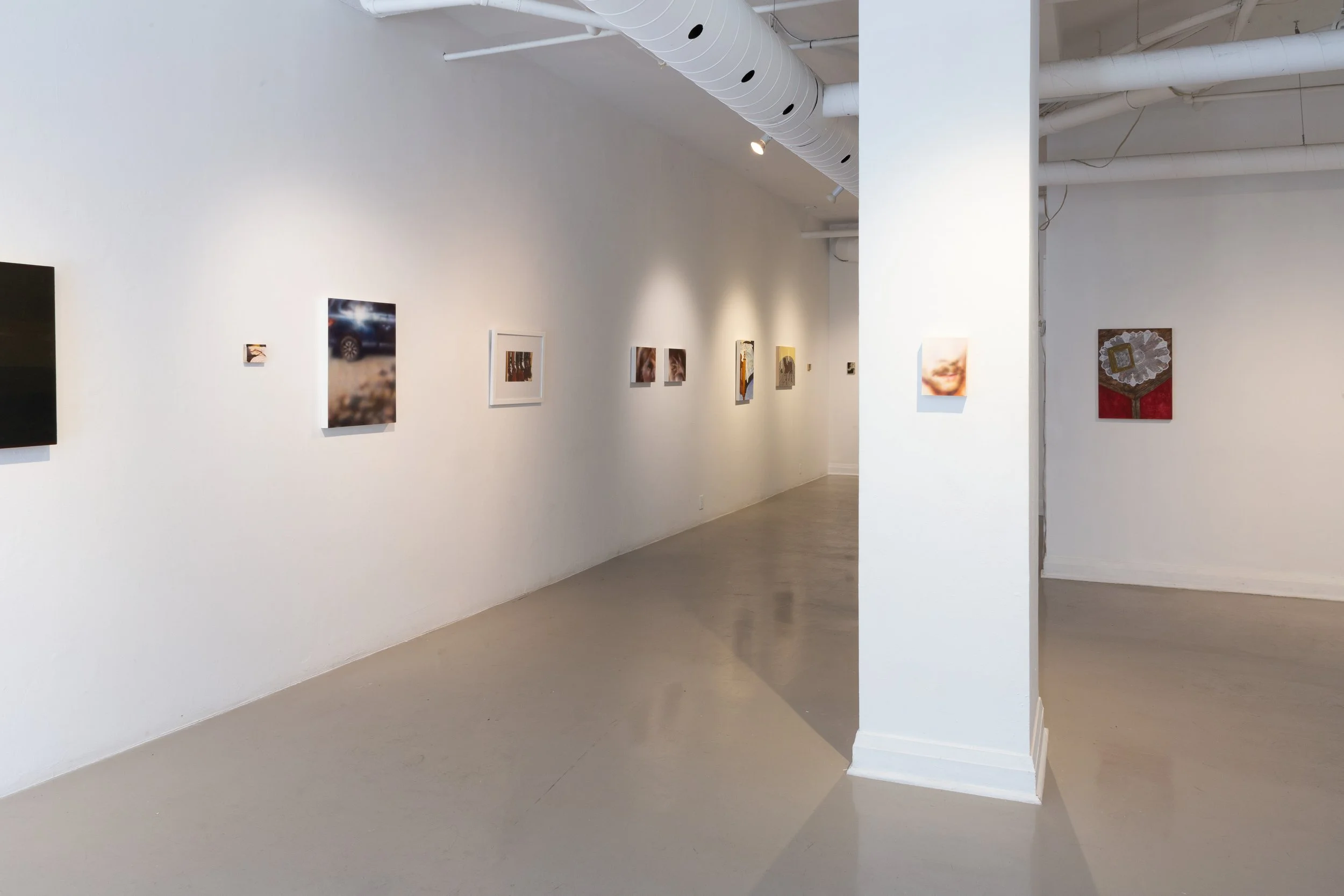
Connective Tissue, 2025, installation view, Xpace Cultural Centre, Toronto.
Photo: Alison Postma.
Jake Santos’s texture, a filter that offsets his otherwise faithfully photorealist renditions, is his saving grace. Connective Tissue, a show I catch at Xpace over the weekend, includes his painting take care (2025). Here, Santos forgoes his usual intimate portraiture for an off-center shot of a car; the sun that bounces off its windows is more distinct and radiant than the object itself. Neither the subject nor the commodity is the central concern; instead, it is light, the kind that bursts through the lens and obscures the clarity of a photograph. The sumptuous texture cleverly evokes the long-fetishized grain of analog media, the direction in which cyber-aesthetics seem to be floating as well.
We talk through machines, and the one chirping loudest in this menagerie is the airbrush, whose atomization mimics the microfragmentation of the pixel. Its method of dispersing pigment is at once mechanized and laborious. The impressionistic images it can create are elegiac, like a memory from childhood that you can’t quite recollect, or a cursed image that momentarily flickers across your screen before becoming lost forever to the void. But these products are enjoyable like pureed food or didactic headlines: prechewed, preparsed, prefixed for our consumption. They relent to the new epoch of illegibility in which we don’t read texts as much as we skim them. Like the act of “surfing,” where one sleepily drifts from one image-isle to another, I worry that pre-degraded forms encourage a shallow engagement with meaning.
I, for one, am still interested in being clear-sighted. Naively, my faith in meaning remains intact, and my eyes rove across the city for a mythic sighting of the same. In its absence, perhaps meaning is mine to construct alone, and at this juncture I find myself in kinship with Bierman-Brophy, Gibbs, De Ruiter, Boucher, Rothe, and Santos. On the streetcar home from Lansdowne Ave, I read Umberto Eco’s posthumous essay collection on my ipad to teach myself how to see again. The book inherits its title from a timeless aphorism attributed to Bernard of Chartres: “We are like dwarfs standing on the shoulders of giants, and so we can see farther than they, not because of our sharper sight or greater stature but because we have been raised higher by their great size.”7
His metaphor is a spatial one, concerned with the ambit of our vision and the collective movement toward some shared horizon. But our gaze has contracted to the current moment, a time that is unfocused and distorted. The past is long forgotten and the future—a progression of thought and expression—risks being replaced by the immediacy of inescapable images. We are all living through the digital age. The point of art, it seems to me, is to see beyond it.
7. Umberto Eco, “On the Shoulders of Giants,” in On the Shoulders of Giants, trans. Alastair McEwen (Harvard University Press, 2019, 11.
by Namah J
Namah is a writer based in Toronto. The impossibility of desire keeps her up at night.