(Silk Road Songbook) by Millie Chen and Arzu Ozkal exhibited at Hallwalls Contemporary Arts Center, September 17- October 30, 2025
The immersive audio-video installation SRS (Silk Road Songbook) by Millie Chen and Arzu Ozkal, recently on view at Hallwalls Contemporary Art Center, is a speculative journey through the land of an ancient migration route, guided by song. Chen and Ozkal chose the voices of women and song as the wavelength for experiencing a reimagining of the Silk Road, sharing oral history, and unifying counter-narratives. The work was filmed on location in Turkey, Uzbekistan, China, Iran, and Kyrgyzstan and positions the historic trade routes known as the Silk Roads as a vector for cultural exchange and decolonization.
The Silk Roads were a network of ancient paths connecting Eurasia and Asia to Europe as well as China with India and the Middle East; India and Africa; and China and Eastern Europe. The routes crisscrossed through the present-day “stans” in Central Asia (Uzbekistan, Kazakhstan, Kyrgyzstan, Tajikistan, and Turkmenistan) and made cities like Istanbul (historically known as Constantinople, and Byzantium before that) into major trade centers. The Silk Roads earned their name for facilitating the trade of silk from China, but these series of routes—or "roads"—transported much more than goods. The Silk Roads were vehicles for human migration; they mixed cultures, languages, and races; extended families; and forced the sharing of ideas, disease, technology—and songs.
Chen and Ozkal take on the vast history of this epic route as a context to tell new stories of historically marginalized groups and contested terrain. SRS (Silk Road Songbook) is joyful to experience. Unburdened from its hefty research, nuanced critique of history, and formidable social goals, it delivers a soothing musical lullaby that veils its call for awareness.
Chen and Ozkal orchestrate a chorus of women from along the route. “Singing together builds collective joy and defiance,” they write. “These are songs of empowerment, channels for human agency.”1 Their artwork amplifies voices that have been silenced in the history of this ancient pathway: “Songs become a ready vehicle for voices that are not usually heard.” They add the inevitable abundance of language and melody to the long history of this road. The artwork contains multiple languages including Turkish, Farsi, Uzbek, Crimean Tatar, Armenian, Ukrainian, Kyrgyz, Russian, and Mandarin. Within this mix and diversity of languages connected by the Silk Roads, we can start to appreciate the cultural melting pot that this route embodies.
But it is the music that can move us to feel connected to these lands and their peoples. These songs sound empowerment. In the words of the vocalist and lyricist Gulzada Ryskulova, “the decolonization of the territory was made possible by the decolonization of the ear.”2
1 All quotations from Millie Chen and Arzu Ozkal, SRS (Silk Road Songbook) (Minerva Projects, 2025).
2. This qoute should be credited to Michael Denning (not Gulzada): Michael Denning, Noise Uprising: The Audiopolitics of a World Musical Revolution (London: Verso, 2015), 9.
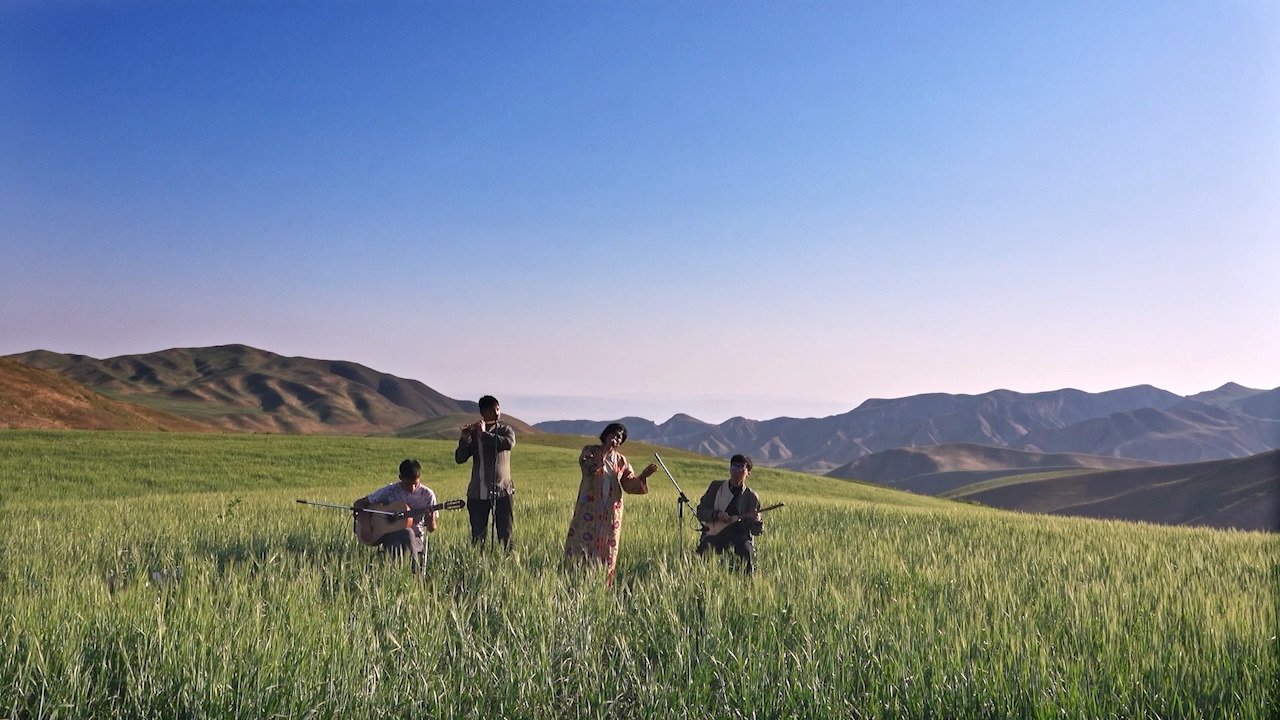
Millie Chen & Arzu Özkal, SRS (Silk Road Songbook),
2025. Digital video (still), color, sound, 22 minutes.
Courtesy of the artists.
Issyk-Kul, Kyrgyzstan
SRS (Silk Road Songbook) travels between Ozkal’s and Chen’s respective ancestral homes, beginning in Turkey and ending in China. The composition metaphorically connects their diverse cultural experiences through sound, voice, music, and land. Chen and Ozkal started with their personal connections to the land and communities and then built relationships with and between musicians, poets, cinematographers, and directors. They expanded their network with friends, scholars, and community groups to reach other artists along the route. Chen and Ozkal traveled, made connections, introductions, and conducted workshops in Beijing, Istanbul, and Tashkent; they invited local creators to build songs to add to the artwork; and they shared guidelines for locations, framing, and recording the song and the land. Many of their leads did not work out and sometimes unexpected connections were the most fruitful. Chen and Ozkal began in 2017, and the completed work debuted at Hallwalls Contemporary Arts Center in 2025. The momentum for this project never stopped despite seven years and a global pandemic. In the end the work came together with over 35 people directly involved in its production. SRS (Silk Road Songbook) is, in a way, a twenty-first century trade route: a virtual network connecting artists from across Asia and the world, most of whom have only met virtually.
The installation at Hallwalls presents five video projections of pastoral landscapes, each representing a different country. All connect through their soundtracks, and the five songs together form a cohesive recording. The five videos are synced together, with a total running time of 22 minutes, and they play on a loop. When you enter the gallery determines what part of the loop you encounter first. The end/beginning is punctuated with silence, black screens, and a darkened gallery.
I entered when the projected landscapes were uninhabited and the gallery was still silent. I expected a song and was becoming uncertain just as the musicians arrived, slowly walking with their instruments into the frame from behind fixed cameras. I thought I heard the land—ambient diegetic sound—and soon the gallery filled with a woman's voice singing like a lullaby: "o la o la o la la la." I saw a ship pass and recognized the mighty Bosphorus with the Third Bosphorus Bridge, which connects Europe and Asia, in the background. The location is Istanbul, a city I visited in 2023. I was surprised by its multicultural tolerance, visible through the abundance of mosques, Catholic churches, Jewish synagogues, and other religious sites. The largest city in Turkey, it is home to the world's greatest markets, including the Grand Bazaar and the Spice Bazaar. The singers, however, are on the riverbank in a park-like landscape surrounded by the ruins of the 18th-century Garipce Castle, built to overlook the gates to the city. The art installation becomes a puzzle and a voyage. I'm hooked. I listen to the voice of Deniz Taşar as she sings her original song, “The New Good,” in Turkish. Her voice—confident, melodic—fills the gallery. Charging the room with consequence, she sets a protest to a melodic tune, modulating in an anthem for free speech.
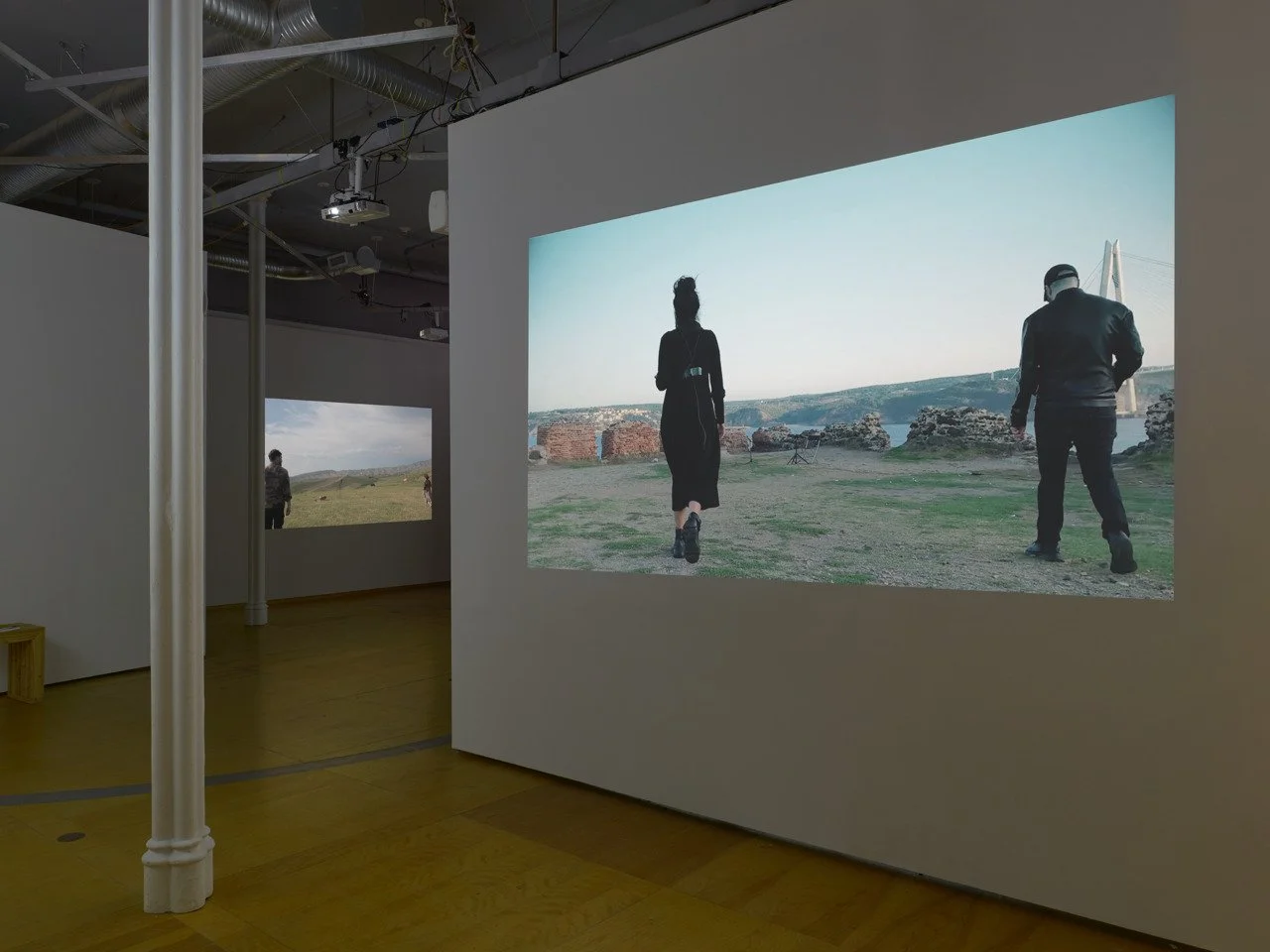
Millie Chen & Arzu Özkal: SRS (Silk Road Songbook), 2025, installation view, Hallwalls Contemporary Arts Center.
Courtesy of the artists. Photo: Biff Henrich.
Istanbul, Turkey
A bridge for us
A line on the horizon
Crossed
And on it, a veil
(Laid like the earth)
Wounded and hurt
Gathering the tales
From a censored past
To a future with sensors
I walk around the gallery looking at the other screens inhabited by musicians silently swaying as if they can hear her too. Next comes the distinctive sounds of a French horn, a different voice, and a tabla.3 I walk to Parkent, Uzbekistan—to rolling fields and darkening skies. There are cows in the distance, and the song is set to a century-old Crimean Tatar melody. The Crimean Tatars, an indigenous Crimean people, were deported to Uzbekistan by Stalin in 1944. The lyrics, however, are taken from a poem by Uzbek poet Cho'lpon, who was a member of the Jadids: a group of Uzbek intellectuals who advocated for social reform and were executed during Stalin's Great Purge in 1938.
The complex song goes:
I am my land's purely
desiring force
3. The percussion instrument used in the Parkent recording is a nog'ora (not a tabla), a traditional Uzbek instrument.
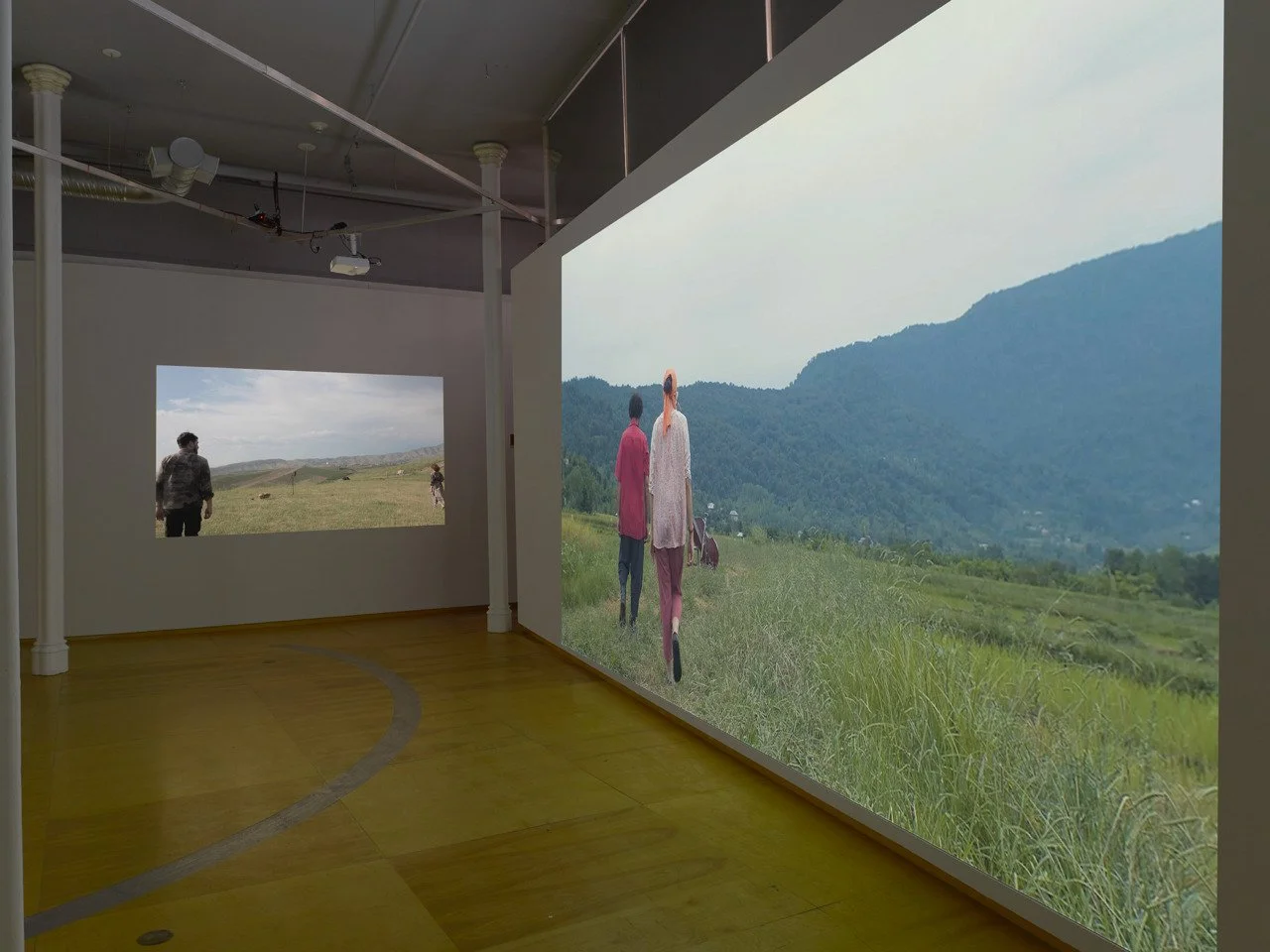
Millie Chen & Arzu Özkal: SRS (Silk Road Songbook), 2025, installation view, Hallwalls Contemporary Arts Center.
Courtesy of the artists. Photo: Biff Henrich.
(L to R): Parkent, Uzbekistan and Chubar, Iran
I traveled to Parkent in 2024 to see its blend of Silk Road history, Soviet-era architecture and technology (including khrushchevka housing and TV towers) and traditional Uzbek bazaars alongside the 16th-century Kukeldash Madrasah. The land of Parkent is distinctive, and the Soviet presence has a disjunctive tone throughout the region, highlighting Uzbek culture’s genre-fusing melody of influences from Asia to the Middle East. My visit was punctuated by a journey to the place where this song was recorded: the Soviet Institute of the Sun (now the Sun Institute of Uzbekistan), a site built during the Cold War to focus light for energy. The Soviets selected the landscape of Parkent because of its clear skies. Listening to the song, I surrendered to the memory of that land and the heat from the heliotropic mirrors as I climbed to the vertiginous top of the colossal solar furnace, the largest in Asia. The Institute sits out in the countryside, surrounded by small villages, Asian mahallas, and cotton farms. The combination of histories present in this pastoral landscape reinforces director Alexey Ulko's intention that this song and its filming location "challenges a one-dimensional view of colonial domination and social domination, giving us a glimpse into patterns of oppression and rebellion."
I will admit that when first viewing the artwork, I just enjoyed the sights and the songs. The lyrics are all in different languages, and the locations are marked only in the gallery guide and exhibition catalogue. Deep knowledge about the songs, the lyrics, the singers, and their intentions is only available through the hefty text that sat on a bench in the gallery: a book containing essays and lyrics translated into six languages. The interplay between written and visual media reveals more than what is available in either language or subtext alone. This artwork has many levels, and if you want to unearth its more radical intentions, you must do the work of reading. SRS looks and sounds like a “soothing musical lullaby” in the gallery and obscures the political framing asserted in the catalogue essay.
The third song has a different character altogether. I move to the third screen, which features two women in a rice field and a man playing a pipa, a Chinese string instrument. The location is an agricultural field in Gansu, a remote province in Northwestern China. The song is a unique version of the region’s folk song tradition, the elusive Hua'er. The songs are characterized by antiphonal singing and express the singers' observations, experiences, and attitudes. In SRS, the two women improvise the lyrics and sing in call-and-response, building the lyrics together. When I visited China in 2011, I learned about the oral history preserved by such traditional songs despite attempts during the Cultural Revolution to rewrite them—keeping the same melodies but changing the lyrics to align with revolutionary Communist ideology. The Hua'er subverted this tactic. SRS’s video-audio recording captured a rare performance, since there are cultural limitations on women practicing Hua'er in public.
They sing:
Allow me to sound a little raw
The sun roasts me into a corpse
Aye, ya—
My lady, you look like a singsong floor
The sun roasts me into a corpse
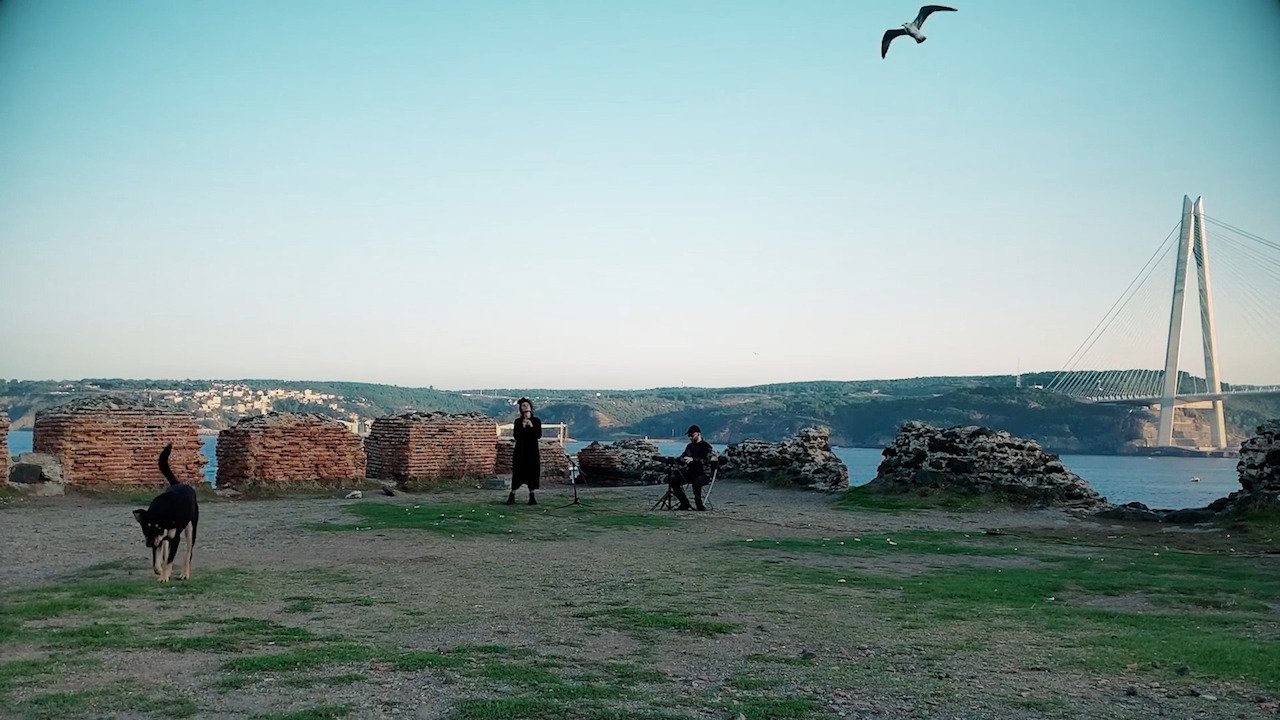
Millie Chen & Arzu Özkal, SRS (Silk Road Songbook), 2025. Digital video (still), color, sound, 22 minutes.
Courtesy of the artists.
Istanbul, Turkey
I reflect on the hesitation for women to sing in public and the limitations placed on music in various regions along the Silk Roads. Views on music differ among Muslims; some consider it haram (impermissible), while others embrace it as part of cultural and spiritual life. Saudi Arabia only recently began allowing all types of music, including Western music, to fill its country. I had traveled to Uzbekistan from Saudi Arabia and witnessed firsthand the silence of women's voices. The Muslim call to prayer is sung five times a day by a muezzin, a man of good character; the melodic sound of the call is amplified and fills town streets. Often more than one mosque broadcasts the call, leading to a provocative experience of hearing all the men's voices together. I walk to the fourth screen and hear the female voice of Baran Ehsaei. She is singing in an open field on a small hillside, accompanied by a double bass played by Arash Zarabi. I am moved by the sound of the bass, its low notes reverberating in my rib cage. I walk close to the large projected image and see my shadow on the wall. I feel like I have entered the scene. Birds fly overhead, and I'm reminded of the location of this recording: the land is a field in Chubar, Iran, a place where women have also been banned from singing in public since 1979.
The political statement that Ehsaei is making by singing in public may not be readily apparent merely from viewing and listening to this work. Consulting the SRS book provided key information about the location and understanding the geopolitical context of the performance. This dual reading prompted me to question whether Chen and Ozkal curated this performance and the mosaic of performances by marginalized voices in SRS to placate a foreign audience. Was my initial viewing of the work, subsumed by the soothing music and exotic locations, feeding a cliché of cultural tourism? How do Chen and Ozkal work to mitigate the risk that SRS replicates the very tropes it claims to resist?
I learned from a conversation with Chen (and through the artist talk at Hallwalls) that Chen and Ozkal devised a strategy for working and collaborating with the artists and prepared a "guide for ethical art collaboration." The guide includes a list of filming and recording conventions and rules. When viewing SRS with this guide in mind, the project more clearly appears as a curation. Reframing the relationship between Chen and Ozkal and the teams of filmmakers and performers in terms of curation explains why some artists chose to use the collaboration to make recordings that assert a political position—like those from Turkey and Kyrgyzstan—while others offered more of a performance of cultural practice for a foreign audience, such as the Hua'er performers from China. How these independent performances come together and the range of interpretations—from cultural tourism to activism to independent voices—ultimately land on Chen and Ozkal as directors and curators rather than on the artists who are making and/or performing the work. Chen and Ozkal could be critiqued for the range of performances and political or cultural statements, but leaving the choices of song and location to be made by the artists might counter such a critique. The use of the SRS platform as a political statement does not lead to the same answer for all the musicians. The Hua'er musicians are performing private, meditative singing for an "other" outside audience while the musicians from Iran, Uzbekistan, and Turkey seem to be asserting their political agency. All the performers are aware of being asked to participate in a project made for a foreign audience, as evidenced through their song, music, and location choices. Nonetheless, this information is exclusively available through the SRS book, website, and artist talks.
One could argue that although Chen and Ozkal set up frameworks to challenge Orientalist representations, exoticization, and the relationship between art and cultural tourism, SRS uses these aesthetic strategies to deliver an easily digestible, lyrical, and engaging artwork. In SRS, the collaborating artists are making sophisticated work and using modern strategies to tell their stories and impact change. Taken together, SRS’s polyphonic songs may drown out these individual and specific struggles for awareness and deliver a simple lullaby that we can sing along to without understanding the meaning behind it.
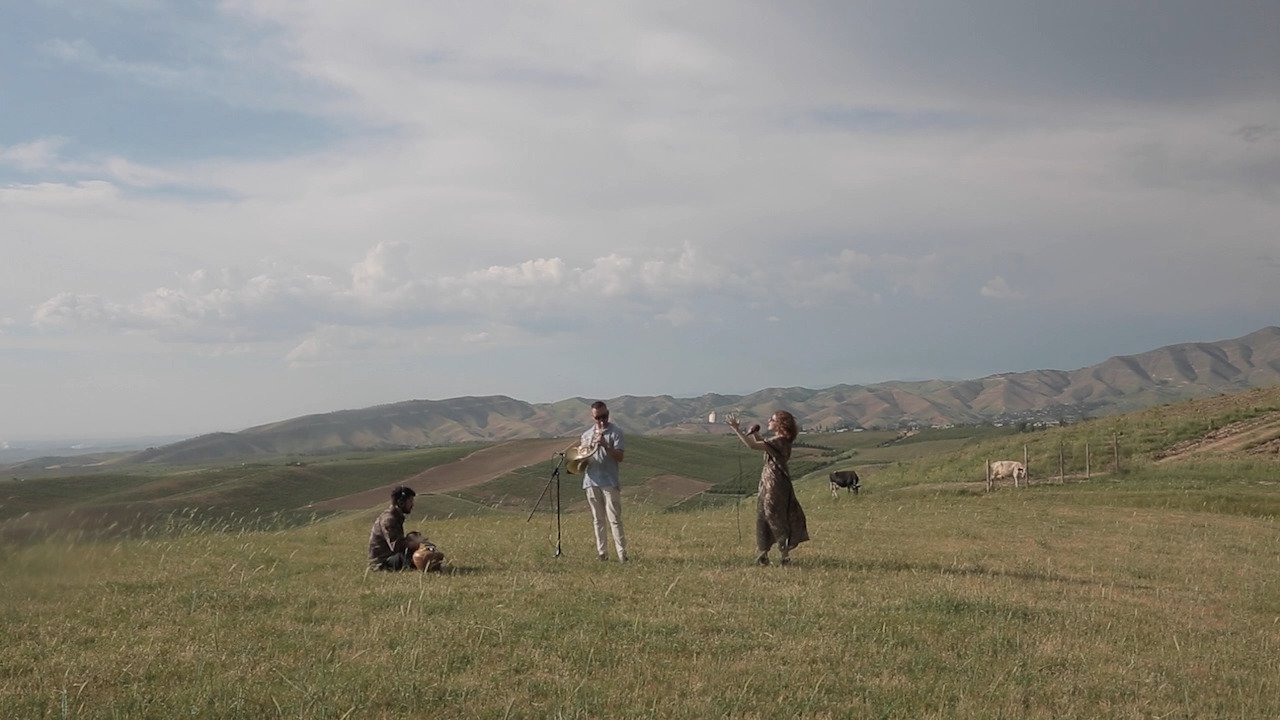
Millie Chen & Arzu Özkal, SRS (Silk Road Songbook),(video still), 2025. Digital video (still), color, sound, 22 minutes.
Courtesy of the artists.
Parkent, Uzkekistan
On the fifth and final screen are four performers: one singer, a guitarist, a person playing the flute-like choor, and a person playing a komuz, a stringed instrument that is the national instrument of Kyrgyzstan. The location is a mountain valley in Issyk-Kul, Kyrgyzstan, a hub for travelers and an intersection of the Silk Roads. The song they are playing builds around the idea that "we are human and there is no difference between us." The emphasis is on travelers—ancient, present, and maybe even those who traveled through this artwork. The traveler is open to the world, willing to experience discomfort and seeking something better or returning to something cherished.
When I learned of SRS, I was immediately curious to reinhabit that mixed cultural space I experienced while traveling in Turkey, Uzbekistan, China, Saudi Arabia, and other countries in the Middle East. The United States is known for having among the world’s most diverse cultures, but I saw the evidence of ancient diversity in the mixed cultures of East Asia and through the megastructure of the Silk Roads. The trade routes remain as a way of life, a vulnerability met by pride in local hospitality and things residents can share—water, dates, camel milk, a shaded place to sit. Chen and Ozkal's artwork might inspire you to travel beyond your comfort zone, to be vulnerable and open to the sounds and sights of the ancient world. It might help us recognize an ancient tolerance for people of difference and to treat road-weary travelers who come to your doorstep or town with pride in your local hospitality. Singer Gulzada Ryskulova says that "singing together builds collective joy and defiance."4 Can you hear the decolonization?
She sings:
Oh, life, what a mystery
you are!
I have traveled long
and far.
Yet still,
I long for more, ey.
The musicians in all five countries exit the scene by walking toward the camera, leaving their instruments and recording equipment behind. The sound of the land continues. The land is the sixth voice in this artwork; it is the connecting feature that stays as a constant, holding space and memory. Chen and Ozkal write, "The aural thread across all the places is sourced from natural elements found in each environment, a shared sound of the land that forms an atmospheric sixth voice, a voice that carries the wind, water, rustling grass, insects, birds, and thunder. Listen to the land—it is the oldest storyteller." History has taken many unjust turns along this contested terrain, but the Silk Roads remain as a path through history and Ozkal and Chen serenade us with sounds and sights of the land and the voices of women to break ground on new paths led by these lodestars.
4. This quote is authored by Chen and Azkal (not Gulzada).
by Andrea Mancuso
Andrea Mancuso is an artist, educator, and founding member of the collaborative practice virocode, which explores the interplay between organic and inorganic systems. Her work has been exhibited internationally, and she has taught art in diverse settings from the Adirondacks to Saudi Arabia, fostering deep connections between art, technology, and environment