‘A Quiet Consciousness’
Annie MacDonell, Interior Life
Annie MacDonell: interior life, 2025, installation view, two seven two.
Courtesy of the artist and two seven two gallery. Photo: Toni Hafkenscheid.
I am writing this review from a shared worktable on the fifth floor of the Toronto Reference Library. Designed by Japanese Canadian architect Raymond Moriyama in the mid-1970s, the library’s multistory, tiered, central atrium is lit by skylights and lined with snake plants and hostas, taking its inspiration from the Hanging Gardens of Babylon. The fifth floor is the building’s highest story and is also the site of a renowned Picture Collection, which serves as the starting point for much of artist Annie MacDonell’s visual research.
I’ve sought this desk in a supposed utopic construction—a communal garden of visual and literary texts—to review MacDonell’s recent exhibition, Interior Life, at two seven two: a small commercial gallery about a kilometer from my perch. I am inspired to write here after our recent studio visit. The artist and I shared coffee and cookies and exchanged thoughts on her work, on the pace at which horror ravages our political and social world, and on the unreasonable expectations that artistic research—a slow and at times circuitous process—could keep pace with the ever-changing news cycle. We spoke about the common inclination to drop out, to retreat to an interior world, and about the power and danger of such desires. MacDonnell’s exhibition is a concise retrospective of only six works, and it looks (with curiosity and trepidation) to the 1970s as a mirror to reread the present. MacDonell’s work in film, photography, performance, and installation is supported by visual, textual, and archival research and underpinned by a feminist conception of the everyday as a basis for political engagement with the world. Despite its brevity, Interior Life represents works from several facets of her artistic oeuvre of the last 13 years; all works were previously shown in museums and artist-run centers.
Annie MacDonell: interior life, 2025, installation view, two seven two.
Courtesy of the artist and two seven two gallery. Photo: Toni Hafkenscheid.
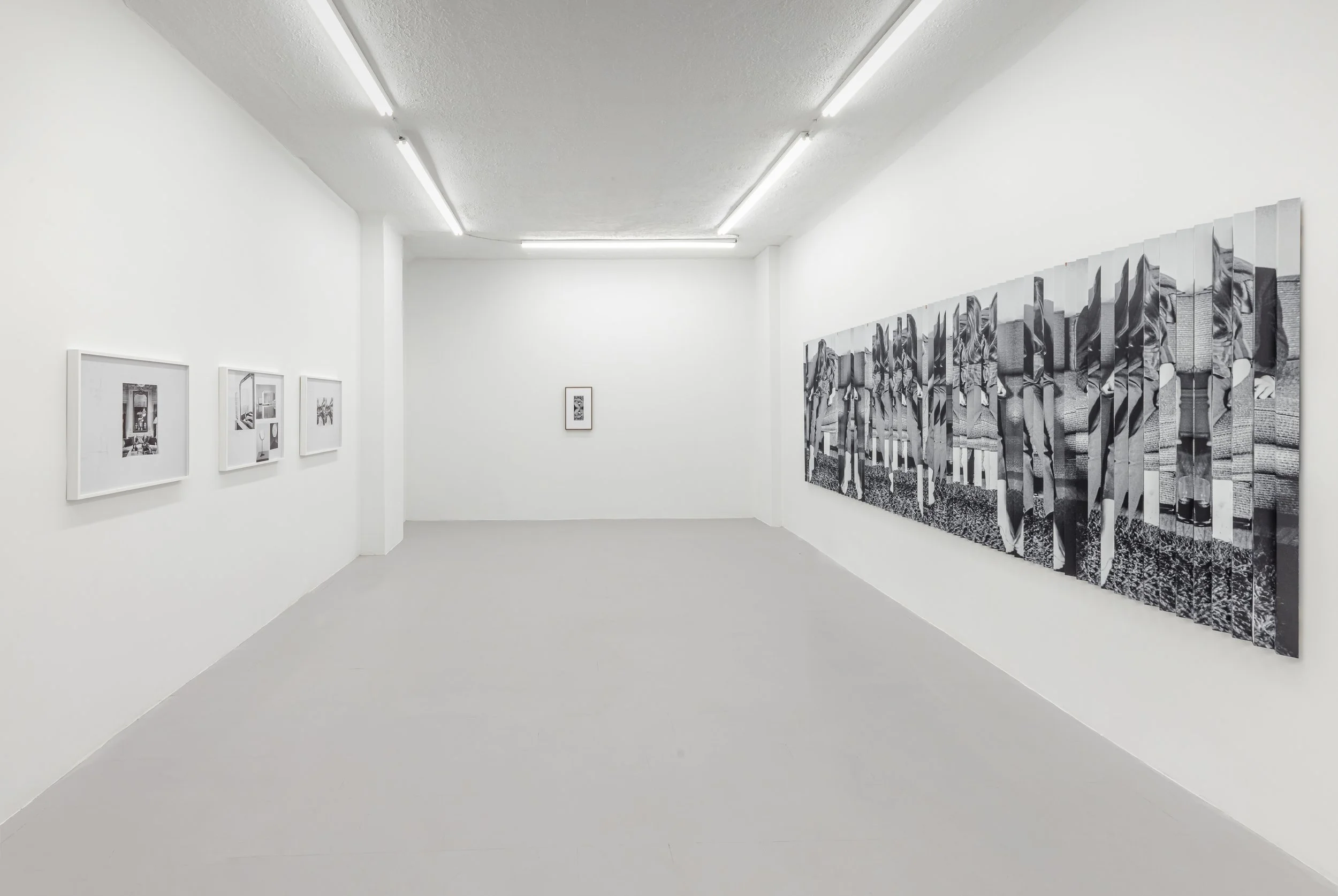
The Picture Collection is a series of five photographs produced for MacDonell’s 2012 exhibition Originality and the Avant Garde (on art and repetition) at Mercer Union, but only three of them are included in the exhibition at two seven two.1 Each one is a black and white photograph of photographs selected by MacDonell from the Reference Library’s Picture Collection, grouped on a well-used studio wall, and rephotographed using a 4 x 5 camera. The Picture Collection holds more than a million images, clipped from books, magazines, calendars, and countless other sources and carefully arranged under 32,000 subject headings. MacDonell’s selections seem to fall under the subjects “Reflection” and “Mirrors”—each individual photograph depicts a reflective surface in nature, artworks, architecture, or interior design. In the act of recomposing these images, she plays with their decontextualization and reproduction, reframing the pictures into something of a visual game. In one image, a U-shaped valley between two mountains, doubled by its reflection in a still lake, is doubled again in another copy of the same image beside it, their repeating lines reading like a sound wave from my distant vantage point in the corner of the room. I am transported by the visuality of an echo.
The original project was rooted in photo-formalism and set in a larger exhibition exploring the potential of repetition as a model for generating meaning; the exhibition itself was an exercise in bringing research material and studio activities into the space of the gallery. Yet, seeing these three select photographs in a new context, set amid newer works, their meaning is less formalist and instead offers something of a portal to reframe MacDonell’s interest in the use of psychedelics in therapeutic research. While her research on this topic extends back a decade, the questions she poses feel wholly relevant—and perhaps more urgent, entangled, and fraught—today.
The title of the 2012 exhibition recycled the title of Rosalind Krauss’s 1981 essay “The Originality of the Avant-Garde.”
Annie MacDonell, Sugar Cubes, 2023, installation view, interior life, 2025, two seven two.
Courtesy of the artist and two seven two gallery. Photo: Toni Hafkenscheid.
It has long been hypothesized that psychedelics facilitate profound and long-lasting changes across several interconnected domains, primarily neuroplasticity, subjective experience, and potential therapeutic outcomes for mental health conditions. MacDonell began research into this topic in the mid-2010s when culture writers like Michael Pollan drove a mainstream resurgence of interest in the therapeutic capacity of psychedelics. While Pollan offered little critique about the kinds of conditions our society produces, MacDonell took his cue to consider drugs like LSD, which enhances feelings of connectedness to others, to the environment, and to the cosmos, as a challenge to the economic and ideological foundations of capitalism, which rely on individualism and competition for private ownership. For MacDonnell these drugs could potentially offer a response to Mark Fisher's influential concept of “capitalist realism,” which builds on Fredric Jameson’s idea that it is “easier to imagine an end to the world than an end to capitalism.” Could psychedelics offer pathways to collective consciousness that might facilitate an imagining otherwise?
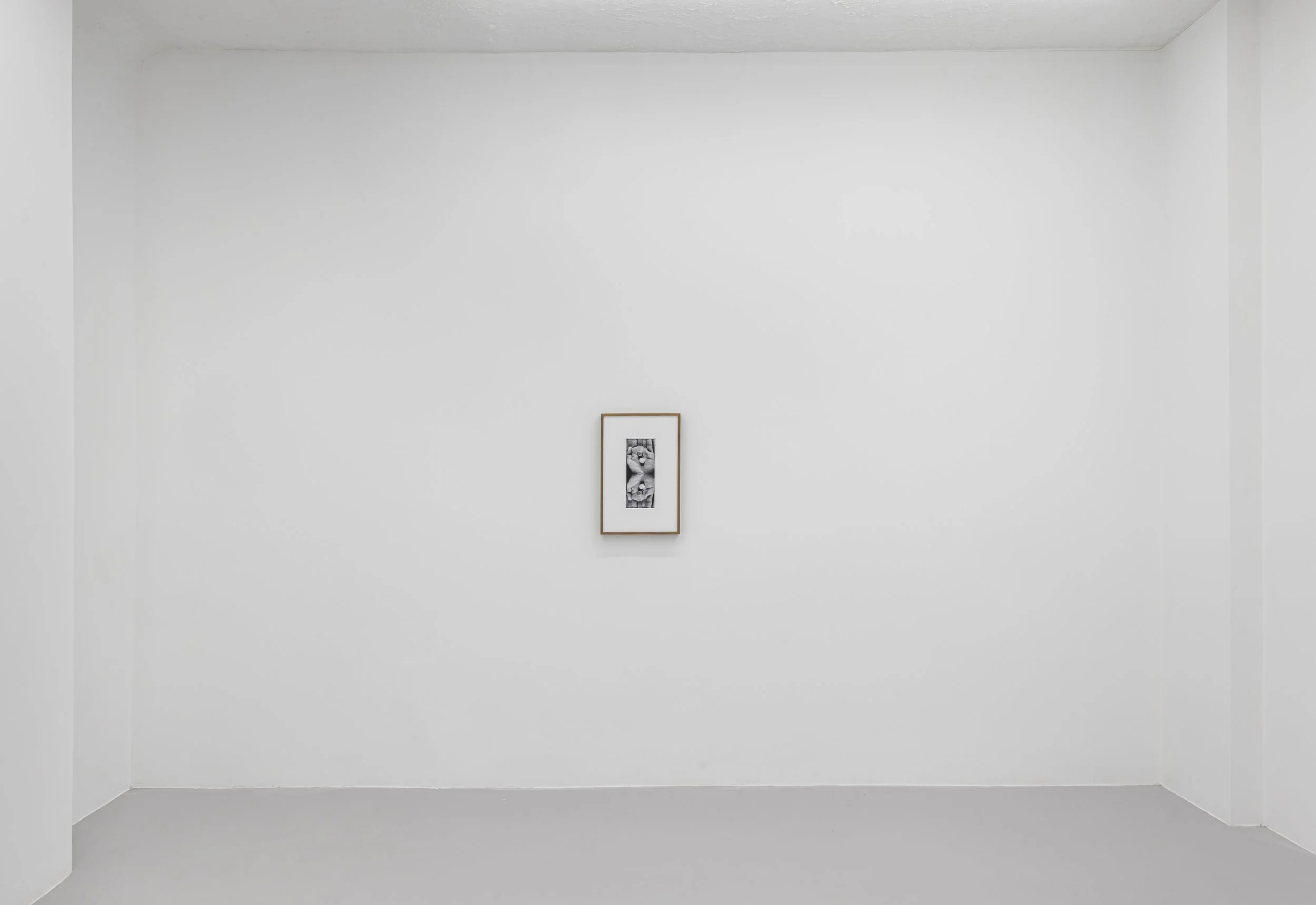
Central to Interior Life is Ego Death Trip, a fifteen-foot UV inkjet print on corrugated aluminum that fractalizes, remixes, and repeats a press photo sourced from a 1970s Toronto Star article on acid parties. The original photograph depicts a young woman on a sofa, slumped in a seated position, long hair obscuring her face. MacDonell’s interventions of upscaling, fragmenting, and pleating the image engage the full body, making the viewing experience kinetic and moving the eye across its surface to find its coded meaning. The title tells us that the figure’s resting state is in fact a drug-induced retreat. Hung adjacent to a doubled image of two sugar cubes resting on the palm of a hand, the photographs from The Picture Collection reveal the source of the subject’s interior world.
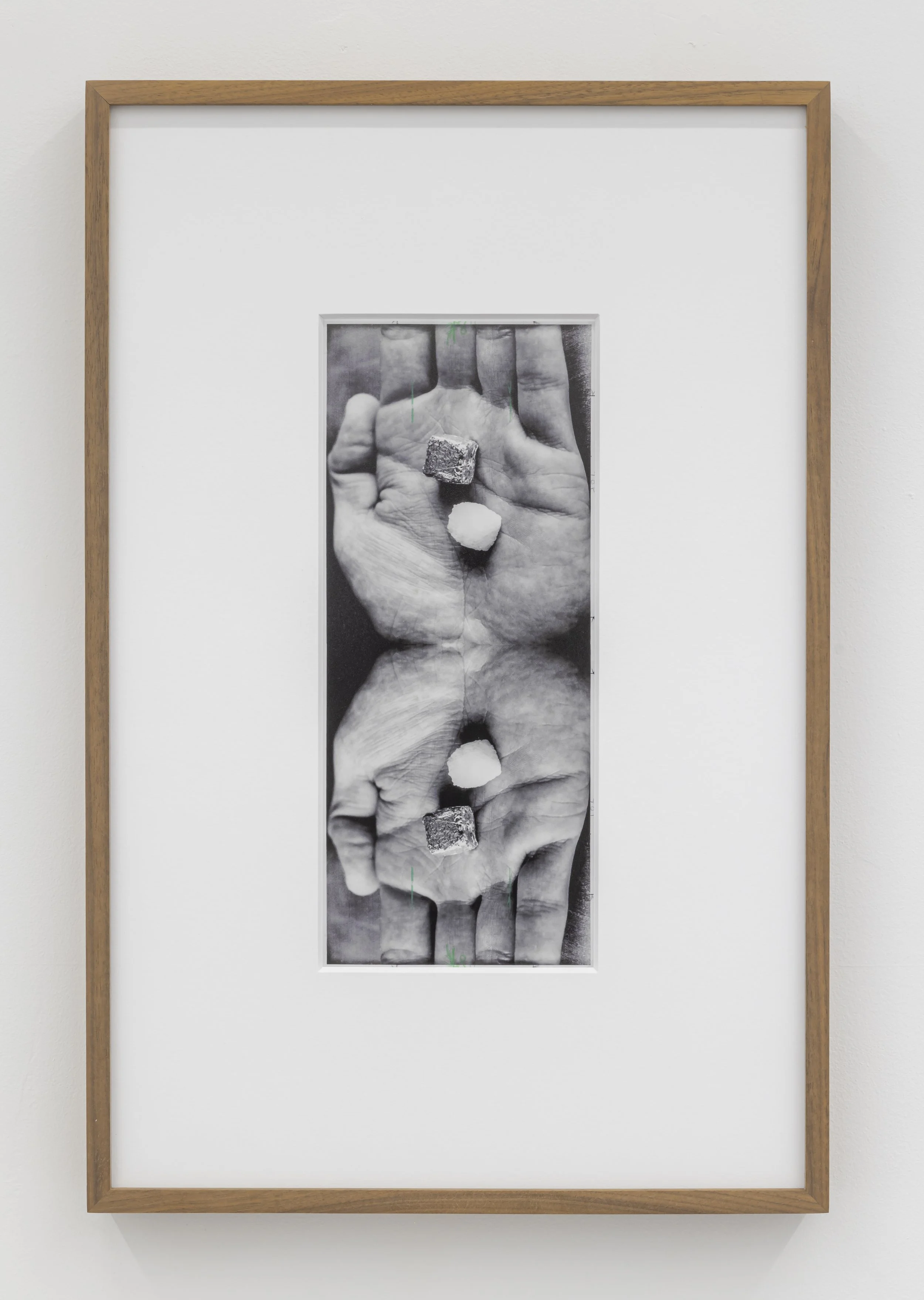
Annie MacDonell, Sugar Cubes, 2023. Inkjet print, 20 ½ × 13 ½ inches.
Courtesy of the artist and two seven two gallery. Photo: Toni Hafkenscheid.
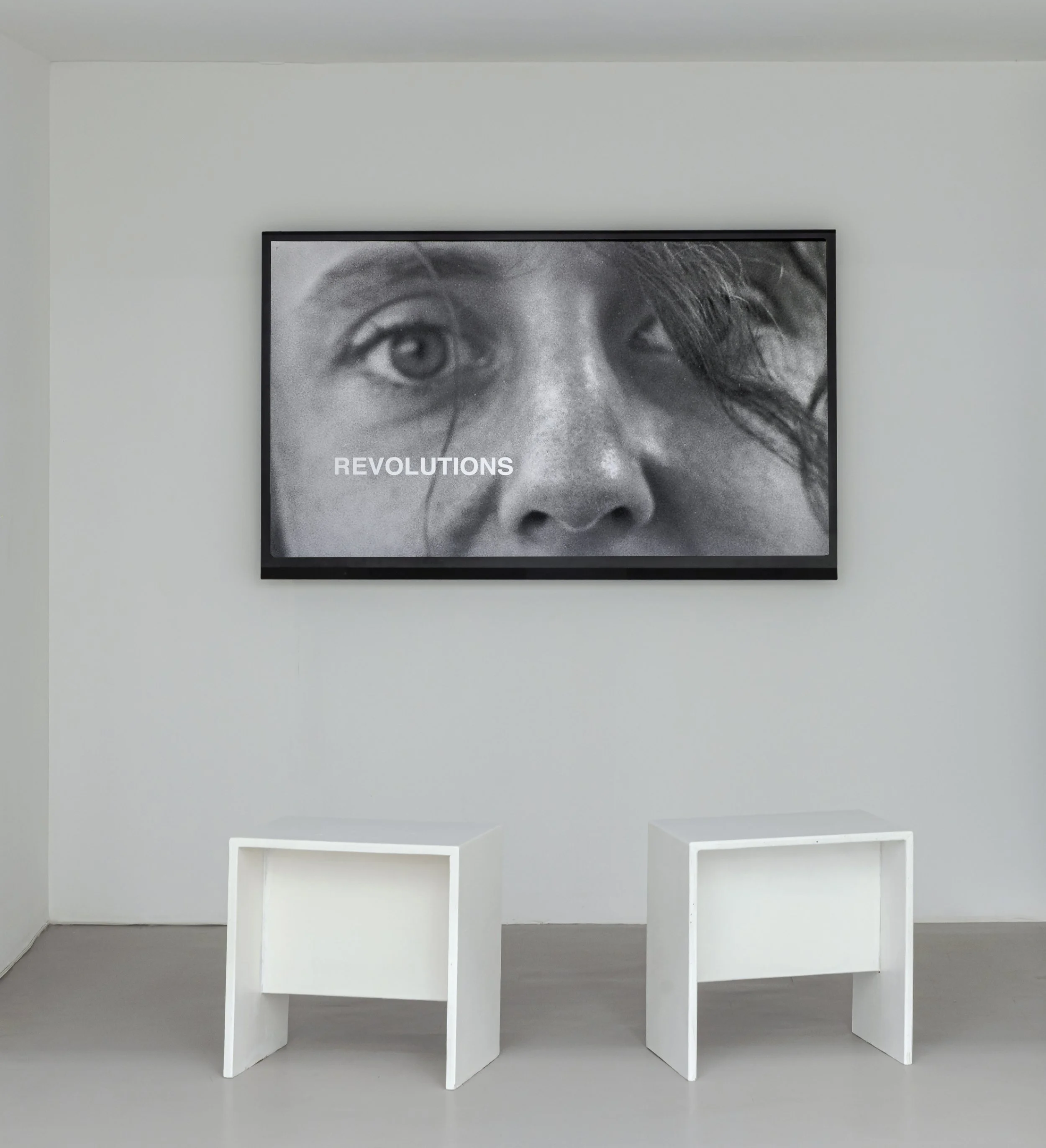
MacDonell explores these threads of research both as an individual artist and in the collaborative work OUTHERE (for Lee Lozano), produced with her longtime creative partner, the French cinematographer Maïder Fortuné. This 33-minute film examines Lozano’s “The Halifax 3 State Experiment,” a lecture she performed at the Nova Scotia College of Art and Design (NSCAD) in 1971. A major center for Conceptual art in the 1970s, NSCAD was known for inviting guest artists to Halifax to present experimental work as part of its Projects Class. Lozano’s lecture-performance took place in three locations with the artist in various states of consciousness throughout the day: sober in the classroom, high on weed in a park, and on acid at a house party. The film mixes archival and new material, including photographs and recordings of the lecture and facsimiles of Lozano’s notebooks, footage of Fortuné and MacDonell donning masks of Lozano’s face, an astrological reading of Lozano’s birth charts, and an actor performing as an artist assembling a pattern from human bones in her studio. In MacDonell’s introductory voiceover, she likens their reimagining of the event to a Frankenstein-esque experiment, but in lieu of electricity as an energizing medium for their summoning, she states “we’ll use images and words and sound, and the surface of the movie screen, and time itself.” A quote from Lozano's lecture punctuates the screen at intervals:
“IDEAS START REVOLUTIONS.”
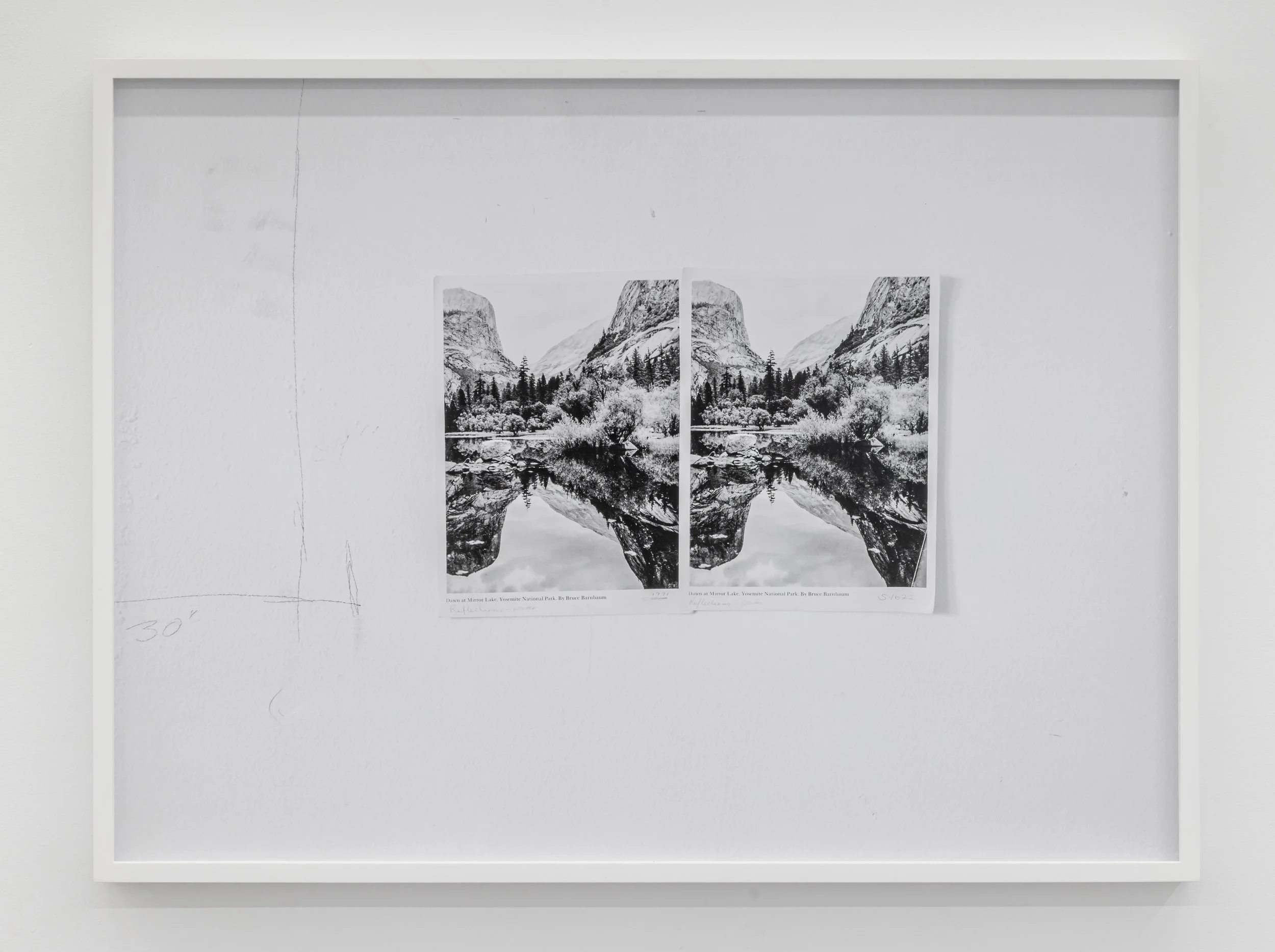
Annie MacDonell, Untitled, 2012. Inkjet prints, 22 ½ × 30 ½ inches.
Courtesy of the artist and two seven two gallery. Photo: Toni Hafkenscheid.
On first viewing Interior Life, I felt trepidation about this thematic imbrication of psychedelic culture, revolution, the artistic avant-garde, and, as immediately raised by Lozano’s work, an interior versus exterior life. While artists, researchers, and creatives may freely dream of achieving possible but not yet actualized states of being, the suggestion that retreat from exterior life (the social, political, and communal world) can be politically radical seems counterintuitive given our current needs: to be vigilant, present, and advocates for complete political and social reform. Today, the proponents of capitalism (tech bros on ketamine basking in the libertarian wastes of Burning Man) seem to have co-opted the potentials of psychedelics, and lauding their anti-capitalist potential ignores the recent history of psychedelic promotion by many profit-driven subcultures, including start-up and wellness culture, and their use-value to the ideology of self in a mass culture of self-care.
On closer reading, it became apparent that MacDonell’s attention to the possibilities of psychedelics in therapeutic and artist research as vehicles to imagine otherwise is simply a hopeful observation on the brain’s capacity to dream beyond the conditions our society produces. With Ego Death Trip, she experiments with writing a new visual language to talk about the psychedelic experience, remixing the figure’s form to reframe an extended, as opposed to an altered, state of consciousness. Likewise, Fortuné and MacDonell attempt to summon Lozano in OUTHERE not for her countercultural, dropout appeal but for her complex understanding of who she was in relation to her art, her porosity. It is an exercise to extend the mind through all the mystery that surrounds Lozano, through the traces she left behind, and beyond the usual limits of that which is material. But perhaps what this work truly reveals is the limitations of artistic research and of psychedelic imagining to resist the pervasiveness and adaptability of capital.
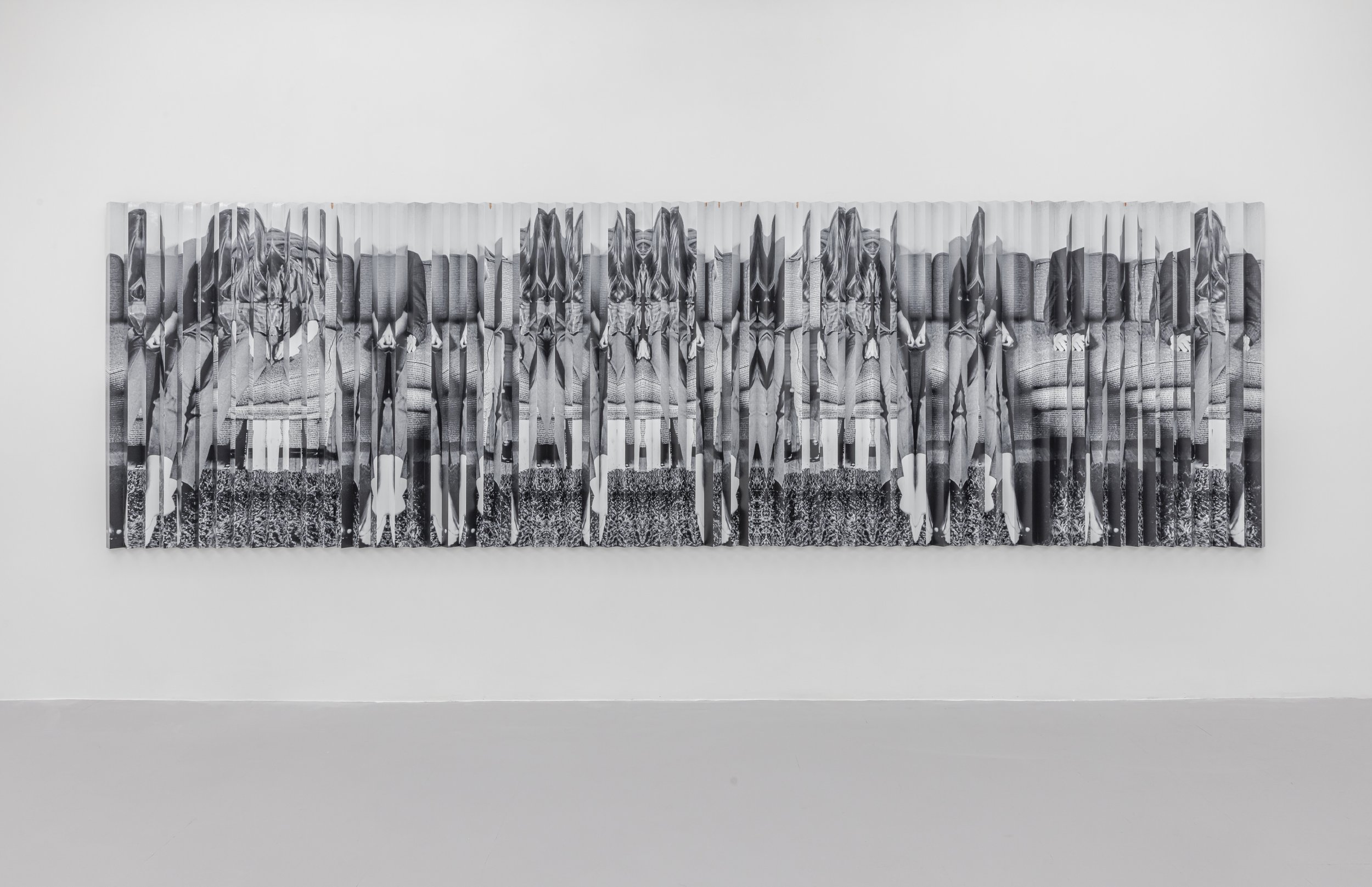
Annie MacDonell, Ego Death Trip, 2023. UV inkjet on aluminum, 60 × 180 × 1 ¾ inches.
Courtesy of the artist and two seven two gallery. Photo: Toni Hafkenscheid.
by Alana Traficante
Alana Traficante is a writer, editor, and curator in Toronto, where she also works as the executive director at Gallery 44 Centre for Contemporary Photography.