After Newness
Reframing the Contemporary City
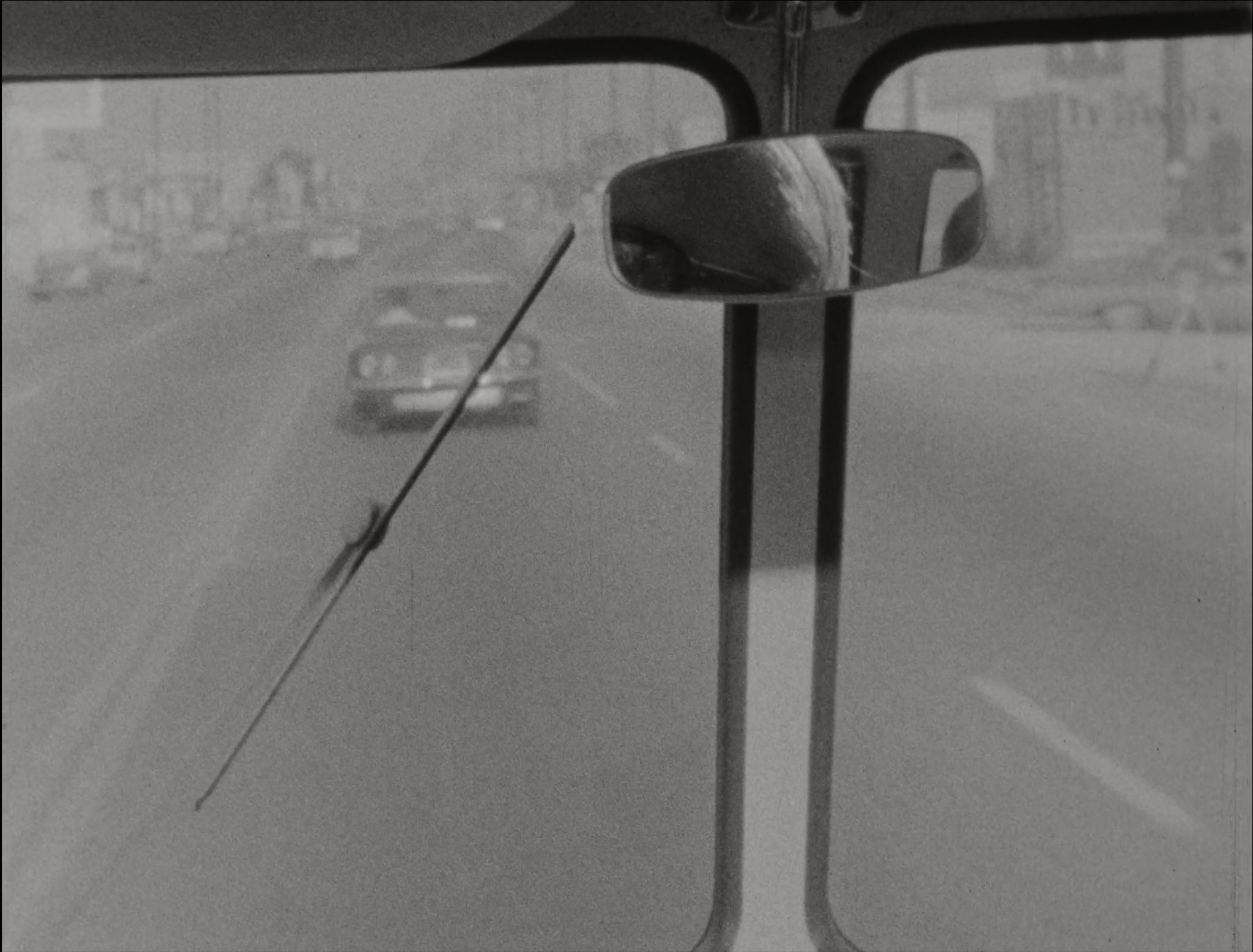
Still from 1965 road trip shot on Super 8mm film, 1965.
Courtesy of Allan D’Arcangelo Archives at the University at Buffalo Art Galleries.
The history of filmmaking is powerfully linked to a history of encounters with what appears newly visible, materially and perceptually. Filmmaking is itself a main actor in the twentieth century’s story of the rapid transformations of space and artists’ responses to these shifts. These connections reappear across different countries and genres, from essayistic and more personal works to more documentarian forms such as city symphonies. In this latter category sits a short film by Allan D’Arcangelo set in the United States during the boom of its highway system. It does not simply document this scene, however, but rather provides an embodied encounter with the country’s changing infrastructure postwar. Newly digitized from the archives of the University at Buffalo Art Galleries, the film is on view for the first time at the Buffalo AKG Art Museum as part of the exhibition Allan D’Arcangelo: Landscapes and Constellations.
D’Arcangelo was born in Buffalo and graduated with a degree in history from the University at Buffalo in 1953. Travels between Mexico City and Los Angeles in the late 1950s would serve as a lifelong source of inspiration for D’Arcangelo’s artmaking, which he started after settling in New York City. His interest in Americana, automotive culture, and the graphic shapes and lines of road signage emerged during this period in his life. Elements of American road infrastructure interrupt and obstruct otherwise open landscapes in the paintings and screenprints for which he is best known.
D’Arcangelo’s fifteen-minute film features what captured the artist’s attention while driving cross-country with his friend and Pop Art compatriot James Rosenquist. D'Arcangelo turned his Super 8mm camera to recording the same elements that populate his paintings and screenprints. During his journey through New York, Las Vegas, Los Angeles, and the spaces in between, he shot from the perspective of a driver, capturing tight frames of rearview mirrors, dirty windshields, road signage, etc. Simultaneously the film reveals the conditions of its own production. The handheld camera, the car, and even D’Arcangelo’s own forehead in the rearview mirror enter the frame. The camera reinforces its subjective position in D’Arcangelo’s hand as it tracks, pans, and zooms in relation to the car’s movement down the highway. Some shots are mere wrist-flicking pans that quickly cut; others are eerily slow relative to the car’s motion. Together, they present a strange document of a mind and body experiencing the newly formed space of the interstate.
The film’s images were not only novel for the artist himself, traveling through unfamiliar places, but new full stop, part of a newly constructed infrastructural reality in the United States. The film functions as an aestheticized document of the United States in 1965, capturing a particular moment in the rapid expansion of the highway system. President Eisenhower’s Federal-Aid Highway Act of 1956 inaugurated dramatic changes in the landscape across the country. Newly built roads cut through cities, and the personal automobile became the dominant mode of transportation. The United States reorganized itself around this new infrastructure, annihilating space and time and making distant places increasingly accessible.
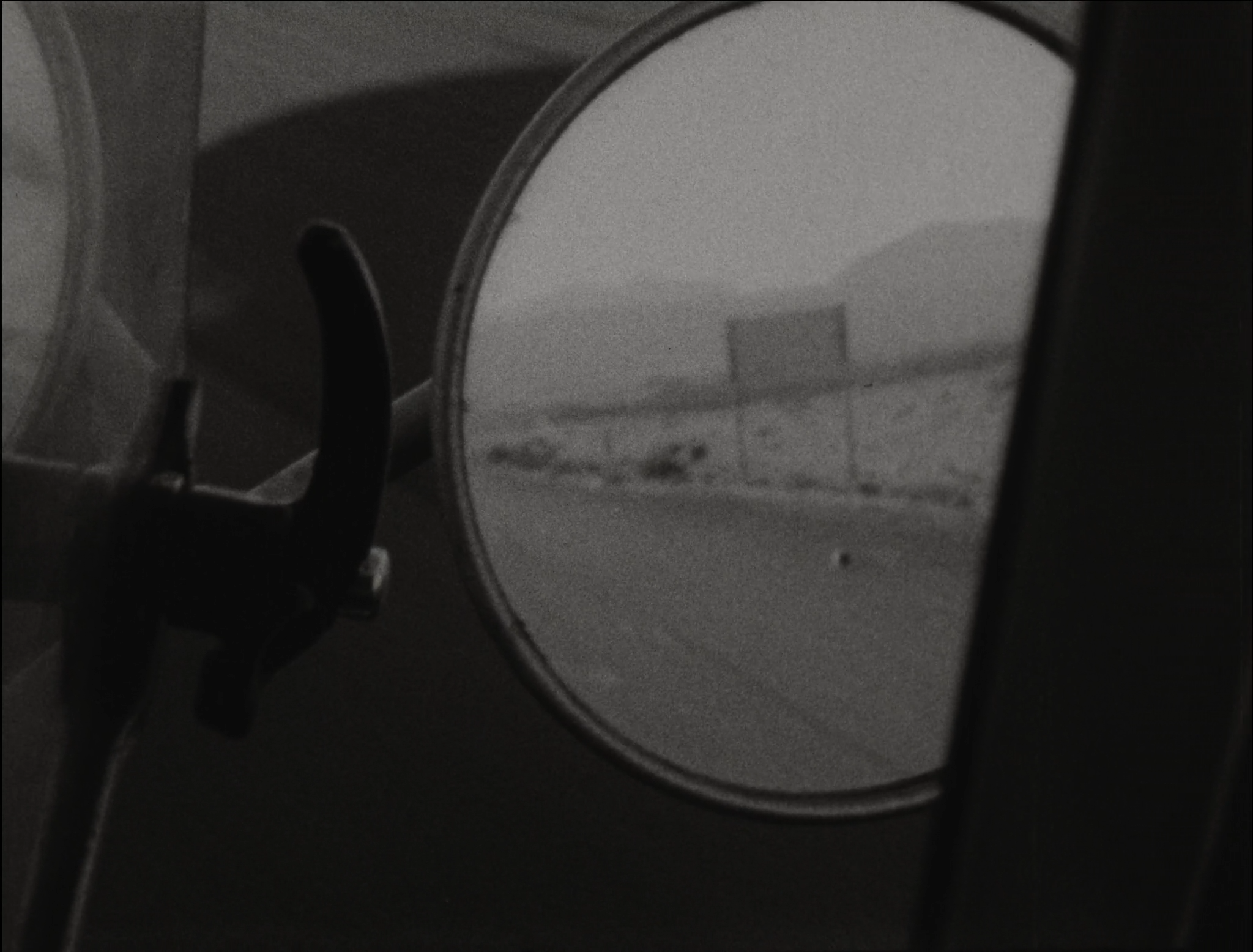
Still from 1965 road trip shot on Super 8mm film, 1965.
Courtesy of Allan D’Arcangelo Archives at the University at Buffalo Art Galleries.
The expansion of the interstate system also standardized the landscape across the country. Roads and their signage began to look similar regardless of location. D’Arcangelo’s work also reflects this homogenization. The film’s scenes are not tied to specific places but instead evoke environments that could exist anywhere in the United States. The work captures the emergence of this newly regulated, uniform, and repeatable landscape.
The connection between filmmaking and novel experiences of space, however, dates to the earliest experiments with the moving image. The Lumière brothers’ cinématographe made the camera portable enough to capture life outdoors, including industrializing modernity. Spectacularized scenes of workers, trains, and urban activity filled the first public film screenings. The materiality of the camera itself is thus closely tied to the documentation of urban centers and their constant transformations.
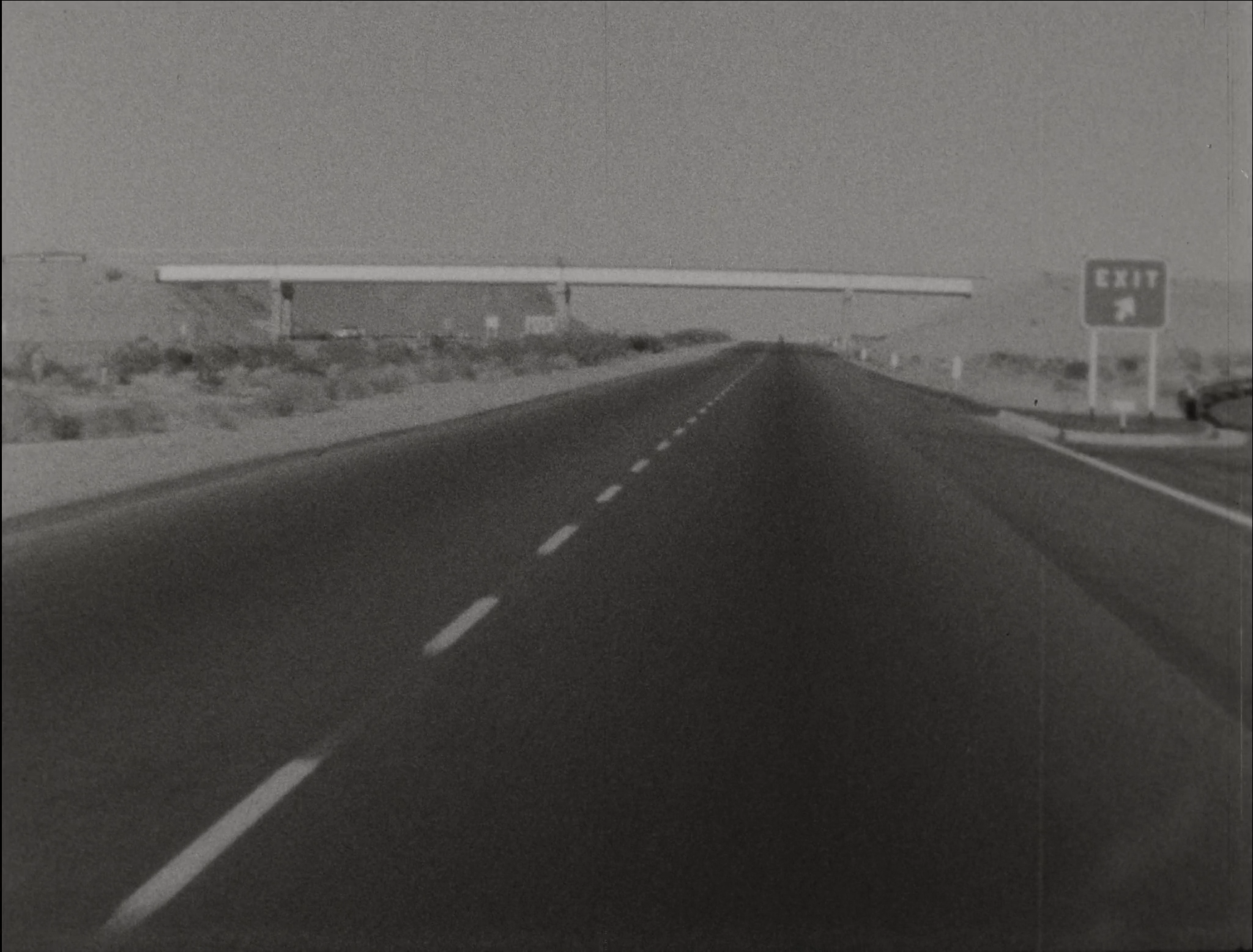
Still from 1965 road trip shot on Super 8mm film, 1965.
Courtesy of Allan D’Arcangelo Archives at the University at Buffalo Art Galleries.
One clear example of the relationship between moving images and changing spaces—an example D’Arcangelo’s film seems to address with cool mid-60s aloofness—is the genre of city symphonies, also called city films or city poems. These emerged in the fertile experimentation of the 1920s as the artistic avant-garde sought to capture urban transformations through new forms of perception and expression. In these films, the city functions as the protagonist rather than merely a backdrop for narrative. These avant-garde documentaries with an essayistic character focus on the new urban reality’s everyday moments, rhythms, and visually appealing qualities.
Without a conventional narrative structure, city symphonies typically follow a temporal progression from morning to night, presenting fleeting moments of people, buildings, workers, cars, and trains. In doing so, they capture the newly spectacular aspects of the quotidian. Their editing is also noteworthy. As the term “symphony” suggests, editors often treated shots like musical notes and organized sequences as if they were chords or melodies, resulting in a distinctive visual tempo. This rapid momentum emulates the fast pace of the genre’s central character: the modern city.
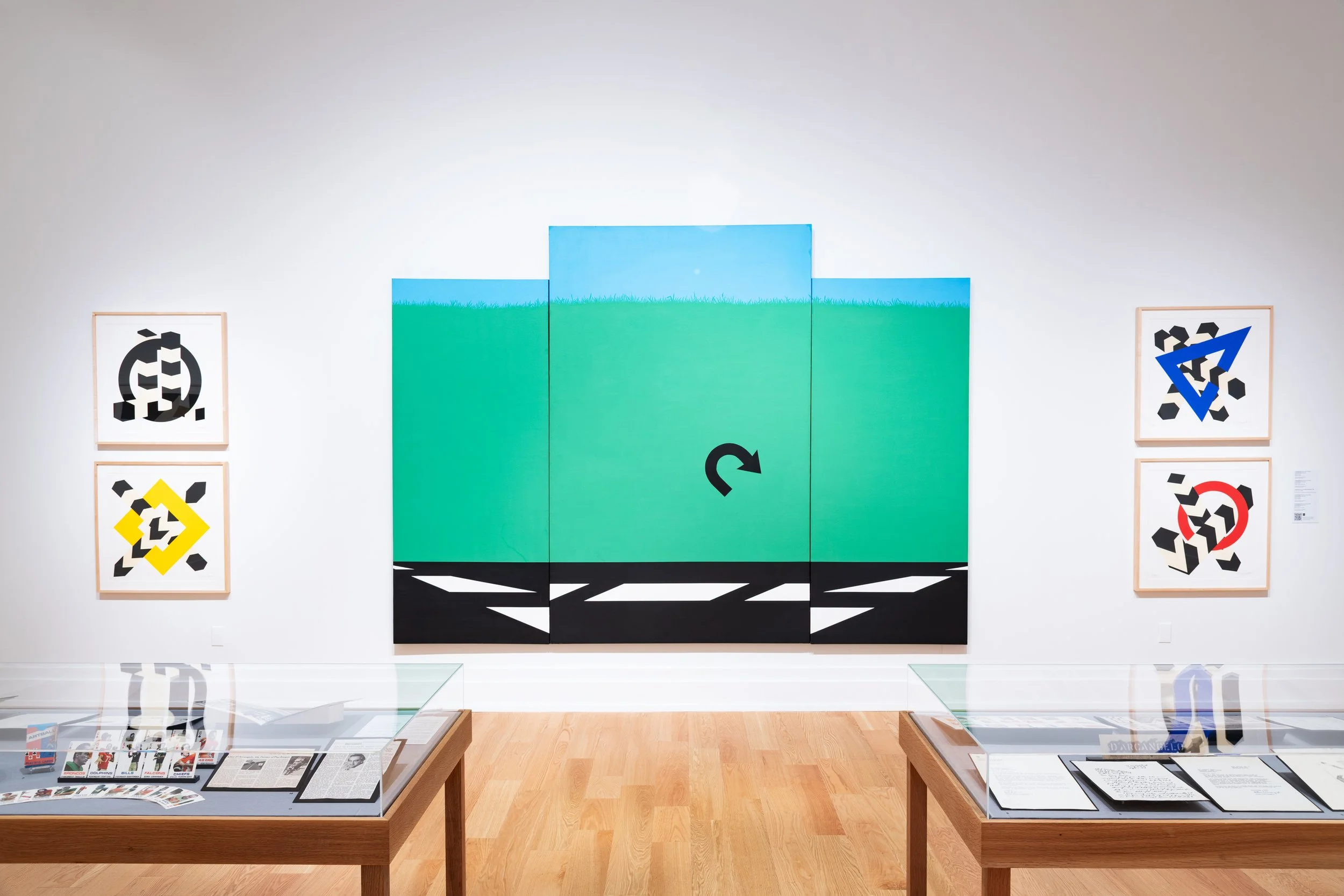
Allan D’Arcangelo: Landscapes and Constellations, 2025-2026, installation view, Buffalo AKG Art Museum.
Courtesy of the artist and the Buffalo AKG Art Museum. Photo: Brenda Bieger.
Both city symphonies and D’Arcangelo’s film evoke the sense of newness emerging from environments undergoing structural transformation. Whether the expanded early twentieth-century city or the horizontal spread of highway systems, these subjects are spaces not yet fully known. In the years since D’Arcangelo’s film, the documentation of urban centers seems to have become a decline in experimental approaches. The continuing transformation of cities no longer inspires the same sense of awe and may therefore be less likely to inspire artistic production. Arguably, contemporary changes in the Global North do not represent a wholly new way of life as they did in earlier periods. Instead, real estate interests often wedge new developments into already established urban fabrics. The aesthetic rhythms of urban life may now appear superficial, obscuring the economic forces behind them and reducing the city to surface aesthetics.
Creators are still documenting embodied spaces and the sense of “newness,” but this work has shifted geographically and conceptually. Today, such works mostly emerge from regions where the effects of industrialization and global capital are more recent or uneven, and they expose current conditions of labor, inequality, and logistical systems.
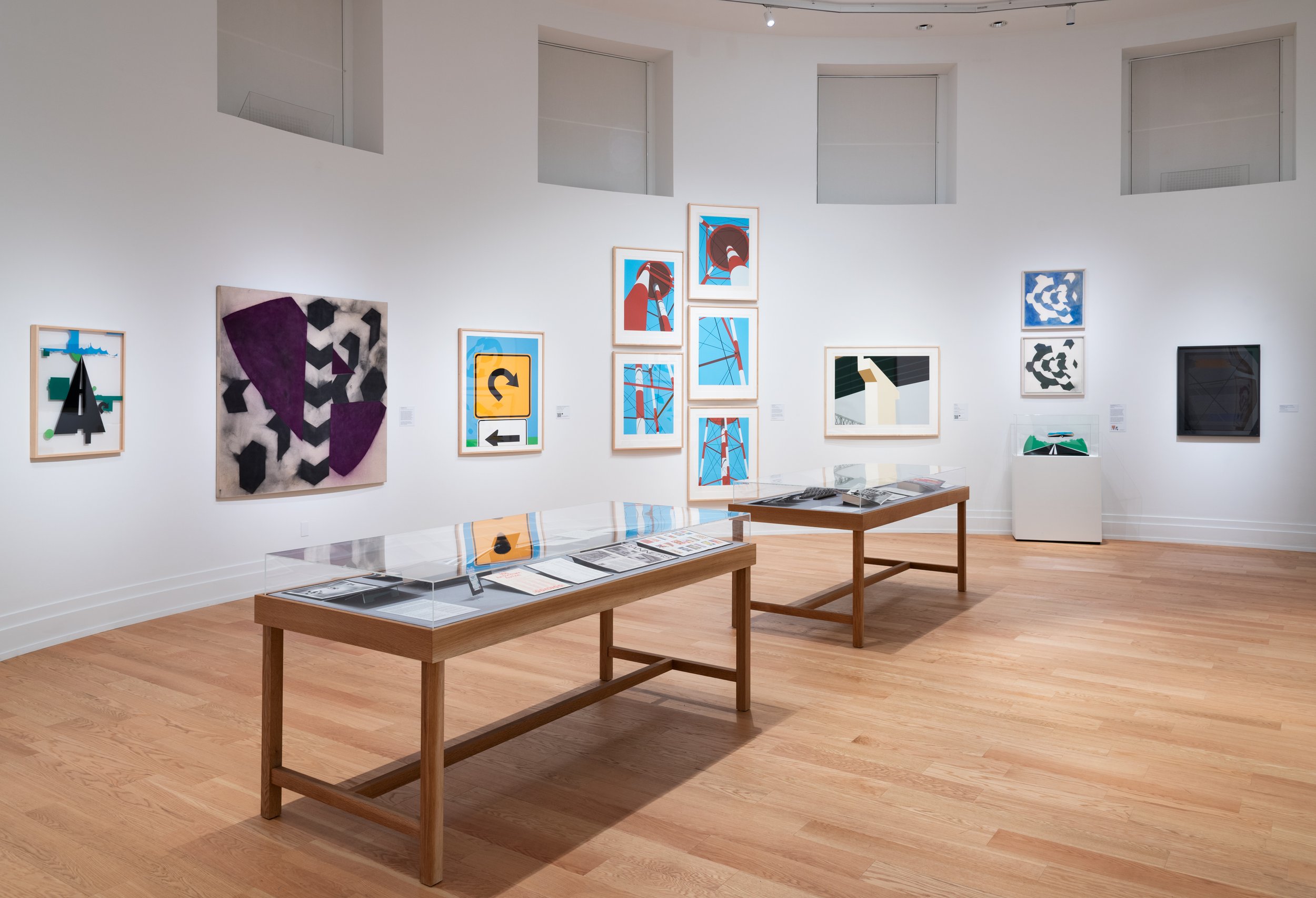
Allan D’Arcangelo: Landscapes and Constellations, 2025-2026, installation view, Buffalo AKG Art Museum.
Courtesy of the artist and the Buffalo AKG Art Museum. Photo: Brenda Bieger.
Consider, for example, the filmmaker Wang Bing’s nine-hour documentary portrait of Shenyang's industrial Tiexi district, Tie Xi Qu: West of the Tracks (2002). In this case, neither the acceleration of modernity nor the construction of new infrastructure—the subject of city symphonies and D’Arcangelo’s work—define the change. Instead, Bing’s film tracks the decay of what was once a vital state-run industrial area between 1999 and 2001. We witness the consequences of factory closures, including demolitions, abandoned buildings, and communities facing joblessness and displacement. The film starts with a camera attached to a train that follows the railroad and immediately explicates the slowness of its pace. The prolonged train ride synthesizes the dismantling and decay of Tiexi, and the continuous slow shot reveals the abandoned city at the pace of deceleration.
The documentation of urban space remains a necessary practice. It continues to draw attention to issues such as violence, unaffordability, displacement, and inadequate infrastructure, and it produces records, uniquely framed through artistic perspectives, for future generations. What has shifted, however, is the location of the “newness” sought by works in this genre. Earlier filmmakers showed the visible boom of modern urbanity, but contemporary artists are documenting environments that are already formed, regulated, or even reaching exhaustion. In this context, newness is no longer found primarily in the building of infrastructure but in how it is inhabited and perceived.
To document cities today, then, is to make visible what has become normalized. The aim is not to rediscover the city as something entirely new but to produce new ways of seeing what is already there. In this sense, the significance of urban filmmaking persists in its capacity to reshape perception.
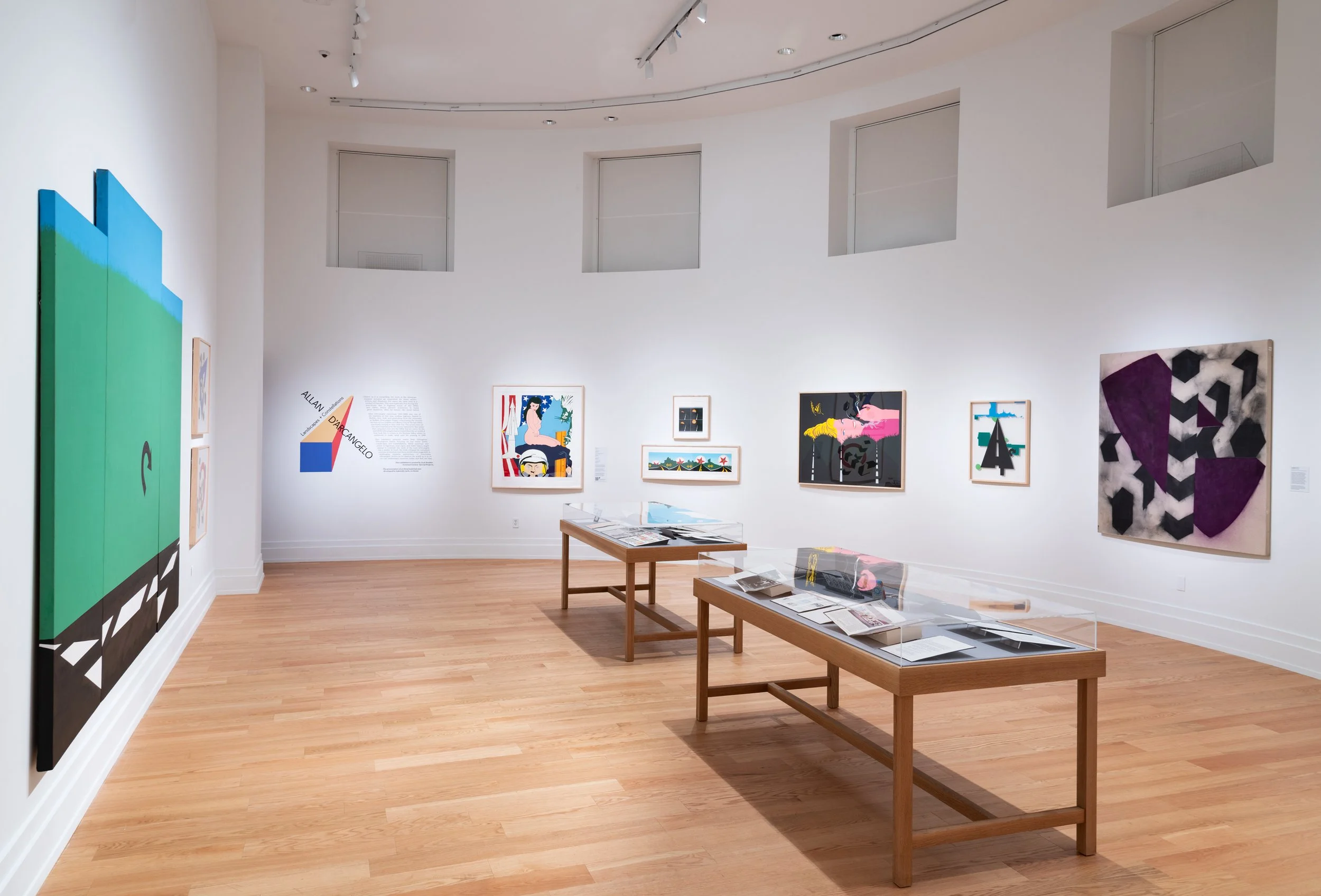
Allan D’Arcangelo: Landscapes and Constellations, 2025-2026, installation view, Buffalo AKG Art Museum.
Courtesy of the artist and the Buffalo AKG Art Museum. Photo: Brenda Bieger.
by Ligia Sato
Ligia Sato is a Brazilian artist who explores the urban environment through lens-based, installation, and video performance art. She earned an MFA from the University at Buffalo and a design degree from the University of São Paulo. She has exhibited widely in both Brazil and the United States.