Do You Like That?
A Reflection on Hearth and Fan Wu’s Erotic Awakenings
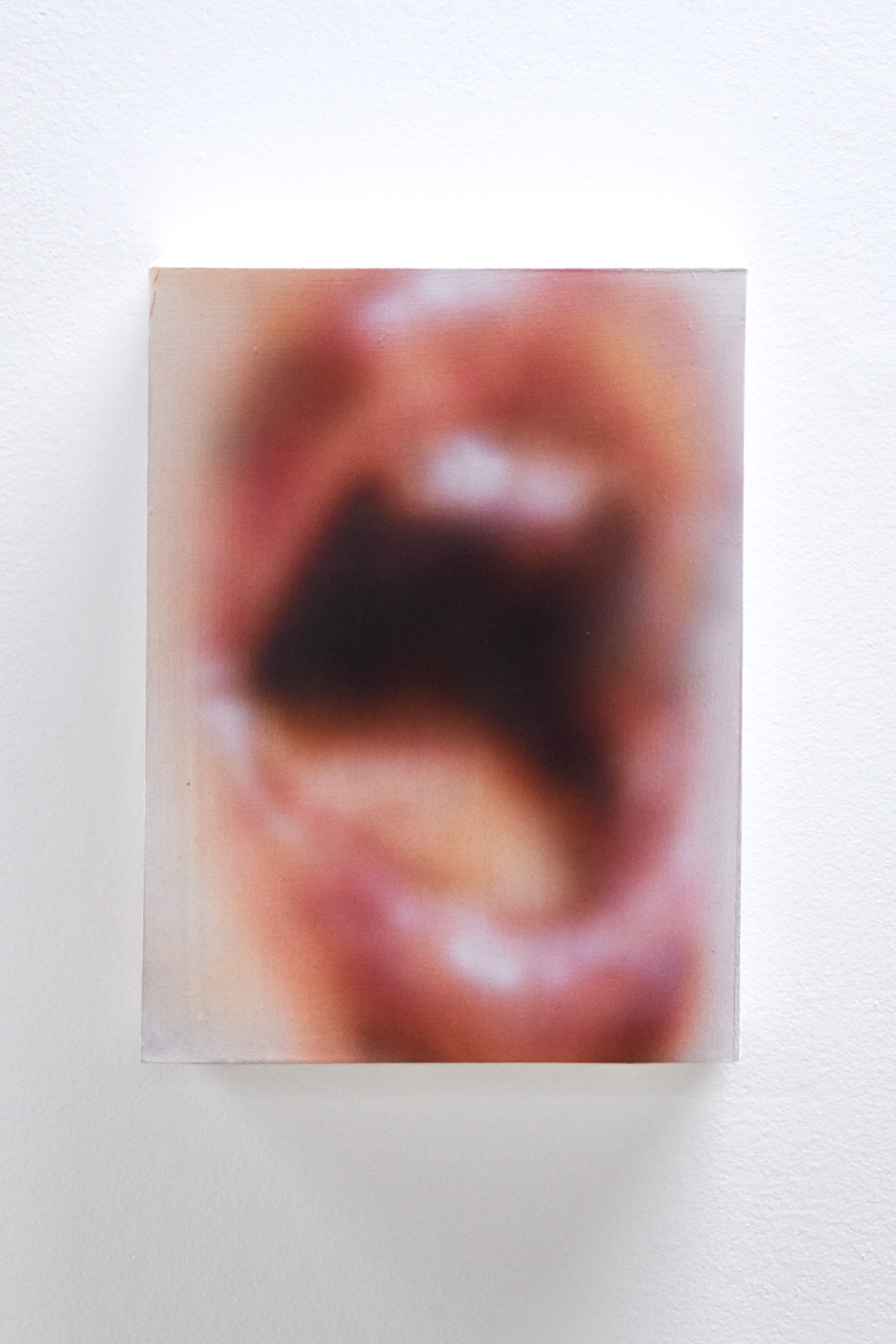
Jake Santos, a thoughtful moment makes excitement wander, 2025. Acrylic ink on wood panel.
Courtesy of the artist. Photo: Philip Leonard Ocampo.
A video you weren’t supposed to see, a feeling you can’t explain, a fixation you can’t escape. A subject’s first moment of sexual inclination is often a difficult one. Discussions of eroticism in the context of developing minds or how that relationship has evolved with the advent of the internet can prove uncomfortable or disheartening. This past fall, a collection of artists came together in a small space on Toronto’s west end to challenge such taboos and insist on the value of exploring the frightening and forbidden in a culture simultaneously embroiled in puritanical conservatism and an ever-escalating fixation on the erotic.
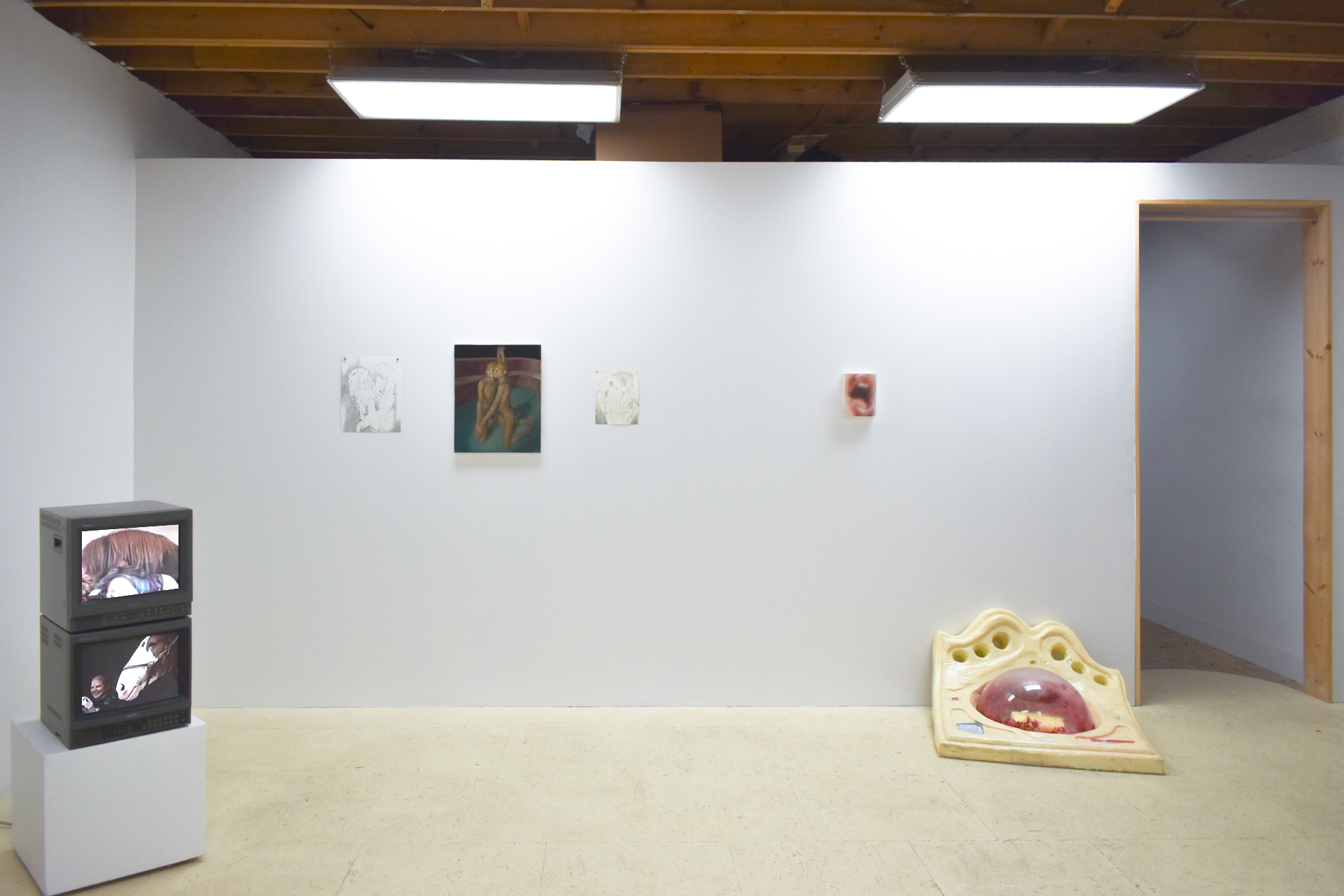
Erotic Awakenings Vol. 4, 2025, installation view, Hearth.
Photo: Philip Leonard Ocampo.
Hearth is tucked into an office space above a Chatr Mobile on St. Clair Avenue near Dufferin Street. It is programmed collectively by artists Rowan Lynch, Sameen Mahboubi, Philip Ocampo, and Benjamin de Boer. For all installments of Erotic Awakenings, they’ve additionally been in collaboration with Toronto conceptual artist Fan Wu. Wu proposed Erotic Awakenings to the Hearth team in 2021, and they have hosted and published online elements of the project since then. The previous three installments of Erotic Awakenings were open-submission writing collections. Hearth invited writers of all backgrounds to submit short stories sharing moments of personal sexual awakening. These range from conceptual work and poetry to more descriptive memoir or autofiction. The project is intimate, to say the least, and replete with details of the cathartic and frightening ways in which writers discovered details of their sexual particularities.
Instantiating the project in physical space is something of a homecoming. Hearth began its life as an exhibition site in a garage without heat or plumbing. But Erotic Awakenings was never intended to center visual art. Wu, its founding voice and leading curator, is a multi-hyphenate but a writer above all else. A few weeks before visiting Hearth, I saw Wu, backed by a live band, perform Steely Dan’s Midnite Cruiser through a voice modulator. Lynch admitted that the project’s strictly virtual iterations and lack of focus on visual art represented a step outside the organization’s comfort zone; Erotic Awakenings remains distinct from the rest of their catalogue. The call for work, though, clearly resonated, filling three volumes of writing. Now this driving force has been focused into visual work occupying physical space in what Lynch describes as a “bookend collection.”
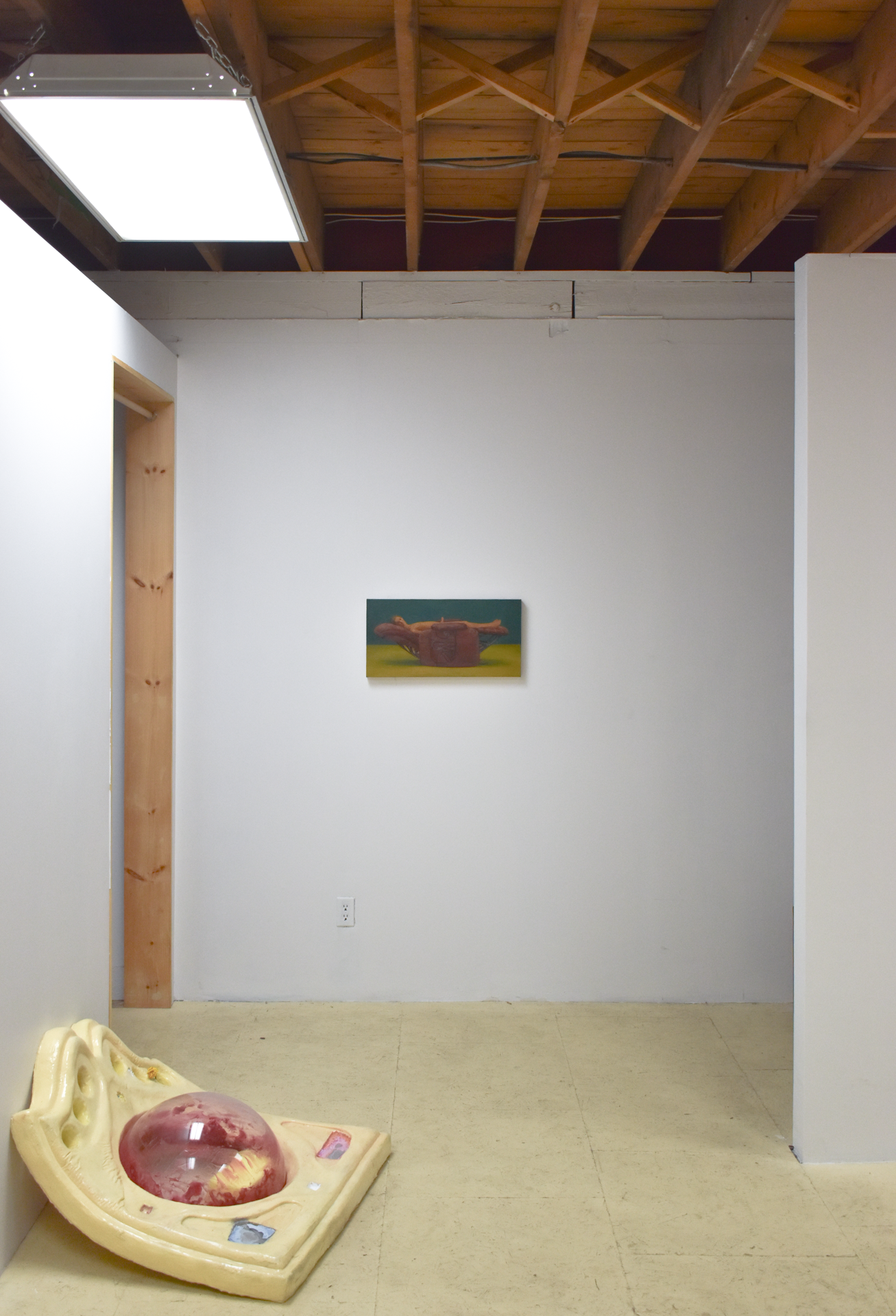
Left: Isabelle Kuzio, Oh Oh Oh To Touch And Feel Very Good, 2025. Flexible foam, urethane rubber, pigments, plaster, plexiglass, silicone, resin, wood, hardware.
Right: Lily Kapler, Caught in my relaxation, 2025. Oil on canvas, 12 x 24 inches.
Courtesy of the artists. Photo: Philip Leonard Ocampo.
For student artist Patrick Etherington, the freedom to explore unorthodox subject matter offered by Erotic Awakenings “facilitated his perversion.” Everyone I spoke with about the project shared this sentiment. Etherington and his former collaborator Jake Santos are largely responsible for Erotic Awakenings concluding in physical space. “Everyone had been talking about Hearth as this artist-run space, then online they had this catalogue of writing I really loved,” Santos tells me while seated under a massive airbrush painting in his studio. Santos and Etherington previously worked together on a series of recorded performance works that reflect on Etherington’s relationships with eroticism and violence. Etherington describes love noise (2025), his contribution to Erotic Awakenings, as a reinterpretation of JOI, a genre of internet pornography in which a speaker provides viewers with masturbation instructions. In love noise, captions transcribing an uncanny narration overlay a droning soundscape Etherington generates by dragging an exposed audio cable over his body. He lifts his shirt to let the head of the cable scrape over his skin and is praised: “Just like that. You’re doing great.” Displaying the work on a rose gold iPad Mini was intended to emphasize the juvenile aspect of the work, Etherington notes. He and Santos both focus on the comedy in their work. Etherington even confesses that he sometimes struggles to see the difference among fetish, death, and comedy. For him, the three emotional peaks represent a homogenous sense of elation. He claims that his work’s two mandates are to be relevant to his life and to make him laugh. He pauses and grins wider before admitting that, while it isn’t necessary, he also appreciates when his art causes him some degree of physical harm. Throughout our conversation he grins like this a handful of times, a signal I understand as confirming when something doesn’t just please him but is also tied to his own relationship with sexuality.
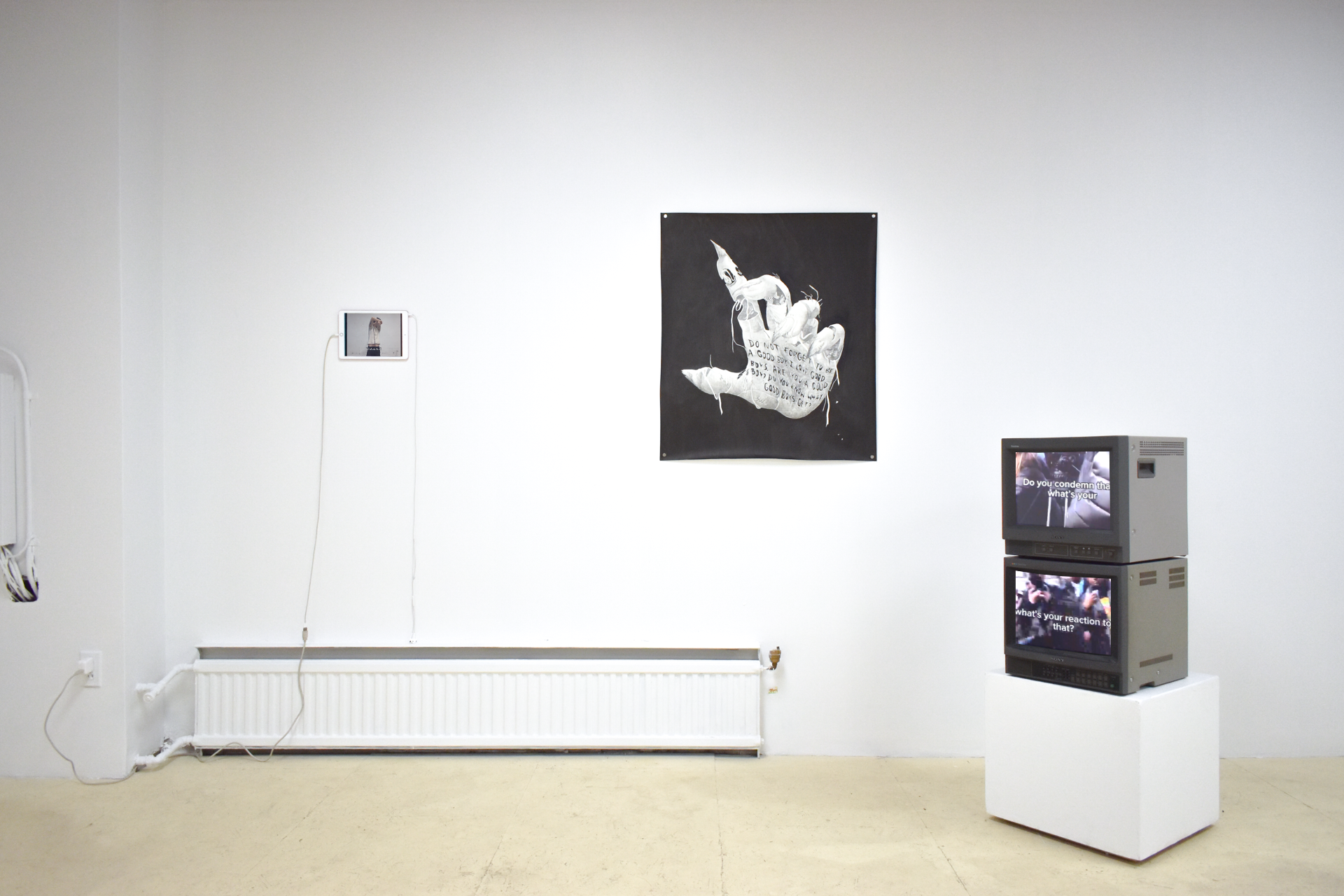
Erotic Awakenings Vol. 4, 2025, installation view, Hearth.
Photo: Philip Leonard Ocampo.
Lily Kapler and Lina Wu, both painter-illustrators, involve recollected memories in their work. In Kapler’s paintings, featureless figures perform abstractions of intimate acts. If these scenes are memories, they are distant and obscured. The emotions communicated or associated with these memories almost seem to have been washed away, and in this the practical truth behind these scenes and poses is lost as well.
By contrast, raw emotion, rather than any recognizable form, is the subject matter of Lina Wu’s work. Figures embrace and kiss as their bodies explode and unravel into ribbons. Here, memories are recalled as a spectrum of emotional associations. Staking the extremes on that scale are Fold (2024), a cross section of an alien geometry, and Hand That Feeds (2025), which pictures a hand unraveling into threads. Carved into its palm is a paragraph of text that ends: ”Do you know what good boys get?” Wu’s reflection and recollections are lurid and tactile. The extreme size of the work emphasizes the violence of these memories.
A distraction grips me while staring at Hand That Feeds back at Hearth. I can’t escape the sound of this television. It’s droning and howling in the center of the room. The television—technically two CRT monitors stacked on top of each other— loops footage of nature and news broadcasts spliced with first-person video of an individual lying on a bed and watching a pornographic film. The film is slowly turning violent. The cameraperson whose vantage we assume falters and stops the recording when the woman in the film, no longer in frame, begins to sob.
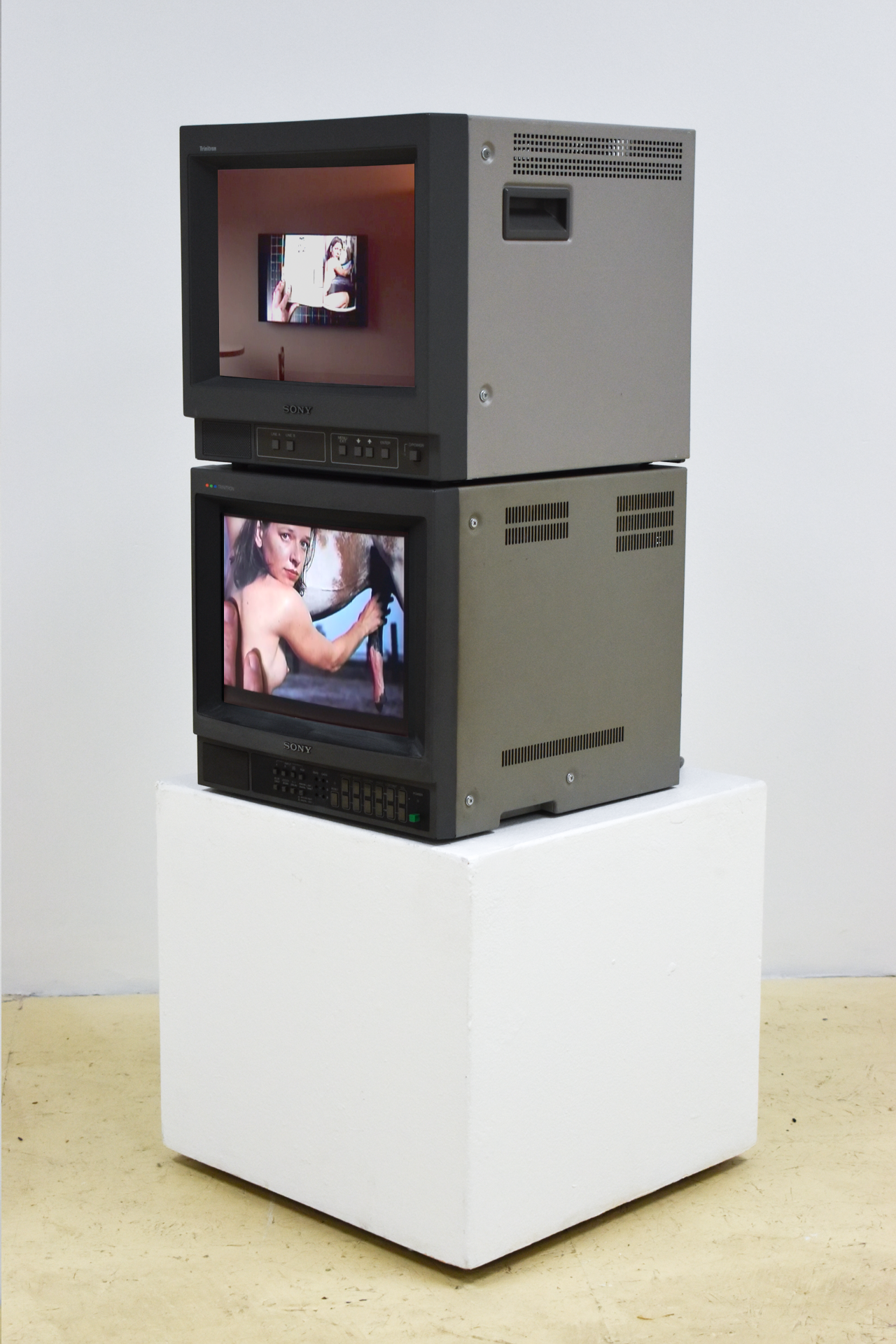
Parastoo Anoushahpour, Opening Scene, 2025. Two-channel video loop, 30 min.
Courtesy of the artist. Photo: Philip Leonard Ocampo.
Opening Scene (2025) is the first thing you see when entering Hearth, and it’s audible even before that. The noise is omnipresent in the gallery space; it sticks in my perception as I view the rest of the work. During our conversation, Lynch intermittently pauses when the sound of screaming or static fills the space. Just as the noise stuck in the mind then, the subject matter sticks in my mind now.
The strongest visual motif across all this footage is horses—and in particular, horses in “shock content.” Opening Scene’s salad of footage initially seemed difficult to parse until the lower monitor quieted over an extended, wavering shot of a computer screen with the URL: sexwithhorse.net. All at once the prior imagery, abstracted by clunky post processing, came into focus: a horse running riderless down an empty city street, recorded from a window overhead; a breaking news bulletin detailing a politician’s speech interrupted by an animal-excrement-hurling audience member; an unseen figure sharing a book of pornographic photography they discovered with a friend. Opening Scene grapples, perhaps more than any of the exhibition’s other works, with the contemporary understanding of and relationship with pornography, and the violence so commonly associated with a first exposure to it. Initial experiences with pornography can range widely, from the wayward clicking of an unfamiliar link to a friend's shared discovery discussed in hushed tones. No matter the surrounding context, these moments are significant not only in terms of sexual development but also as a first exposure to violent or transgressive imagery and the dangerous sides of the erotic.
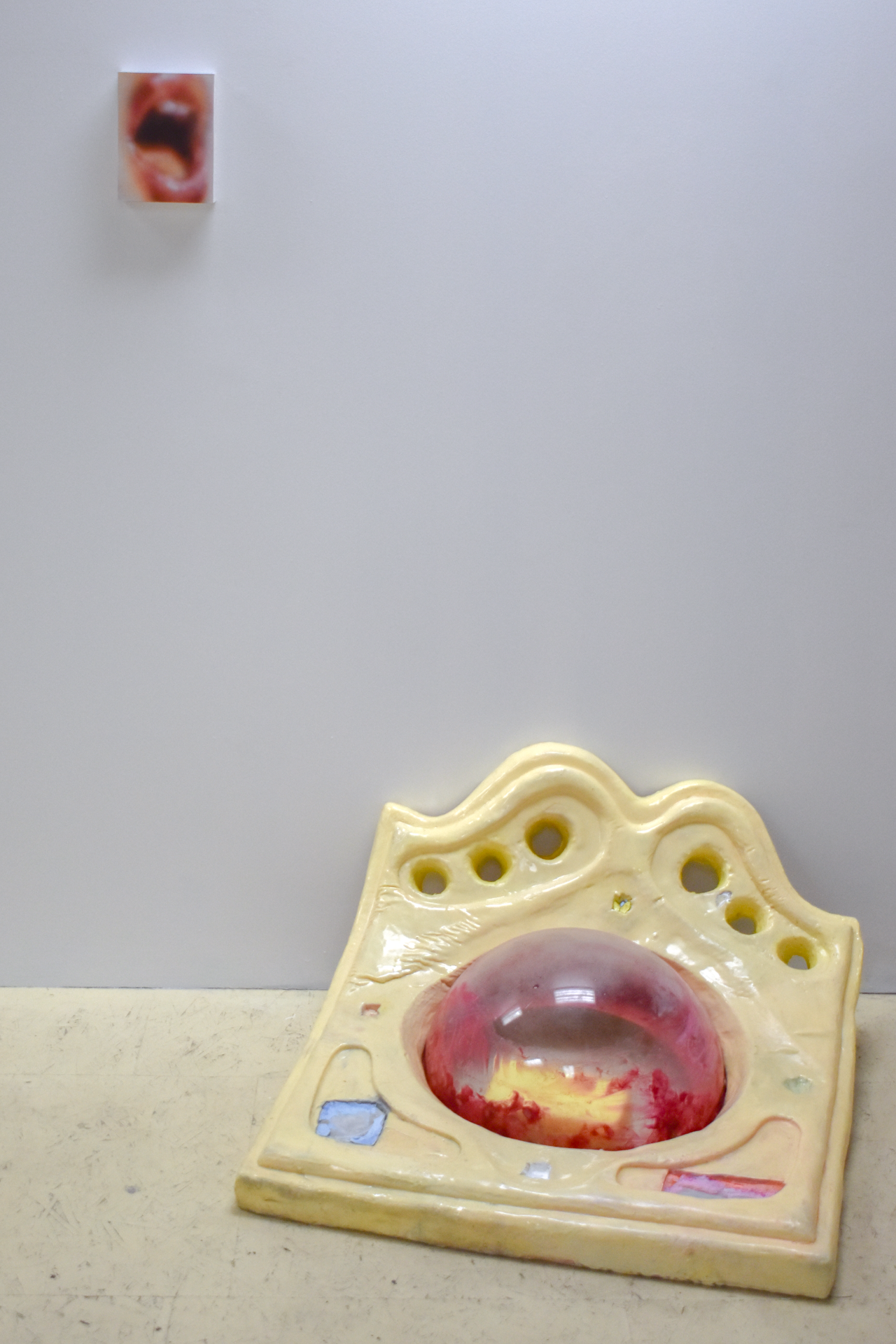
Erotic Awakenings Vol. 4, 2025, installation view, Hearth.
Photo: Philip Leonard Ocampo.
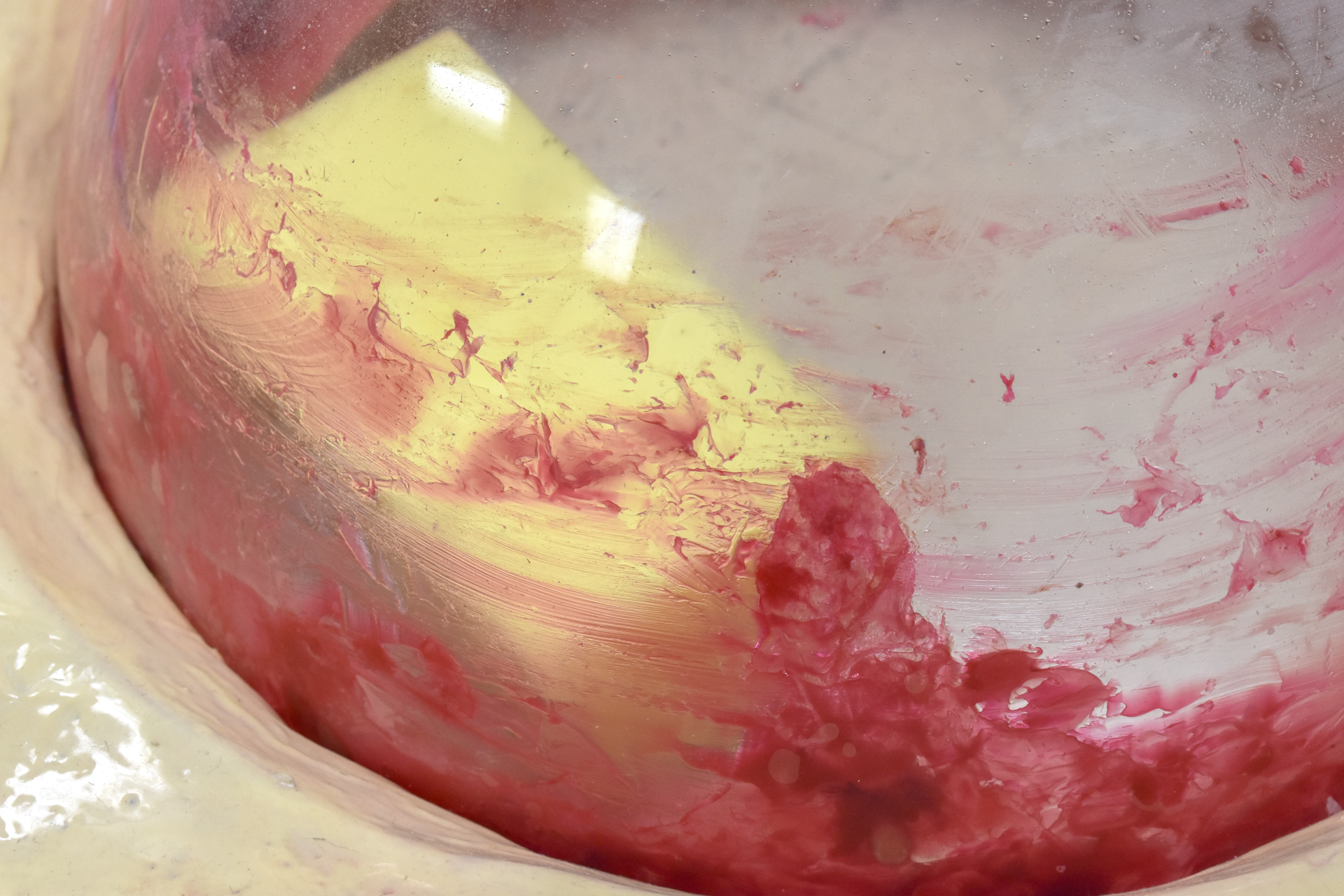
Isabelle Kuzio, Oh Oh Oh To Touch And Feel Very Good, 2025. Flexible foam, urethane rubber, pigments, plaster, plexiglass, silicone, resin, wood, hardware.
Courtesy of the artist. Photo: Philip Leonard Ocampo.
In a cafe in Koreatown, I’m speaking with Fan Wu about Isabelle Kuzio’s Oh Oh Oh To Touch And Feel Very Good (2025): a structure that coopts the architectural details of a children’s play place, its interior coated in red grime. It’s the piece in Erotic Awakenings that, for me, held the greatest association with sexual violence, with its interior coated in red grime. Wu is jolly, and we speak amicably as we watch the Toronto Santa Claus parade pass by on Bloor Street. He’s understanding as I voice my anxieties with the piece and its subject matter, but he pushes back gently. “Why not go there? I encourage you to examine that.” Throughout our conversation Wu is adamant about the value of artists and audiences engaging with the challenging sides of eroticism. “Art is a safe space, if I can use that term, for projection. It’s contained, and buoyed. It invites reflection from the viewer. It doesn’t self-disclose too freely.” I am reminded of a line from the gallery information sheet back at Hearth. Printed atop the document is a quote from David Wojnarowicz: “In loving it, I saw it freeing me from the silence of the interior life.” Beneath that is a series of lines closer to poetry than any traditional curatorial statement and, at the bottom, a final disclaimer: “Exhibitionism is a recurring character of this home. Do you like that?” Erotic Awakenings is more than the eroticism on which it reflects. It is a challenge and an embrace, but more than that, it is an invitation.
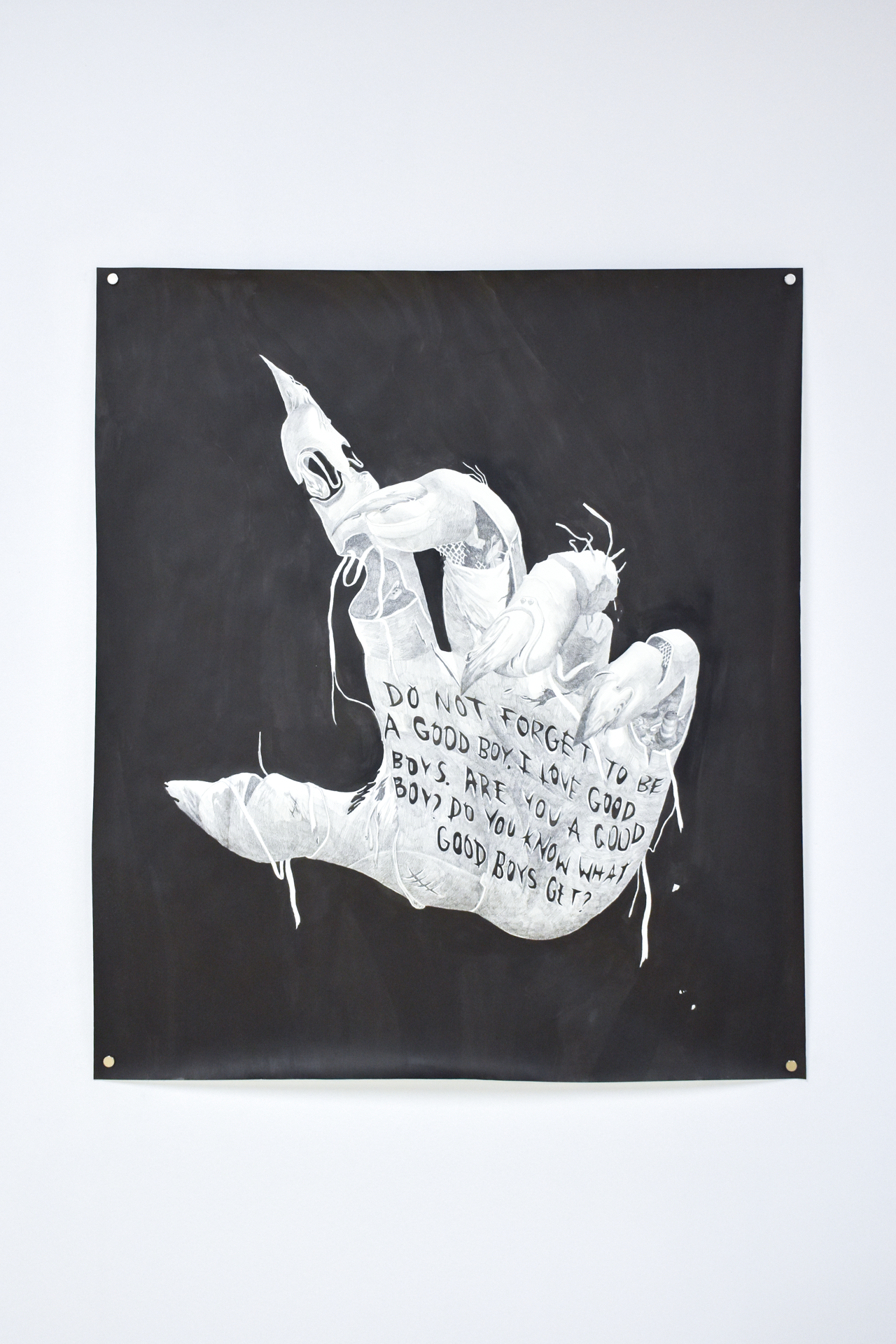
Lina Wu, Hand That Feeds, 2025. Pencil and ink on paper.
Courtesy of the artist. Photo: Philip Leonard Ocampo.
by Liz Harris
Liz Harris is a student of critique and curation at OCAD University in Toronto, Canada.
All of this is very important to her. She can be contacted via lizharrisarts@gmail.com.