Letter from the Editor – Issue 21
Josh Kline’s recent essay for October offers chilling insight into the withered critical capacities of the former seat of the global avant-garde. For an artist who has positioned himself at the forefront of New York City’s self-insistent cultural and political posturing, Kline’s querulous analysis sticks to describing surface effects and amounts to little more than that the rent is too damn high. With one ominous nod to “neoliberal capital,” the piece studiously avoids any actual structural analysis, let alone the stickier questions for an artist of the changed nature of contemporary art itself. While he admits, at least, that New York City is unlikely to be made great again, the piece cannot escape its own narcissistic nostalgia for its subject of criticism and it is, obviously, written post-festum; the owl of Minerva has long flown. Kline is content to describe his view of the horse’s ass well after it’s left the barn.
There is much to criticize in the piece besides Kline’s deficient analysis and shrill tone, particularly around the complex of his myopic views of how art bears its social and cultural content; his apparent desire to return to what he uncritically refers to as “the old kind of contemporary art;” his idea of where expressions of the contemporary are actually to be found outside of the merely institutionally-validated practices that are recycled through museums over and over again; and his dated, naive perspective on the relationship between art and politics. Kline greatly overprivileges real estate as the master variable of contemporary art’s crisis, collapsing questions of meaning, form, and politics into the conditions of its production, without addressing how art actually works once it’s made. His argument ultimately still locates the value of contemporary art within the very institutional circuits it laments, even as their claims to centrality have already eroded. For this audience, though, the jig is really up toward the end of his text, when in describing alternative art spaces and collectives around the world, he says that, “Visiting Jogja, the center of Indonesia’s art world, is like tunneling back through time to Olympia or Providence in the 1990s.”
I don’t want to collapse the many particularities of distinct regions and their histories into a single idea of the “regional;” it is their differences that define them. But for anyone who lives outside of Jakarta, or in Puerto Rico, or Detroit, or Buffalo, Pittsburgh, Lincoln, Little Rock, basically anywhere in the American South or West besides LA, and too many other places in the world to be enumerated, we know we don’t live in the past (and certainly not in the 1990s!). Almost everywhere, everyone in the world (besides, perhaps, a few institutionally successful artists based in New York City and Los Angeles)—anywhere that has been on the bad side of accumulation by dispossession, deindustrialization, de-development, debt peonage, whatever—the so-called polycrisis has long been upon us. All over, people are deep into building a world while in freefall. And for those of us outside of the major metropoles, we know that regionalism is the future, not as a retreat into the local, but as a condition already imposed, lived, and being worked through in real time.
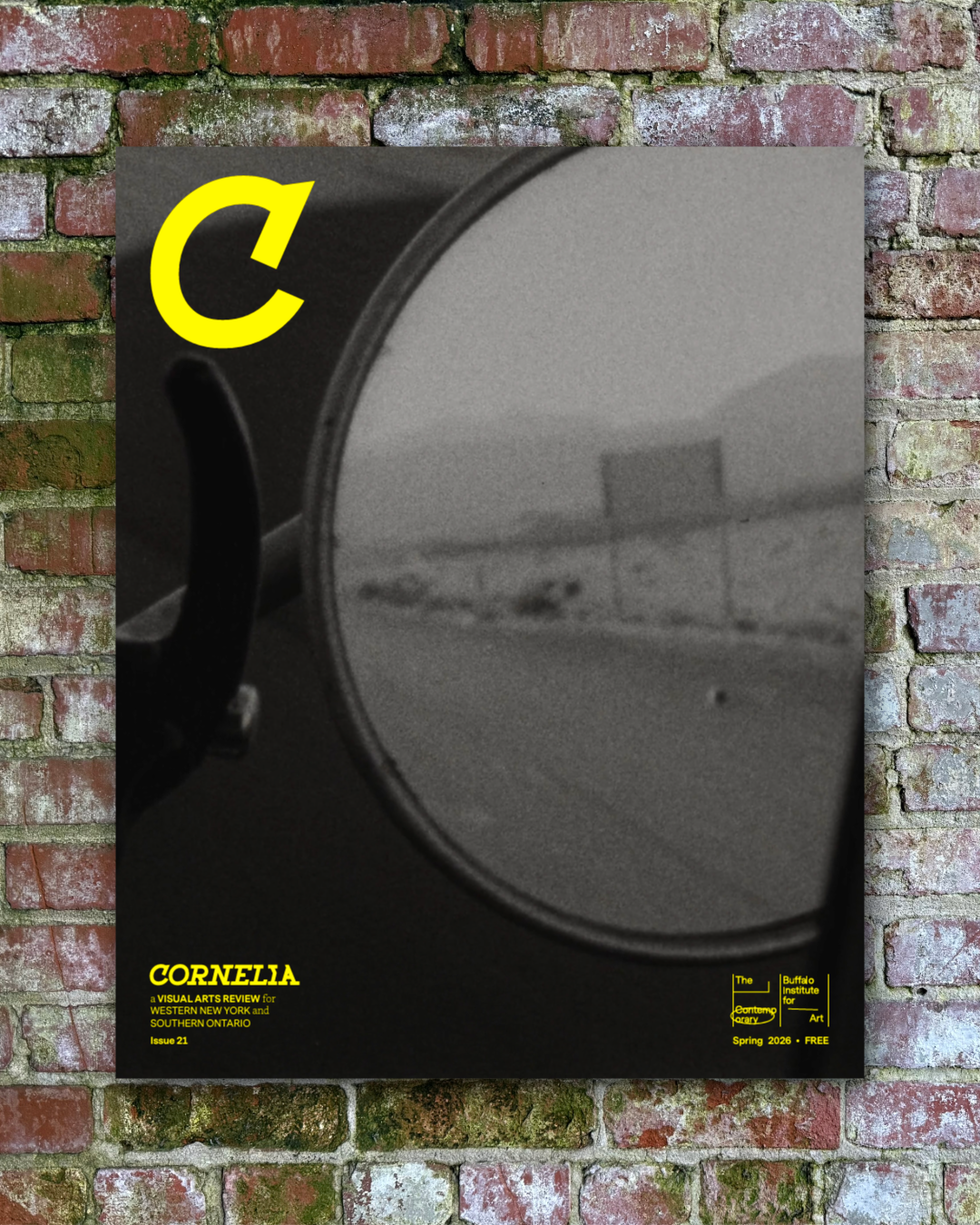
We are living in the future here; it’s just not evenly distributed. And if the centers of the old art world can only describe their own decline in retrospect, then it falls to those of us outside of them to describe and to build what comes next. In this issue of Cornelia, Ligia Sato addresses a recent Allan D’Arcangelo exhibition at the Buffalo AKG; Liz Harris reflects on contemporary Canadian artists’ experiences of the erotic; Kyla Kegler discusses the bumpy historical intersections of craft and contemporary art through the Burchfield Penney’s biannual craft exhibition; Angel Callander situates HaeAhn Paul Kwon Kajander’s recent exhibition at Mercer Union within a condition of globalized rootlessness shaped by empire and technological standardization; and George Payne thinks through Hodinöhsö:ni’ art as a living practice of peace grounded in continuity, material knowledge, and sovereignty. Together, these articles are a map of the contemporary that is already unfolding outside the center.
Thanks as always to Mark Yappueying for beautiful design, Emily Mangione for copy edits, wavy for a final polish, and our wonderful supporting advertisers for making Cornelia possible.
Nando Alvarez-Perez
Editor-in-Chief

Published by
The Buffalo Institute for Contemporary Art
Nando Alvarez-Perez
BICA Co-Founder and Co-Director, Programs & Publications
Emily Ebba Reynolds
BICA Co-Founder and Co-Director, Strategy & Engagement
wavy
BICA Gallery Assistant & Generator Fund Coordinator
Emily E. Mangione
Copy Editor
Mark Yappueying
Design
Contributing Writers
Angel Callander
George Cassidy Payne
Liz Harris
Kyla Kegler
Ligia Sato