Let Them Craft
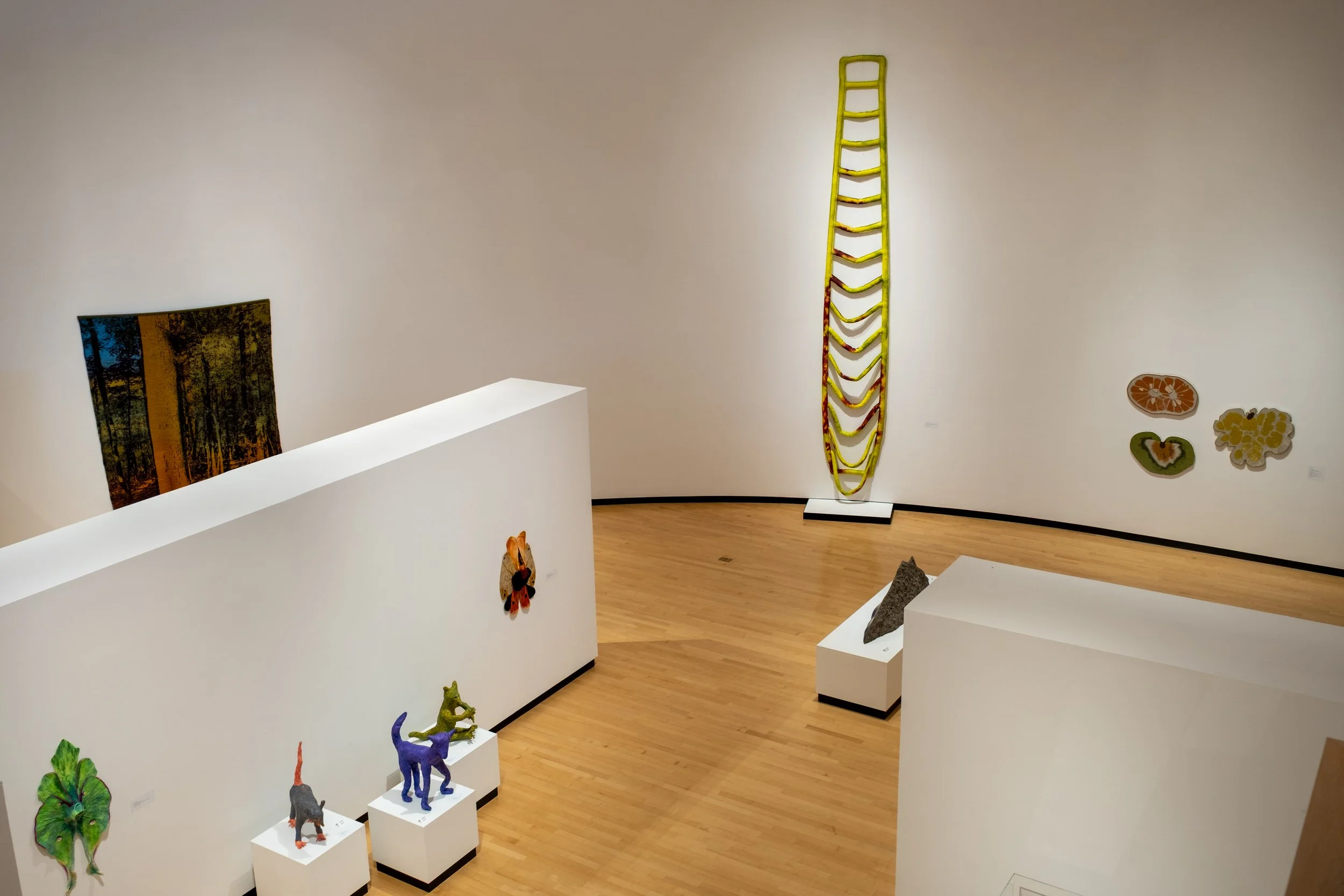
The Sylvia L. Rosen Craft Art Biennial 2025, 2025-2026, installation view, Burchfield Penney Art Center.
“Have nothing in your houses that you do not know to be useful or believe to be beautiful.”
— William Morris
I’ve been thinking about craft in our current moment. In an age marked by de-skilling, outsourcing, dematerialization, and the mediation of experience through screens, the precision of handwork and embodied utility offered by craft seem newly relevant. At the same time, the boundaries between craft, art, and design have grown increasingly slippery as these formerly distinct categories circulate through overlapping markets. Design fairs proliferate alongside art fairs; contemporary art galleries increasingly show furniture, ceramics, and textiles; and collectors who once ignored these mediums now pursue them enthusiastically. In part this shift reflects decades of feminist challenges to the marginalization of mediums historically coded as feminine—ceramics, fiber, etc. But it also reflects the art market’s capacity to absorb whatever materials or practices carry cultural cachet at the moment.
These musings were prompted, in part, by selected works from The Silvia L. Rosen Craft Art Biennial 2025 alongside conversations with my dad about the shifting relationship between art, craft, and design. In what follows, I consider where and how craft lives today—and what contexts might allow us to appreciate it on its own terms, separate from the art market’s tendency toward fetishization and recurring thirst for cultural grit, novelty, and conceptual validation.
The Silvia L. Rosen Craft Art Biennial 2025
Walking into The Silvia L. Rosen Craft Art Biennial 2025, I found myself searching for criteria that might unite this wide range of “craft art” objects. These operate under very different assumptions about what craft is, what it does, and how it should function within a craft show. More broadly, the category of craft has become increasingly elastic—caught between its historical grounding in utility and material knowledge and its contemporary positioning within the art world’s conceptual frameworks.
Historically, most objects we now call craft—pots, tools, textiles, structures—began as solutions to practical problems. Their forms evolved not from aesthetic theory but from negotiations among materials, tools, and human needs. None of this, however, excluded beauty. Instead, beauty in form was often inseparable from beauty in function. Members of cultures that understood aesthetic pleasure as indispensable to daily life layered decorative motifs, symbols, and sacred references onto functional forms as a way of sustaining attention through the labor of survival.
My dad, Kevin Kegler, began his artistic career with an undergraduate degree in furniture design from Buffalo State College in 1981 and has since moved through boat building, historical restoration, sustainable cob construction, sculpture, and traditional Japanese woodworking. When I asked how he thinks about craft, he returned to utility (a seemingly scarce quality in this Biennial) and to the relationship between human, material, and technology:
What we make as craft reflects the technology we've developed. . . . I think about it as a three-way connection: craft is technology, material, and human being. And when it's balanced, it's beautiful.
This three-way relationship helps explain why past generations understood craft as a form of knowledge rather than simply a category of objects. Skill develops less through conceptual intention than through repetition. Over time the maker’s relationship to tool and material becomes embodied knowledge—closer to muscle memory than conscious strategy, the proverbial riding of a bicycle. At the same time, craft carries a powerful cultural fantasy: the sacred relationship between isolated maker, tool, and material. Anyone who knits experiences this meditation. The satisfaction lies less in the finished object than in the rhythm of the process itself. There is a kind of embodied interconnection between self and source that feels larger than ego and individual genius—an encounter with forms of knowledge that exist whether or not we claim them.
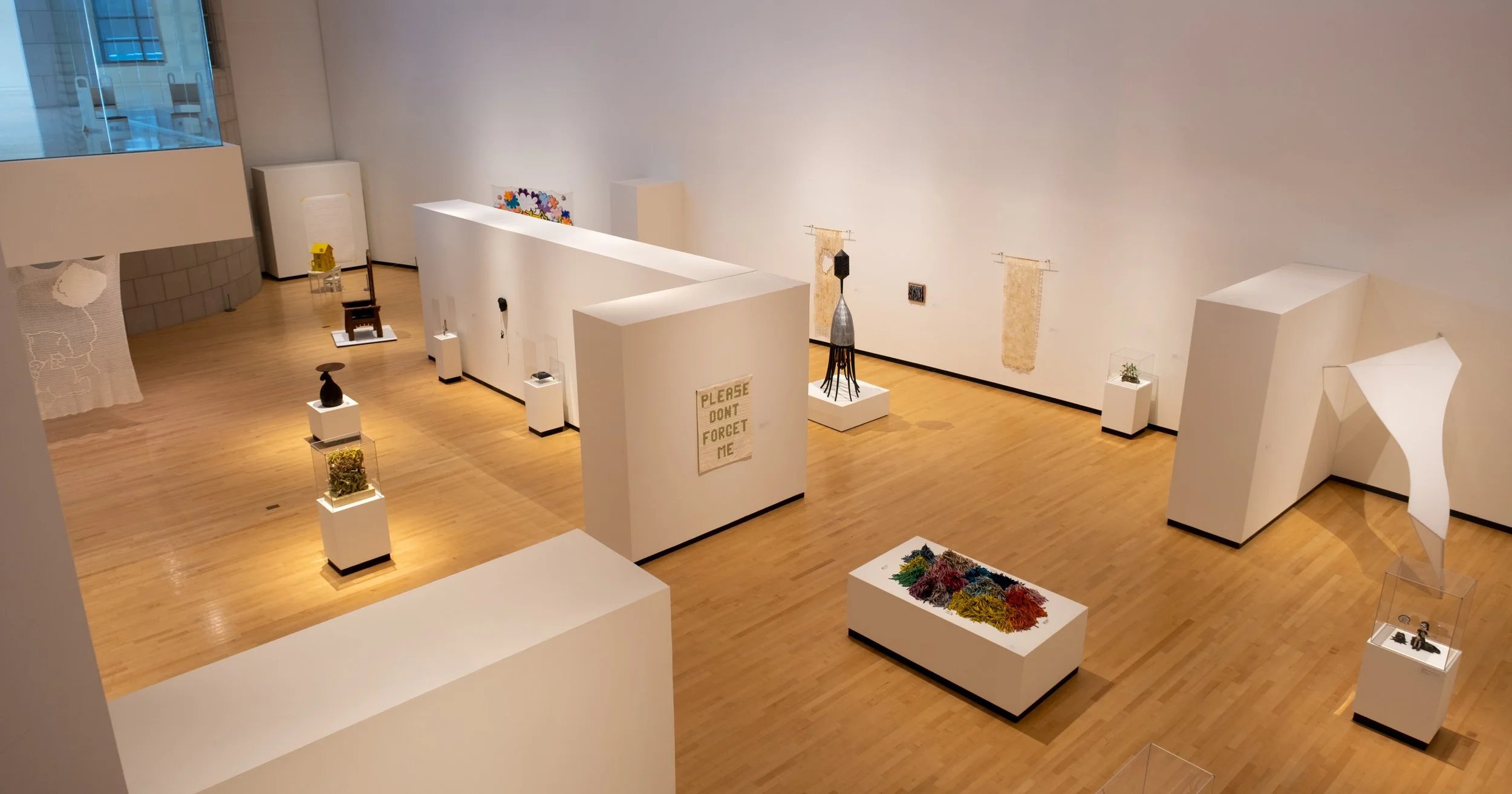
The Sylvia L. Rosen Craft Art Biennial 2025, 2025-2026, installation view, Burchfield Penney Art Center.
Phenomenon
The first work I notice upon entering the exhibition is a solid glass football-shaped object resting on a reflective black surface that resembles marble. The beam of a small flashlight casts a geyser-like shadow that explodes into swirling shapes of light on the adjacent white wall.
At first glance the relationship between form and material feels straightforward enough; after all, the basic phenomenological experience of light refracting through glass is an ancient physics trick. There seems to be no need of interpreting a metaphorical concept less interesting than the formal event itself.
But the work also hovers riskily in an ambiguous middle ground. As art it feels thin—little more than a demonstration of a physical phenomenon far more dramatically expressed elsewhere in the world. As craft, it barely mobilizes glassmaking’s technical or material intelligence. Ultimately, the object more closely resembles a kind of precarious lamp than a compelling resolution of either field.
That ambiguity and tension runs through the Biennial at large. Many of its artists trained in craft techniques—glassblowing, textiles, woodworking—but frame their objects within the familiar apparatus of contemporary art: the artist statement, the discursive justification, the intellectual alibi. The results feel muddy. Rather than asserting the authority of craft on its own terms, the works often borrow legitimacy from the norms of contemporary art—adopting its language and reproducing the hierarchy that places “art” above “mere craft.”
Within that context, Evan Seeling’s piece becomes instructive. Its appeal lies not in conceptual explanation but in direct perceptual encounter. Artists such as James Turrell, Olafur Eliasson, and Larry Bell have long explored how simple manipulations of light and material can restore wonder to experiences we assume we already understand. The phenomenon itself is the content. It needs no metaphor and asks only that we look long enough for the material world to perform.
Labor
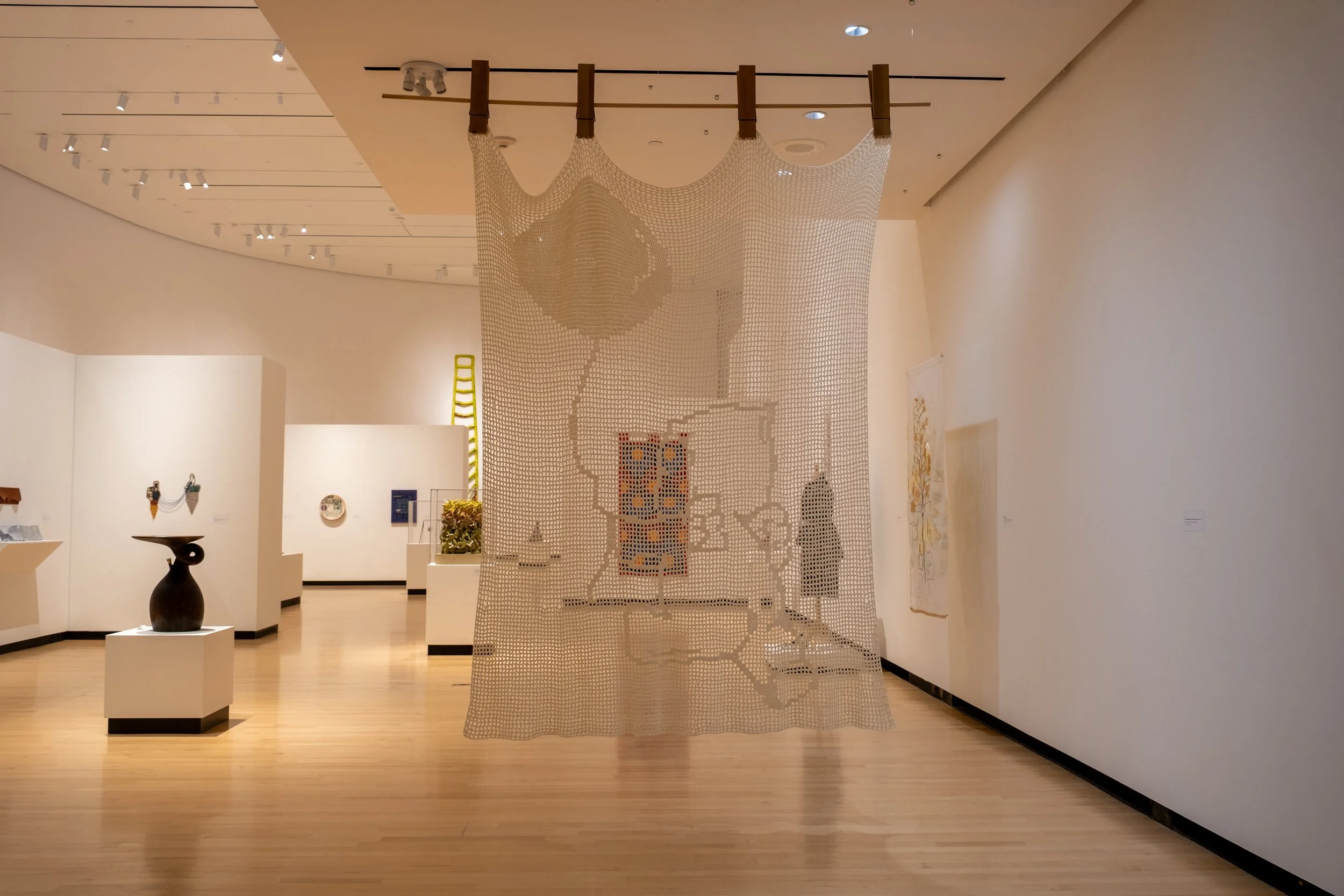
The next work I approach is a bedspread-sized, filet-crochet textile. The plastic fuzz of its white acrylic yarn shimmers where light catches stray hairs.
Spanning the textile is a larger-than-life Kewpie doll holding a balloon, presenting its winged little butt to the viewer as it prances away. The soft structure hangs from four oversized clothespins hooked over a wooden dowel suspended from the ceiling, not quite draped but not quite stretched.
The work foregrounds duration. Filet crochet accumulates through incremental gestures—one stitch at a time—until the grid resolves into an image. The technique carries long associations with domestic labor and the kind of history feminist artists and scholars have worked to reposition within contemporary art discourse. Wavy’s piece translates that lineage into the scale and logic of installation.
The Kewpie figure introduces another layer of cultural reference. This character first appeared in early twentieth-century illustrations and then as a series of mass-produced dolls. Today, it sits between kitsch icon and nostalgic artifact. Wavy’s Kewpie, reconstructed through painstaking hand process, collapses distinctions between popular imagery, domestic craft, and contemporary art display. Standing before the work, the image shifts between Kewpie and labor—between the sentimental figure and the gestures that produced it.
Wavy’s title, The Only Finite Element on the Periodic Table, suggests crochet as a temporal record: a structure built through countless gestures that exceed the scale of their individual constituent movements.
The Sylvia L. Rosen Craft Art Biennial 2025, 2025-2026, installation view, Burchfield Penney Art Center.
Matter
The gallery as a site of dissemination does not always do the work justice. The white cube confers status and a certain alienation from the mess involved in the object’s making. When it comes to craft, the ghost presence of process feels especially significant. The interior space at the Burchfield Penney Art Center, however, is more complicated than the typical white cube. Hardly pristine, it is a sprawling labyrinth of irregular walls painted various hues and overhung with a density of objects that produces its own visual clutter.
Approaching a white platform piled with thirteen proximal mounds of color-sorted Crayola “crayon carcasses,” I am confronted by a comical DO NOT TOUCH tent card directly in front of the work. The warning carries a certain irony. Historically craftspeople produced objects meant to be handled or used, yet here—and elsewhere in the exhibition—objects whose material intelligence seems to invite physical encounter are held at a distance.
Wax feels bodily in a way plastic cannot imitate. Settling into these piles of tiny characters, I take in the iconic smell of Americana childhood and notice the way light moves through the matte substance—which alternates between opaque and translucent—before stopping at the paper substrate. The paper becomes a permeable membrane, transformed through saturation and bleed, yet still blocking flow.
Wax feels like something I want in my mouth, like chocolate. The material carries its own embodied logic of experience. The combination of this magical natural substance with artificially contrived elements—color pigment and sorting—references and defies nature.
In another work elsewhere in the gallery, Chantal Calato has poured the insides of the crayon carcasses into block forms ranging from half-and-half cartons to milk-carton size. Their dense color and mass recall the experience of walking into the installation of Joseph Beuys’s mammoth fat blocks at Hamburger Bahnhof. That connection points to another tension in the exhibition. Beuys’s Unschlitt (Tallow) (1977) clearly speaks the language of conceptual sculpture. And Calato’s reference to it could be an example of a contemporary craft borrowing the gestures of canonical art as a way of situating itself within art’s hierarchy of legitimacy. Or (I suspect) the inverse is true—that this is contemporary art centered on material and framed as craft by the context in which it appears.
Embedded into each of Calato’s “Building Blocks” is a piece of plastic dollhouse furniture. For the sensory-obsessed abstractionist in me, these factory-made elements interrupt what had been a small sensorial feast. Online videos of Calato’s studio reveal the larger world to which these sculptures belong. Within the chaotic grab bag of the group exhibition, I miss Calato’s broader context. The work seems to ask for a setting capable of holding the full life of its making rather than the cluttered neutrality of gallery display.
Inheritance
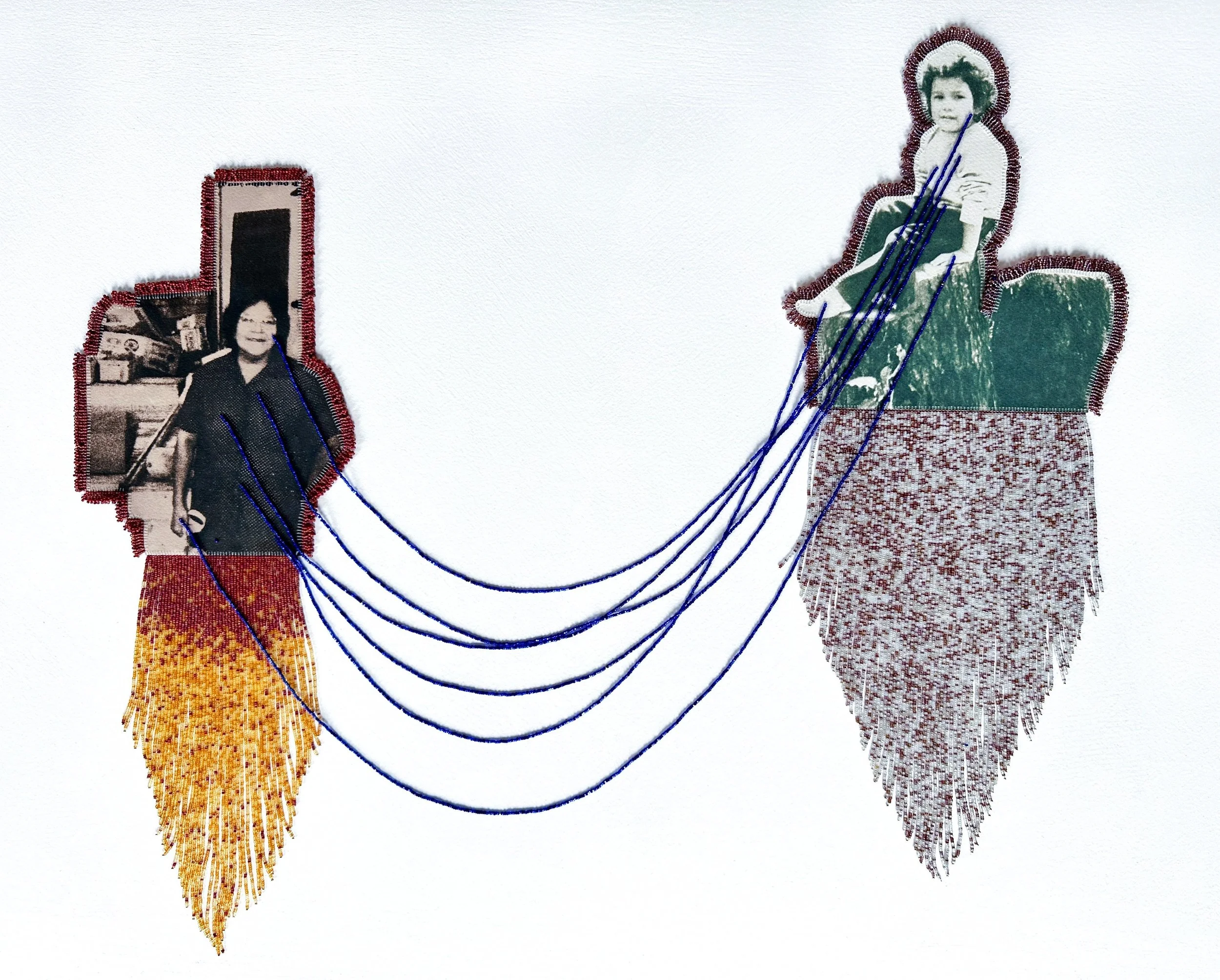
Approaching Luanne Redeye’s Grandmother’s Granddaughter, I register two black-and-white xeroxed images hanging side by side on the wall. Each is no bigger than my palm and adorned with Native American beadwork that gives them the feeling of icon-like pendants. Several strands of blue seed beads drape from the child above to the woman below—linking their hands, stomachs, lungs, hearts, and heads.
*red seed beads to blue seed beads has been corrected from print*
The work follows a familiar contemporary art strategy: pairing archival imagery with traditional materials to ask questions of lineage, memory, and cultural inheritance. Beadwork is unmistakably a craft practice rooted in long traditions of use, exchange, and communal knowledge. Here, however, it functions unmistakably as a contemporary art gesture meant for gallery spectatorship.
Historically, beadwork circulated through systems of making and use; here, it sits static as material reference within the logic of exhibition display. The shift reflects a broader push by museums and biennials (including this one) to mobilize inherited craft traditions as conceptual material and cultural currency. And this raises questions about how often practices like beadwork appear in institutional programming as “craft” even when their practitioners clearly operate within the discourse of contemporary art.
Luanne Redeye, Grandmother’s Granddaughter I, 2024. Mixed media, 18 x 24 inches.
Courtesy of the artist.
Instinct
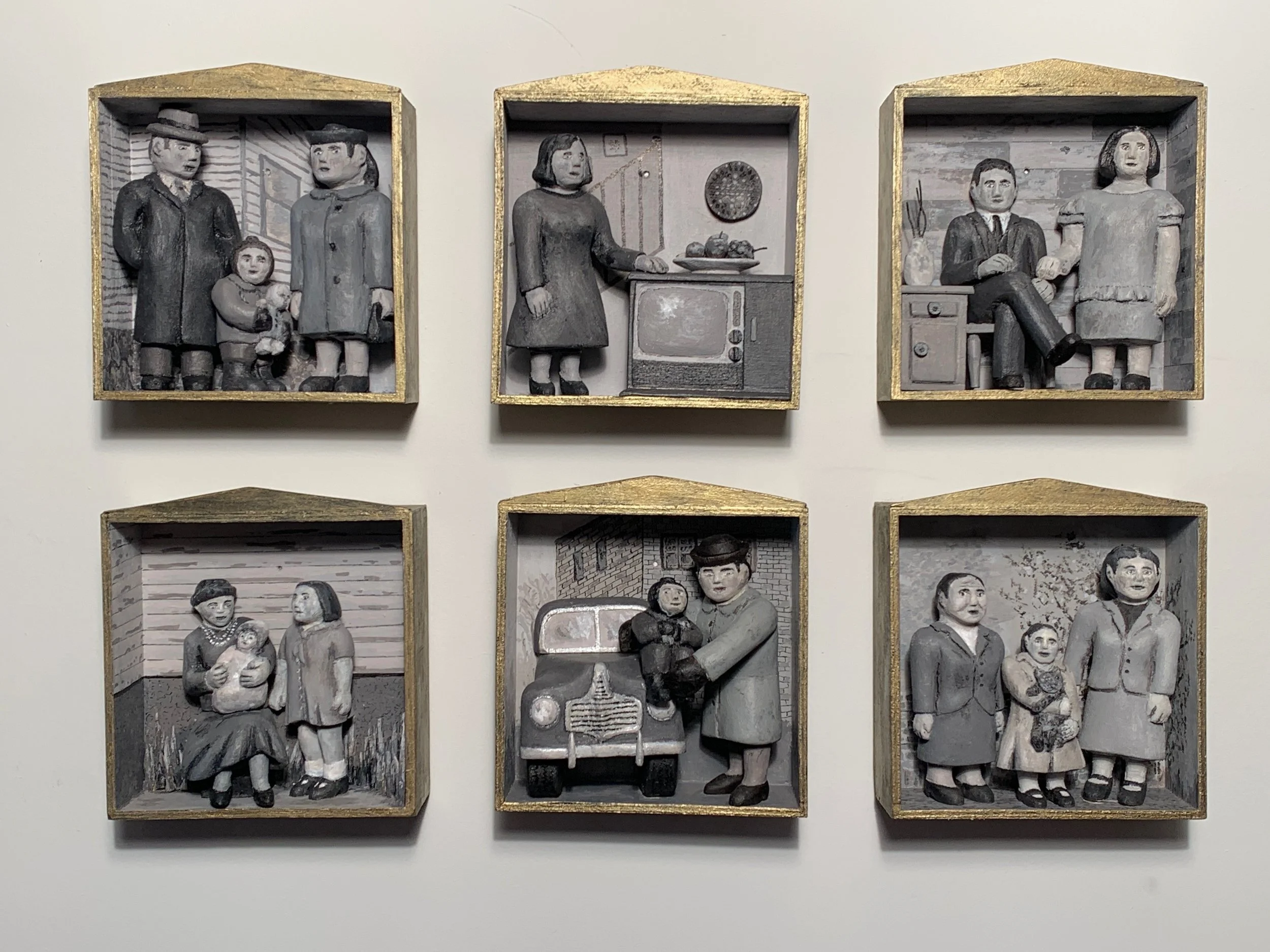
Towards the very end of the exhibition—just when I thought my attention for taking in anything more had expired—I’m drawn across the room into Old Family Photo Album, a collection of six Polaroid-sized grayscale boxes hanging on the wall. From afar I can see miniature three-dimensional life inside them, and I approach with childlike delight.
The boxes contain tableaux suggesting mid-century family portraits: overcoated men, pom-pom–hatted children, a domed television cabinet, fruit, staircases, dresses, pearls, old cars, wood-sided houses with tall grass around their foundations. At first, I read the intricately sculpted miniatures as painted clay; they evoke the same surreal wonder I remember from Gumby or Peewee’s Penny Claymation. Later, I learn that they are carved wood, and their Marisol-esque blockiness registers. They carry the quality of a material or process with limited control over the outcome, allowing just the right dose of effortless abstraction to suffuse an endearing command of form and emotion.
Looking into these portals, I feel a sense of gratitude that eighty-something-year-old Ruth Geneslaw has done this work and that I can follow her small journeys without developing carving blisters on my own hands.
Dissolution
I’ve been in Ojai, California, filling my sun battery before returning to Buffalo’s last dark days of winter, while writing much of this piece. Yesterday, sitting in a mountain stream after a six-mile hike in the afternoon heat, I thought about the looming extinction of humanity and the urgent need to change how we treat this planet’s resources if we hope to last a little longer.
Looking down at the water rushing over my feet and the ancient round pebbles beneath them, the ice water like knives against my sun-drenched skin, those anxieties dissolved, and the barrier between myself and this beautiful planet fell away.
The only comfort I find in contemplating humanity’s dire state comes in such moments of dissolving separateness—when I feel that the universe will continue evolving long after my body retires.
This most frequently happens in nature. But I’ve come to think it can also happen in the practice of craft: through the repetition of gestures passed down through generations, through negotiations between hand and material, through the embodied understanding that the knowledge moving through us is older and larger than our individual selves.
And that may be partially why the current appetite for craft feels complicated. In a moment defined by abstraction, outsourcing, and digital mediation, handwork offers a fantasy of return to utility, source, touch, some less alienated relationship among body, purpose, and world. But when the market absorbs craft primarily as texture, cultural grit, and a sign of authenticity or relevance, it becomes antithesis of the very conditions that once gave it meaning—use, repetition, skill, inheritance, and practical relationship.
What I return to is not whether craft can be art or whether contemporary artists can work meaningfully with craft traditions but rather how a preoccupation with these categories produces a kind of conceptual fetishization that obscures both the object’s craft and poetic value.
Ruth Geneslaw, Old Family Photo Album, 2024–2025. Wood, 11 x 18 ½ x 1 ½ inches.
Courtesy of the artist.
This isn’t a new predicament—artists have always navigated the tension between market trends and the integrity of their making. But when curators and market-makers position craft and art as categories that validate each other, both risk losing clarity and the ability to operate on their own terms. A potentially generative relationship becomes a feedback loop of justification in which neither category realizes its full potential or stands on its own.
Through the logic of craft and practices of making, we are but a brief knot of energy in this long continuum, momentarily animated by an ego and inextricably linked to all who came before us and all who will follow.
by Kyla Kegler
Kyla Kegler is an artist based in Buffalo. Kegler evokes themes of fantasy, illusion, embodiment, relationship, pleasure, and purpose across painting, sculpture, performance, and film.
Her recent film, The Accumulation of Meaning Over Time (2025), premiered at the Buffalo AKG Art Museum. Shot primarily on 16mm, it explores how self-understanding deepens over time and how collective meaning accumulates across generations, bodies, and images. Her exhibition The Last Whole Earth—a collection of abstract paintings, ceramic objects, and a T-shirt—is on view at Rivalry Projects, Buffalo, from May 1 through June 19, 2026, and at NADA NY, NYC, May 13 through 17 2026.