Latinx Art Goes Big
Let Us Gather in a Flourishing Way at Buffalo AKG
Our annual gala is TOMORROW!
Come celebrate 7 years of community and contemporary art with us.
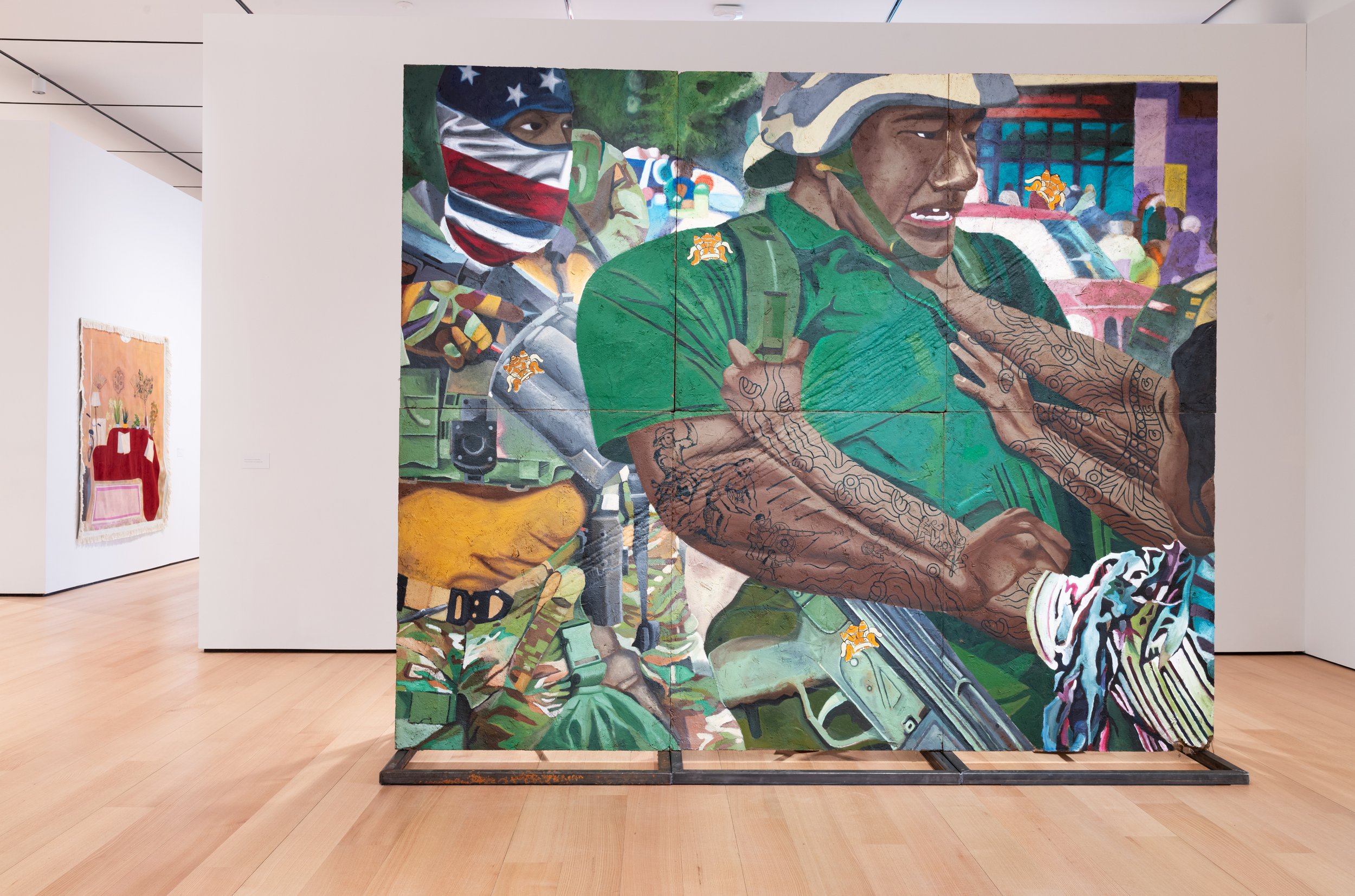
Rafa Esparza, Tratos: Después de Pedro Valtierra Entre Redadas, 2025-26, installation view, Let Us Gather in a Flourishing Way, 2026, Buffalo AKG Art Museum.
Courtesy of the artist. Photo: Brenda Bieger.
An immense work by Justin Favela looks out an expansive bay of windows on the third floor of the Buffalo AKG Art Museum in the new Let Us Gather in a Flourishing Way (henceforth Let Us Gather). As I moved through the exhibition and encountered still more outsized works—a lofted billboard, a hanging pillar, and canvases so large they seem to exert a gravitational pull—one thing became clear: Latinx art has gone big.
Latinx, the roughly two-decade-old term organizing the show, emerged as a sociological designation before expanding into art history. The size of the works, and the exhibition itself, are particularly significant considering the relative novelty of the term, its cautious embrace by conservative institutions like art museums, and the wider terminological maelstrom that surrounds it. Building on precursor terms like Latino, Latina, and Latin@, Latinx drew a transgenerational membrane around Latin American and Caribbean migrant communities living in the United States, preempting binary gender markers inherent in Spanish grammar with the insertion of an “x.” The term captured wider attention in the wake of the 2016 Pulse shootings in Orlando, and alongside the capitalization of Black and modest growth in use of nonbinary pronouns, it joined a broader push for language to do reparative political work. The exhibition’s title, excerpted from a work by former United States poet laureate Juan Felipe Herrera, continues this coalition-minded impulse. It casts a communitarian romance over the gathering of work by more than fifty artists representing a range of generations, heritage, and genders.
Justin Favela, St. Maarten (1972), After Marisol, 2025-26. Site-specific piñata tissue mural (paper and glue on wall) Commissioned by the Buffalo AKG Art Museum. Courtesy of the artist. Photo: Brenda Bieger.
Detractors have pointed out that most folks the term aspires to describe, roughly one in five people in the United States, do not claim it. Moreover, in emphasizing shared ties to Latin America and the Caribbean, the term risks flattening different relationships to homeland, reasons for departure, and experiences of migration and particularities across generations. There are also differences in what Arlene Dávila calls national privilege and broader affinities and antagonisms these groups experience vis-a-vis US imperial hegemony. The term evinces an interest in solidarity, coalition-building, and a more expansive understanding of gender that may or may not exist in communities that prefer to identify either more traditionally as Latino and more specifically, for instance, as Nuyorican. Non-Latinx writers like myself who use the term would do well to remain attentive to these tensions, which LUGIAFW largely brackets in favor of a more expansive vision of Latinx collectivity. Its monumental scale is part of that vision: rather than dwelling on its internal contradictions, the exhibition projects Latinx as a capacious category capable of making claims to visibility on an epic scale.
Even as it remains contentious as a sociological category, Latinx has been more widely adopted by academic and cultural institutions. Art spaces especially have leveraged the term as a wedge, holding open the door to wider interventions in the archives and canons from which certain artists have been and remain excluded. Over the past fifteen-some years, the attenuated rise of Latinx has spurred the creation of academic and curatorial appointments, professional organizations and publications, and, to the point, exhibitions. As is the case with Let Us Gather, Latinx art has increasingly expanded beyond the purview of community-oriented cultural spaces and toward art museums.
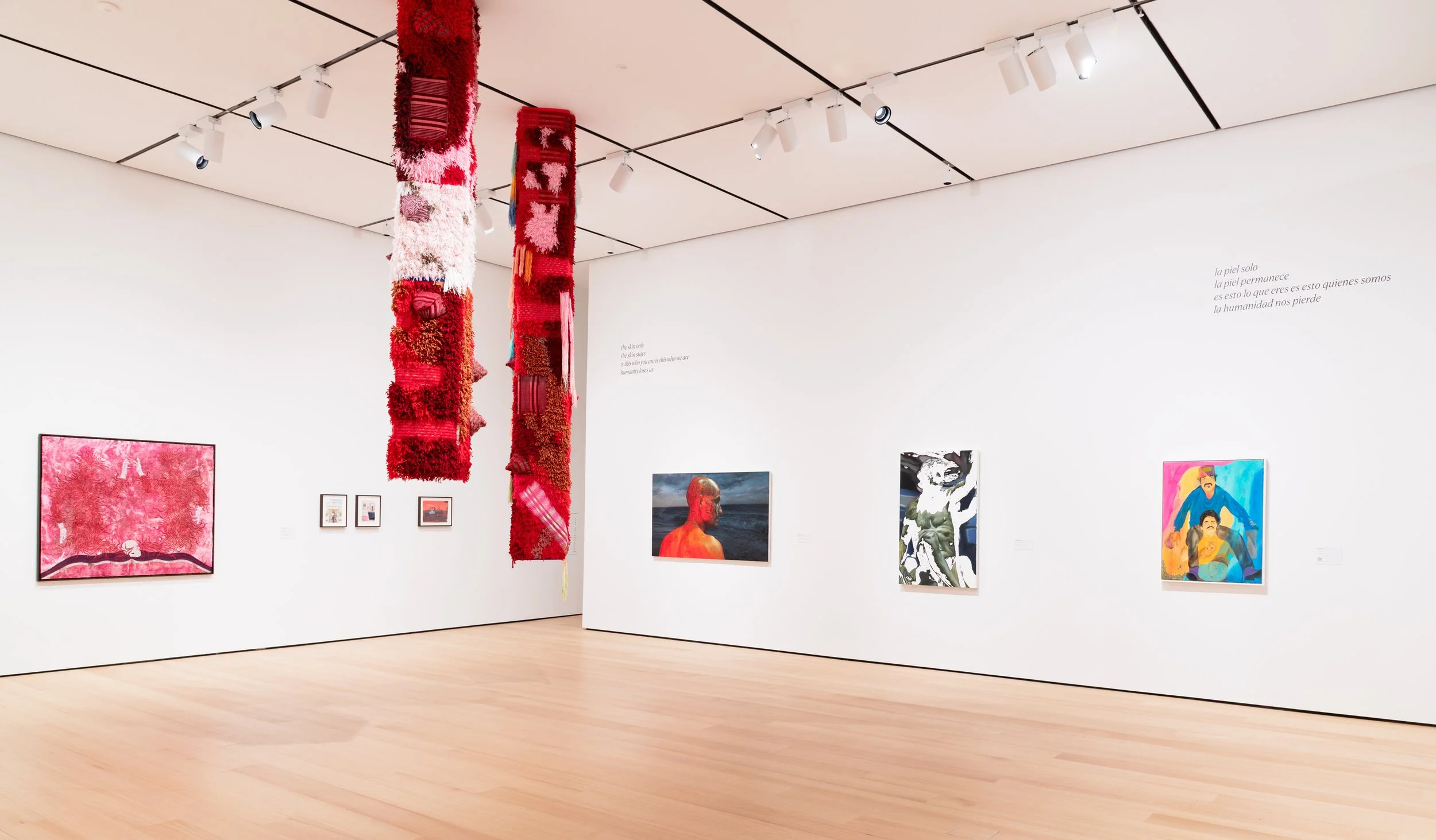
Let Us Gather in a Flourishing Way, 2026, installation view, Buffalo AKG Art Museum. Photo: Brenda Bieger.
Paradoxically, today’s noxious migration rhetoric and the whitewashing of American history may coexist with the potential for more durable infrastructures for Latinx art. More than three decades after Laura Águilar stood outside a Los Angeles art gallery offering to work for access (technically, “Axcess”), Let Us Gather arrives at a moment when Latinx artists are entering—belatedly, tentatively—the wider canon of US art. With that entrance comes a series of questions: What is gained and sacrificed in this move to broader art spaces? Does the public for Latinx art change with this transition? Who is this art for? Finally, in the exhibition’s own terms, who is invited to the gathering?
With fifty-eight artists, it is a big gathering. Let Us Gather pairs Chicanx and Diasporican artists alongside creators whose histories and identities extend beyond those formations—take, for instance, Suchitra Mattai, a Guyanese American artist of South Asian descent. However, we are given little insight into what type of gathering this is. Perhaps it’s a tertulia, an informal gathering of artists and writers? Or, better yet given the preponderance of BFAs and MFAs, an art crit? Indeed, despite well-explored differences of heritage, gender, and race, there is surprising uniformity in the artists’ educational backgrounds. All but a handful have a BFA and MFA, and twenty percent of those exhibiting have a terminal degree from one of the two top-ranked art programs in the United States. Additionally, perhaps due to the relative contemporaneity of the term Latinx, a mild historical amnesia permeates the show’s roster; the median artist was born around 1984.
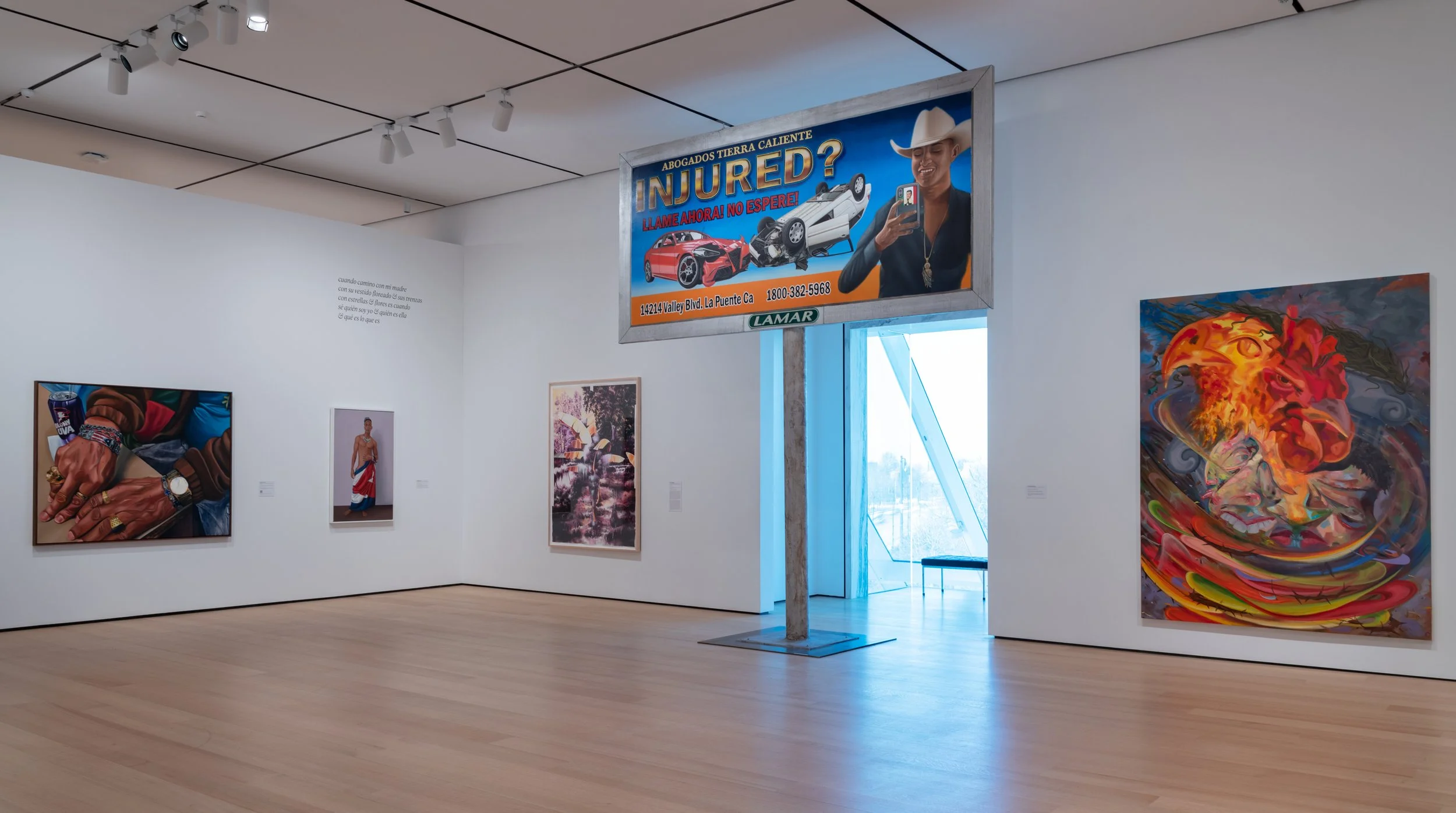
Let Us Gather in a Flourishing Way, 2026, installation view, Buffalo AKG Art Museum. Photo: Brenda Bieger.
With this educational and generational uniformity, one could imagine the exhibition more simply situated as a survey of contemporary US painting with works that variously incorporate craft, explore the fissures between representation and abstraction, and, as mentioned, trend toward the immersive in scale. Instead, there is an insistence on foregrounding affective bandwidths and recuperating practices emerging from Latinx lifeways. Within this framing, Let Us Gather unfolds across a series of exceptionally elastic categories that are variously aesthetic (pinturx, abstraction), thematic (history, community, identity), and figurative (land, bodies).
One of the show’s most compelling arguments is that Latinx artists materially innovate on painting’s staid Eurocentric genealogies by integrating deeply personal methods drawn from craft, trade, and heritage specific to each artist. To name this intervention, curator Andrea Alvarez, herself an Ecuadorian immigrant to the United States, offers “pinturx,” a portmanteau of Latinx and pintura. The work by Favela mentioned earlier, for instance, invokes popular and craft traditions associated with piñatas, an icon of Mexican, Mexican American, and American culture. Favela reimagines a landscape by Venezuelan American artist Marisol in the museum’s collection using strips of colorful tissue paper. He premises his approach not on the pop irony of the piñata’s iconicity, circulation, and reproducibility but on a meticulously, ambivalently, and perhaps even lovingly rendered material labor that draws on his own heritage as a queer Guatemalan Mexican American.
Quite often, these practices also recuperate forms of work historically marginalized for their proximity to racialized femininity and domesticity. For Mexican American artist Yvette Mayorga, this is cake decorating, her mother’s profession, which the artist reimagines in painting covered with pink acrylic paint piped like icing. A high femme confection of Rococo filtered through Rasquachismo, the result is replete with false eyelashes, plastic nail charms, and rhinestones. Elsewhere, the materiality invokes other cultural histories. There is Suchitra Mattai, who knots saris into waves of color, and fiber artist Sarah Zapata, who distills weaving and rug-making practices tied to her own Peruvian heritage into pillars that float and lean.
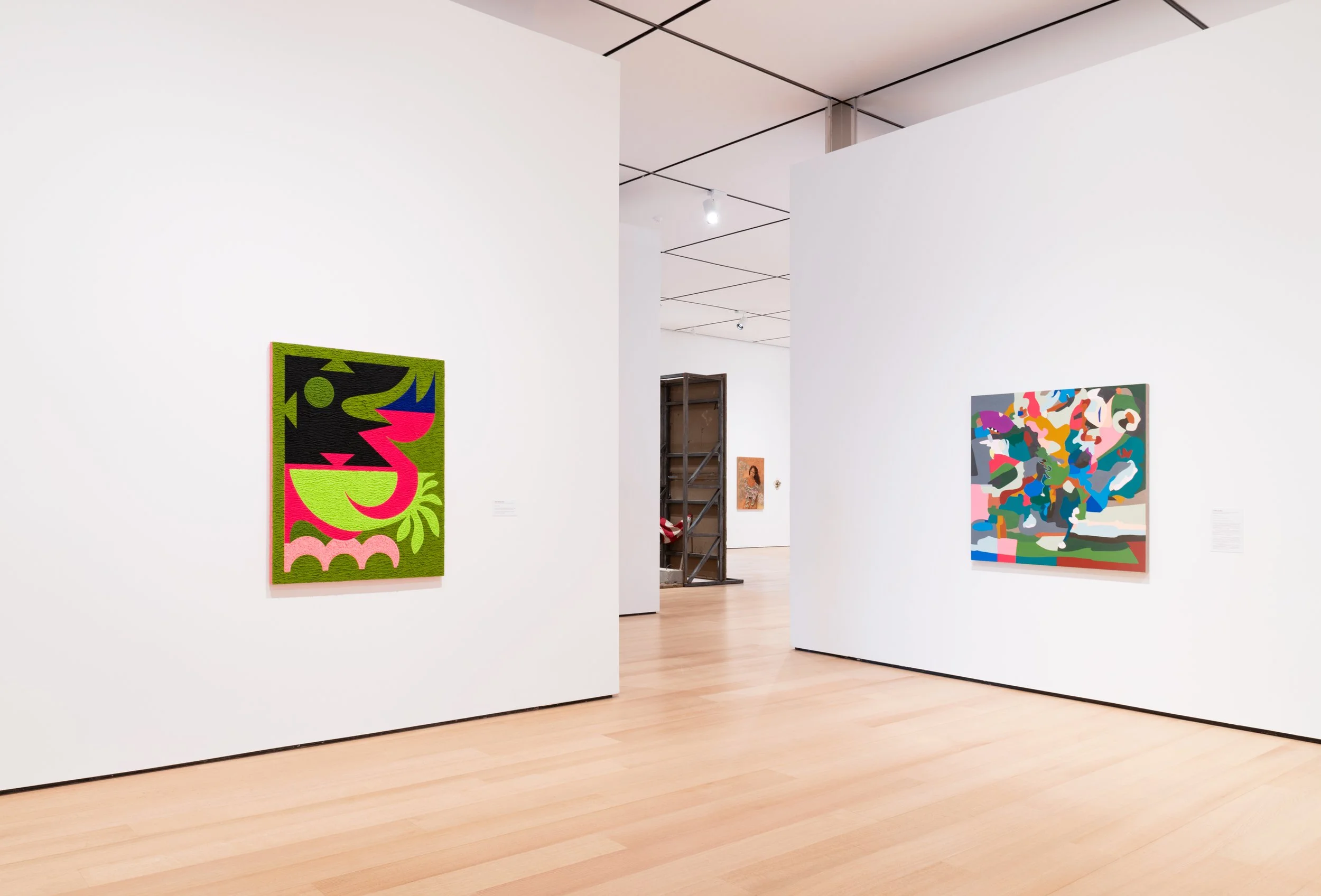
Let Us Gather in a Flourishing Way, 2026, installation view, Buffalo AKG Art Museum. Photo: Brenda Bieger.
A cynic could see the show’s investment in painting as pandering, a move to legitimate Latinx art by centering the most privileged medium of Western aesthetic theory. Building on earlier movements like muralism, however, these works instead expand painting’s horizons to accommodate cultural practices both inherited and reimagined. Cake decorating, fiber art, and craft hardly delimit a shared visual lexicon. What connects them is less a common style than an attention to the histories and forms of labor embedded in aesthetic practice. In this way, Let Us Gather situates Latinx art as a set of practices through which those histories and ways of working become visible.
Alongside recuperating these practices, Let Us Gather weaves between representation and abstraction, exploring more novel representational paradigms and the work of artists who abandon figuration altogether. Several works are preoccupied with everyday acts of lounging and lazing. Mayorga’s figure reclines on a bed, but she’s not alone. In Mexican-born painter Aliza Nisenbaum’s canvas, a figure sits casually on the ground before a theatrical backdrop. The subjects of David Antonio Cruz sprawl across a couch in intimate heaps of lounging bodies.
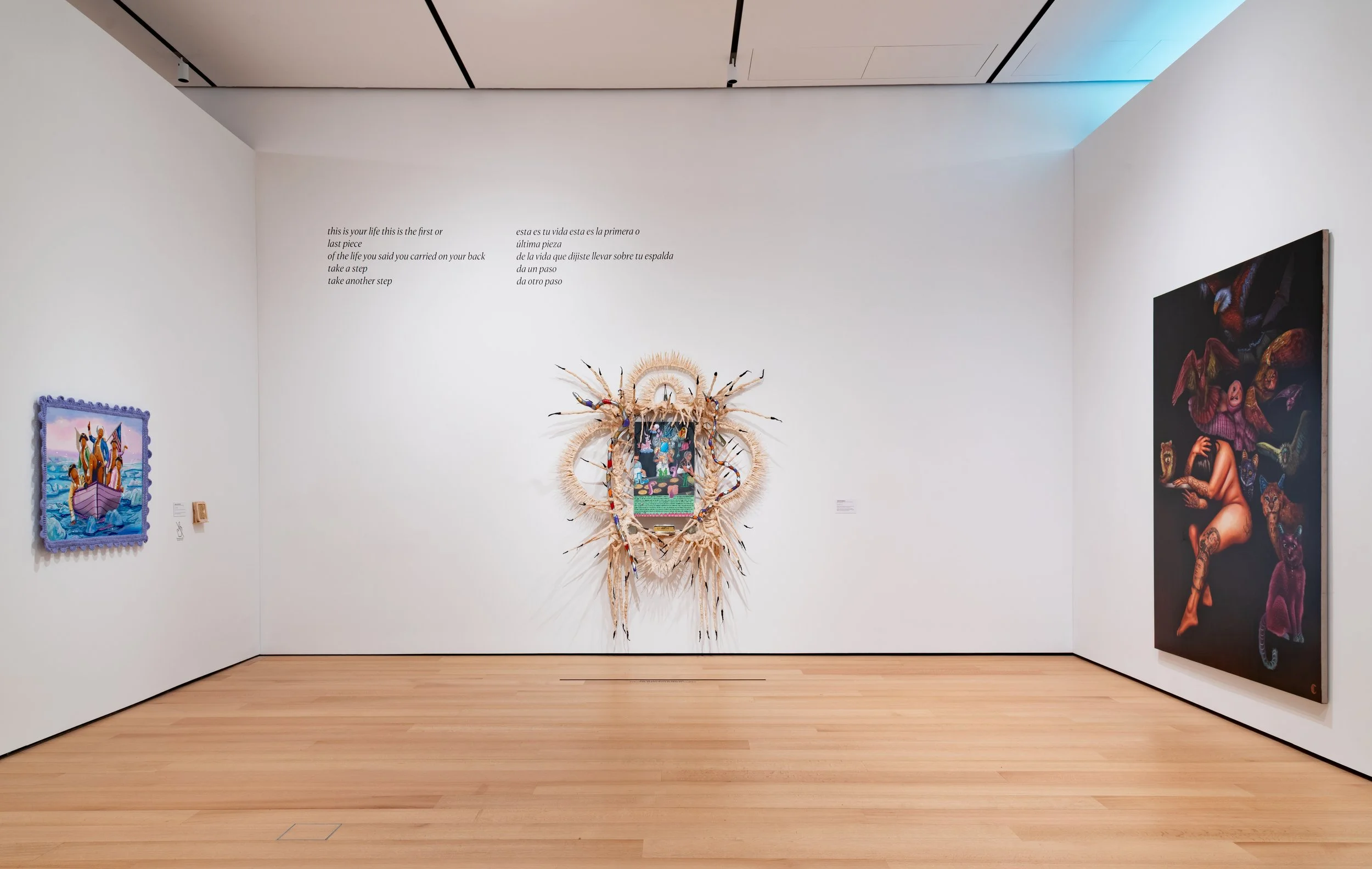
Let Us Gather in a Flourishing Way, 2026, installation view, Buffalo AKG Art Museum. Photo: Brenda Bieger.
These paintings derive their significance in part in relation to earlier works that forwarded a politics of uplift through representations of Olympian feats of resilience. In contrast, scholar Marcos Gonsalez has described acts of lounging, lazing, and daydreaming like those described above as passive resistance toward capitalist imperatives to labor productively. From this vantage, Mayorga’s, Nisenbaum’s, and Cruz’s works notably refuse to produce only dignified and hardworking subjects, even if they do so in relation to the productive subjects they ostensibly displace. The paintings do not simply escape the representational paradigm of the hardworking migrant. Rather, they turn its terms against themselves to offer idleness, intimacy, and repose as newly available forms of representation. The figures across these works gaze out toward their viewers with a casual disregard. Here, moments of repose suggest a subtle politics of refusal, one particularly potent given the politics that churn around the exhibition.
For another cohort of works that abandon figuration altogether, this refusal is not merely thematic but formal. Diasporican artist Candida Alvarez, whose practice spans five decades, has described gleaning material from the everyday—the view from a window, a cityscape—before drafting entangled forms and, finally, filling them intuitively with expressive color. Elsewhere, Leslie Martinez collages rags, paint chips, and other studio detritus onto a canvas, which they subsequently cover in waves of synthetic color. Somehow their work manages to feel both like debris from a place in ruins and the raw material for a new world. Both artists’ engagement with abstraction can be read not merely as a refusal of legibility but also an insistence on art as a means of prompting forms of life and feeling not yet fully imaginable.
There are also works by Rafa Esparza and Guadalupe Maravilla that engage the political domain more directly, but overall, Let Us Gather locates its politics elsewhere. It largely glosses over art with more marked histories of protest like political sign-painting, muralism, and graffiti. Instead, the exhibition’s politics emerge through subtler propositions about how subjects live, labor, rest, and make. Walking away, what lingers most is not the political valence of any given work, but the exhibition’s own emphatic politics of scale.
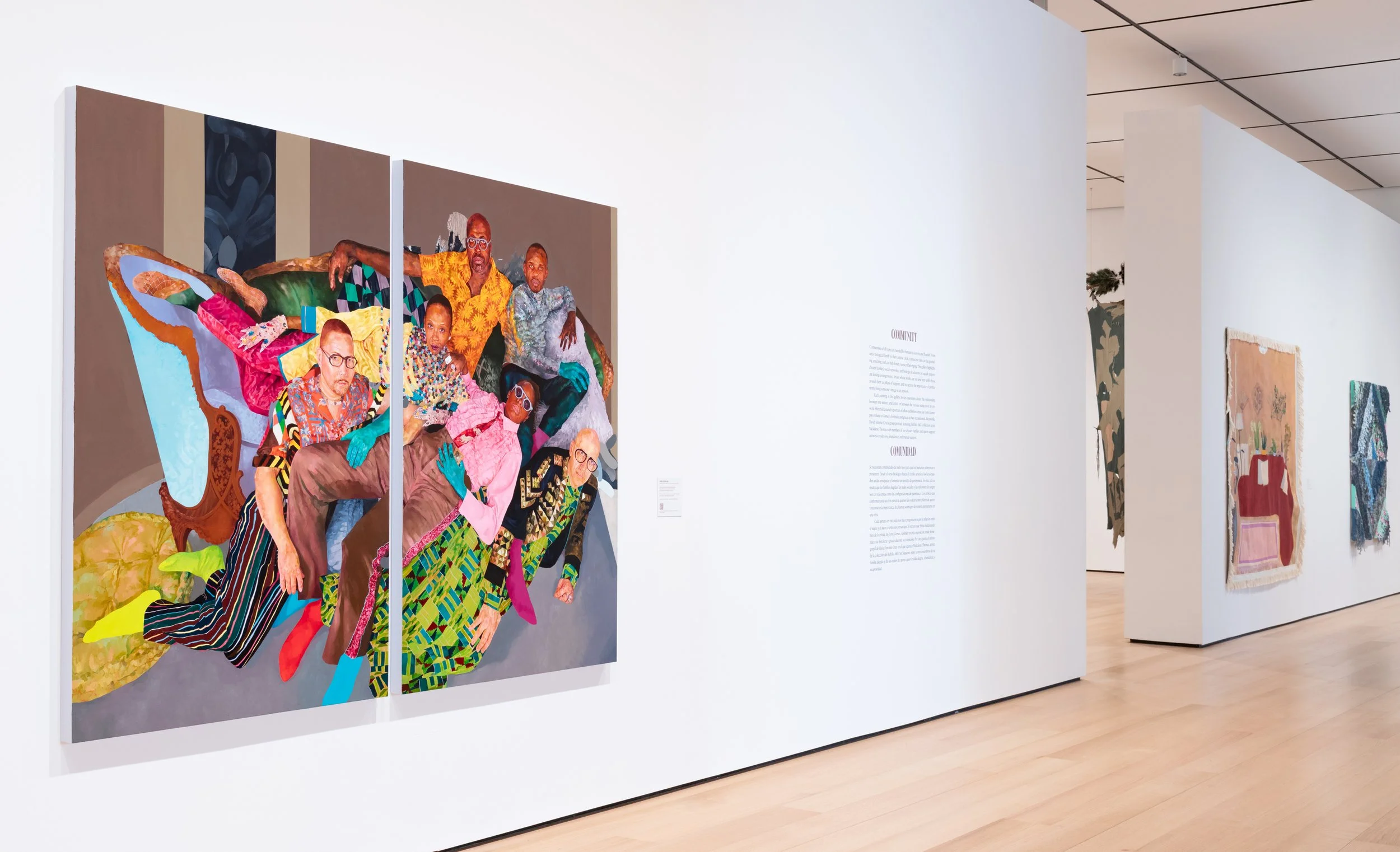
David Antonio Cruz, iknowyou’vebeenwonderingwherei’vebeen:adrift,adraft,astare,atilt,asigh, exhale.but,icamebacktoletyouknow,gotathingforyou,andican’tletitgo_the raft., 2024, installation view, Let Us Gather in a Flourishing Way, 2026, Buffalo AKG Art Museum. Courtesy of the artist and Monique Meloche Gallery, Chicago. Photo: Brenda Bieger.
Let Us Gather navigates the present moment’s contradictions between the increasing institutionalization of Latinx art in the United States and a political climate increasingly hostile to Latinx communities and migrants. Its response is, quite literally, to go big. By centering painting scaled to monumental proportions, Let Us Gather makes size a proxy for significance. The exhibition itself follows suit as it sprawls across an entire floor and, in the years to come, tours four additional museums. Its expansiveness is a claim to institutional space and an acknowledgment of the need to legitimate Latinx art there. The unresolved question that lingers, then, is whether becoming bigger necessarily means becoming more politically expansive?
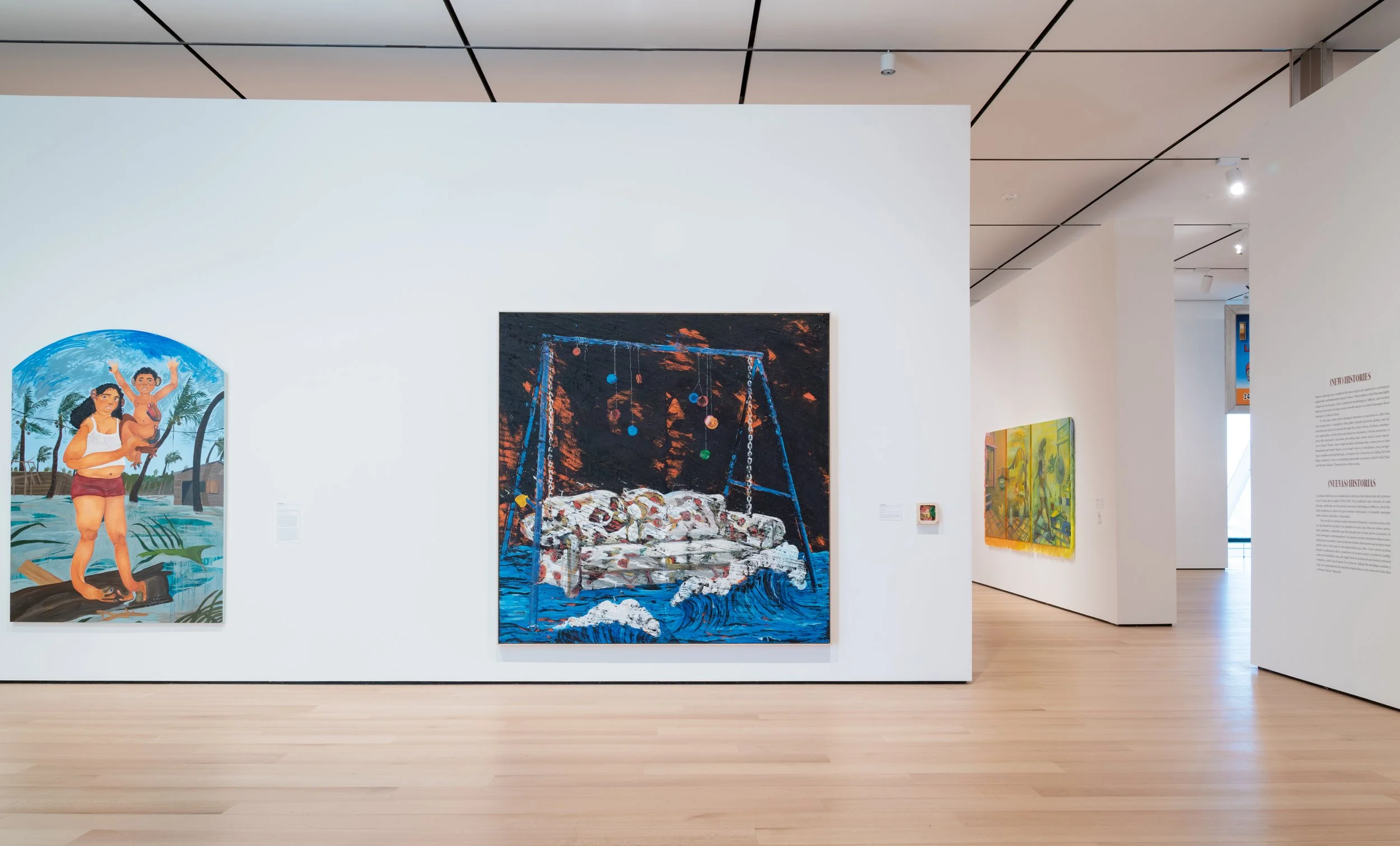
Let Us Gather in a Flourishing Way, 2026, installation view, Buffalo AKG Art Museum. Photo: Brenda Bieger.
by Luke Urbain
Luke Urbain (they/them) is a writer and scholar focusing on aesthetic responses to social and economic precarity in the Caribbean and its diasporas, with attention to the folds of race, queerness, and coloniality. Their criticism asks what aesthetics can offer toward the elaboration of alternative political forms and modes of care. Currently, they are a Visiting Assistant Professor at Williams College