Jacob Lepp's ‘Butterfly Kisses’ at Bonny Poon
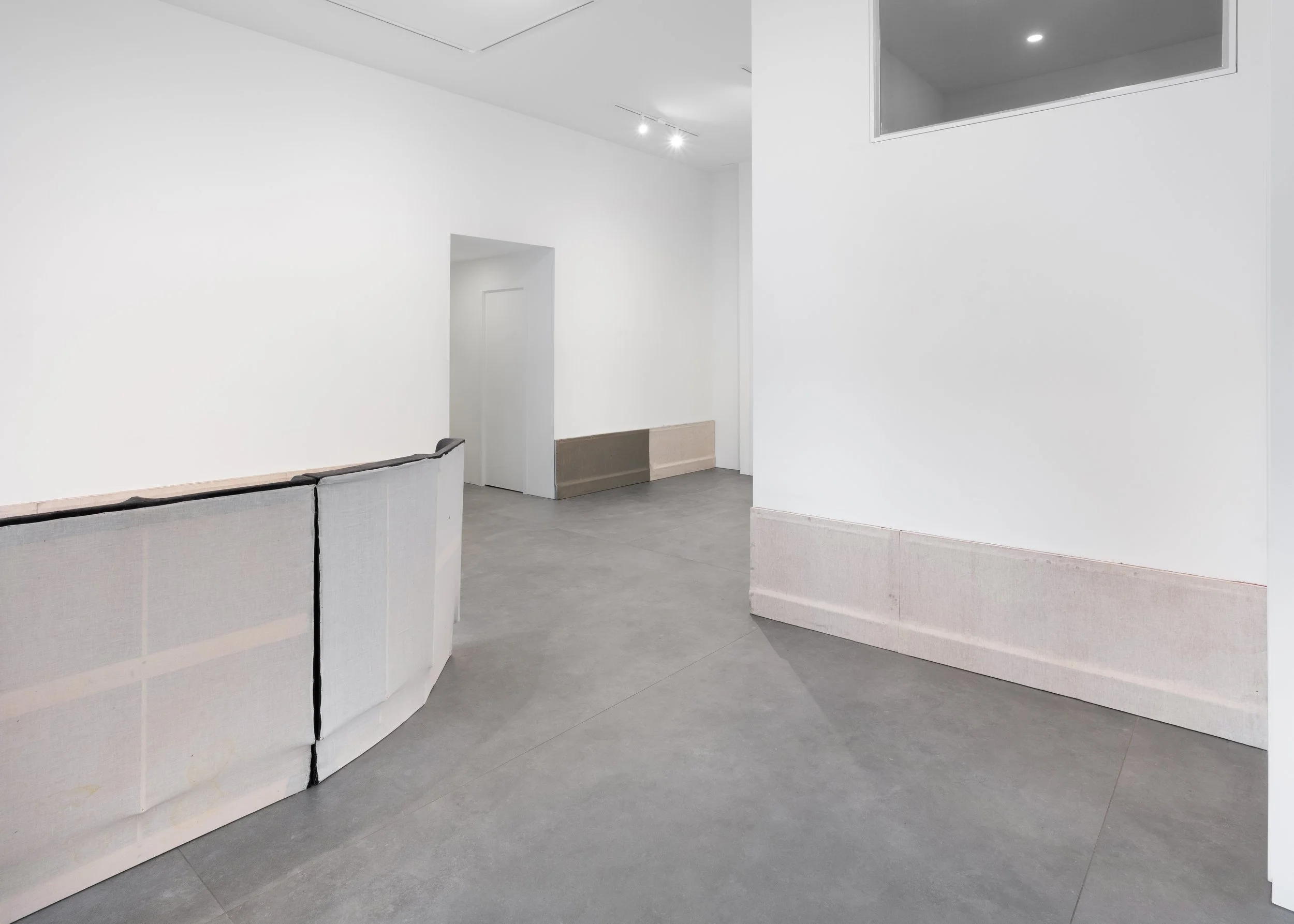
Jacob Lepp, Butterfly kisses, 2026, installation view, Butterfly Kisses, 2026, Bonny Poon Conditions.
Courtesy of the artist and Bonny Poon, Toronto. Photo: LF Documentation
Between kindergarten and high school graduation, I must have taken nearly a dozen field trips to the Art Gallery of Ontario. I remember a blur of stressful subway rides, lost worksheets, and the magnetic pull of the gift shop but not so much the art—with the distinct exception of Iris Häussler’s He Named Her Amber (2008). The elaborate installation filled the historic Grange house behind the museum with the unsettling tale of Mary O’Shea. The young Irish maid purportedly lived there some time in the century before last and embedded traces of her would-be anonymous life in the floors and walls of the house. As ambitious and strange as it was, what made Amber such a memorable art experience was the fact that it wasn’t presented as one. Instead, we learned days later that all those cryptic notes and witchy composites of wax and fingernails supposedly discovered during a restoration project were really part of a fiction planted by the artist. Simultaneously I realized I’d been misled by an ostensibly trustworthy adult and my understanding of what art could be exploded. Next, I felt the ground tip beneath my feet.
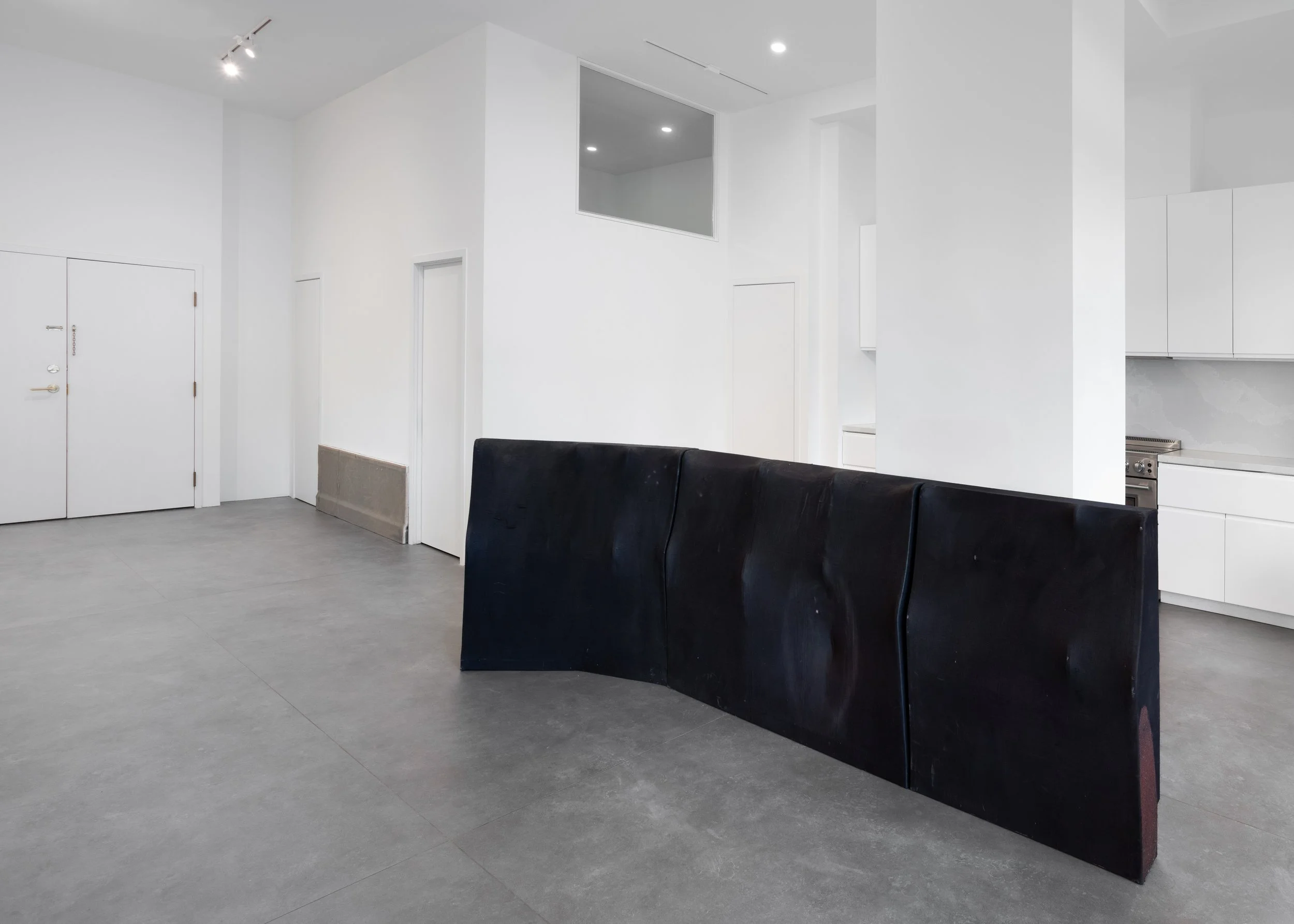
Jacob Lepp, A flock of three or more, 2026, installation view, Butterfly Kisses, 2026, Bonny Poon Conditions.
Courtesy of the artist and Bonny Poon, Toronto. Photo: LF Documentation.
By the time I saw Jacob Lepp’s Butterfly Kisses at Bonny Poon / Conditions earlier this year, I’d long since learned to appreciate the feeling of being destabilized; it speaks to work that estranges certainty. Of course, Häussler’s narrative-based ruse makes for a very literal example, especially in contrast to the subtle vertigo of Lepp’s exhibition. Butterfly Kisses is, overall, less-than-friendly to language. However, what’s easy enough to identify is that, like He Named Her Amber, Butterfly Kisses draws a certain emotional resonance from that well of psychological potency we call “home.” Lepp’s primary gesture of outfitting the gallery with a restrained pair of sculptural installations facilitates an experience of the existing environment. Both installations abstract familiar features of the domestic interior, and together, they mobilize the rich ambiguity of private and public space (it helps that Conditions itself is an apartment-based gallery). The show vacillates between critical and sentimental tones, mirroring the conflicted way we understand spaces more broadly—as general and particular, anonymous and personal, and structural and incidental. Lepp captures these tensions viscerally with simple affective contrasts. Ultimately, for all this verbiage, where Butterfly Kisses really distinguished itself is with an attention to form, material, and somatic experience.
How Is Where You Are, 2025-2026, installation view, Mercer Union. Commissioned by Mercer Union.
Courtesy of the artists and Franz Kaka. Photo: Vuk Dragojevic.
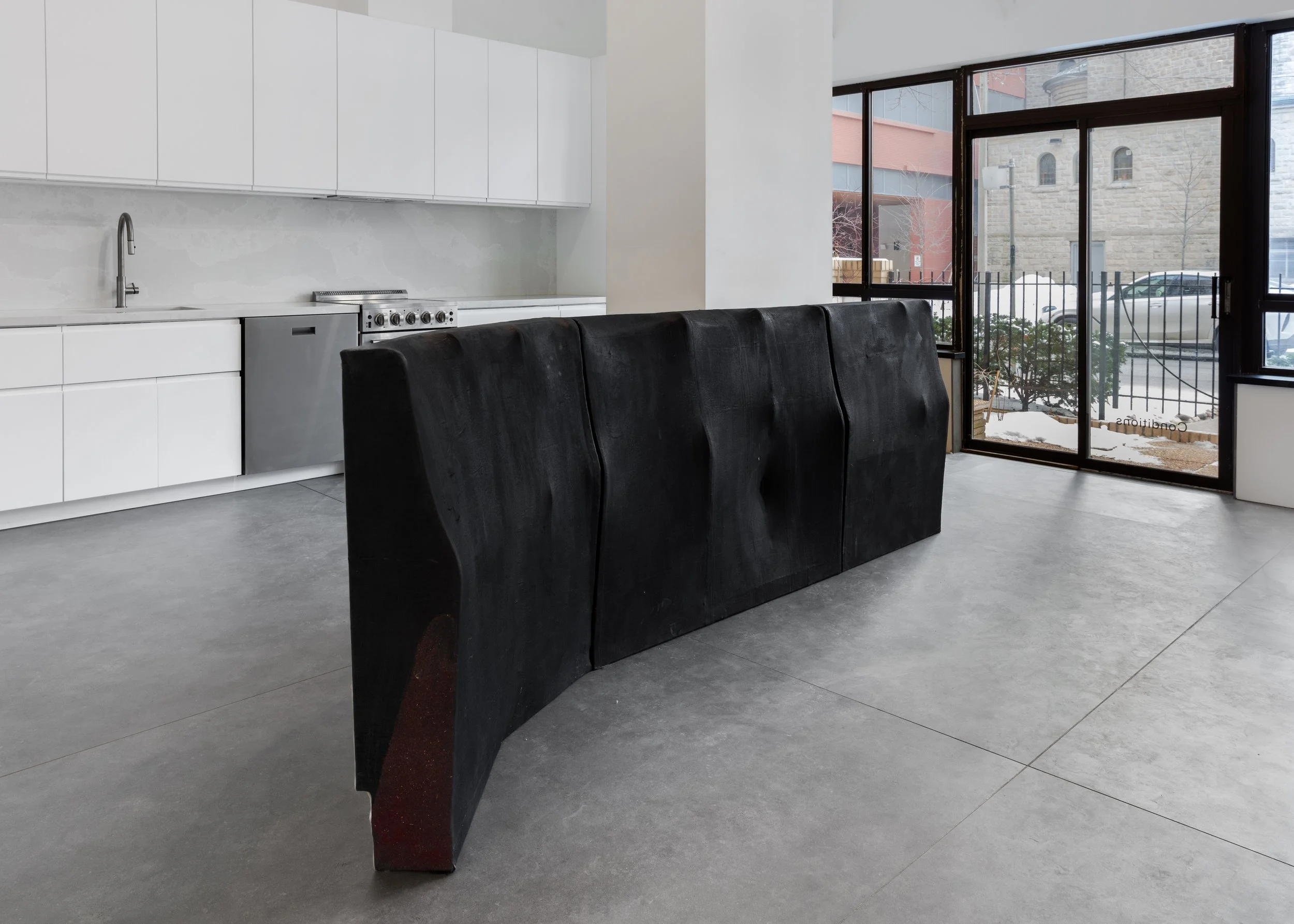
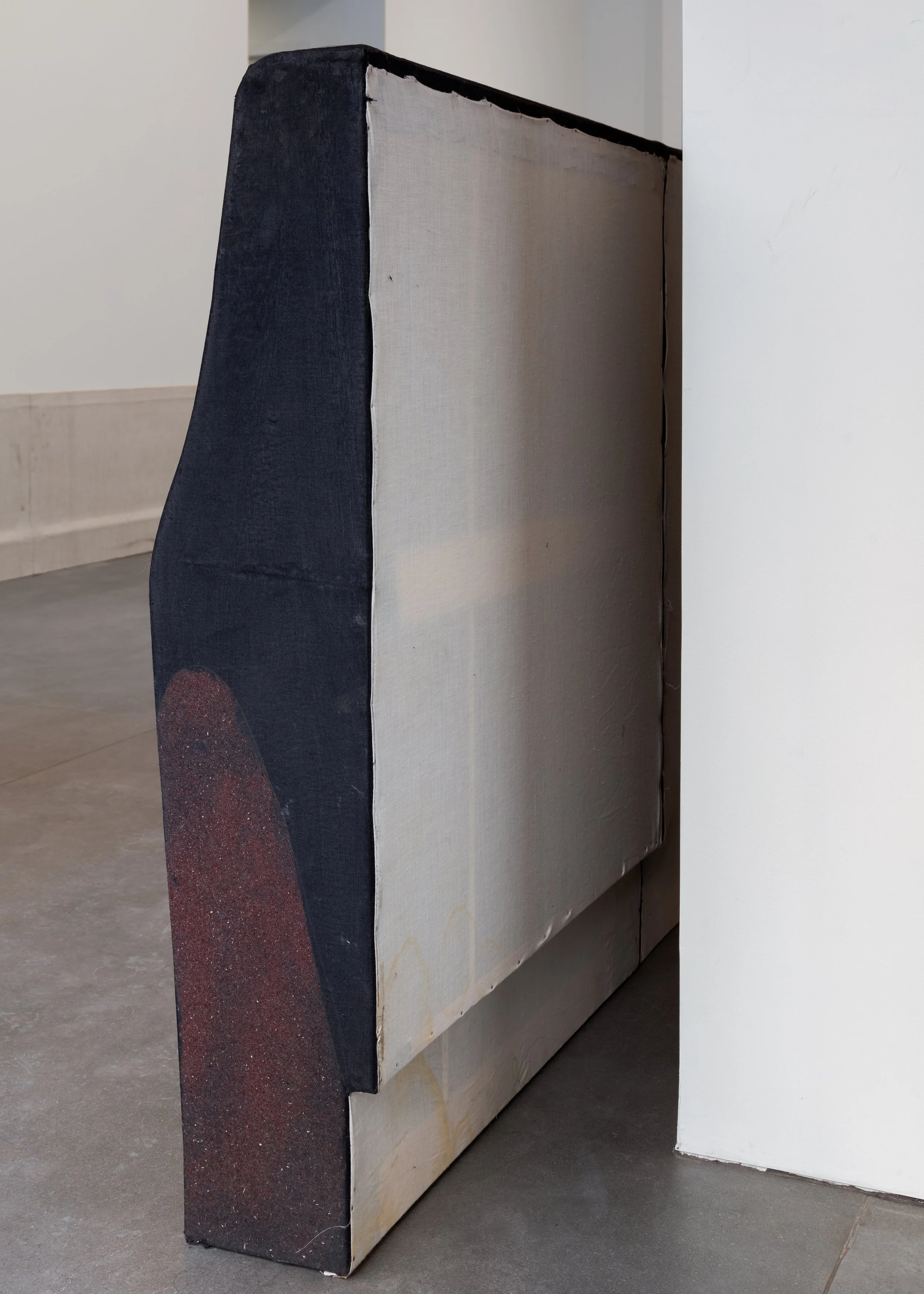
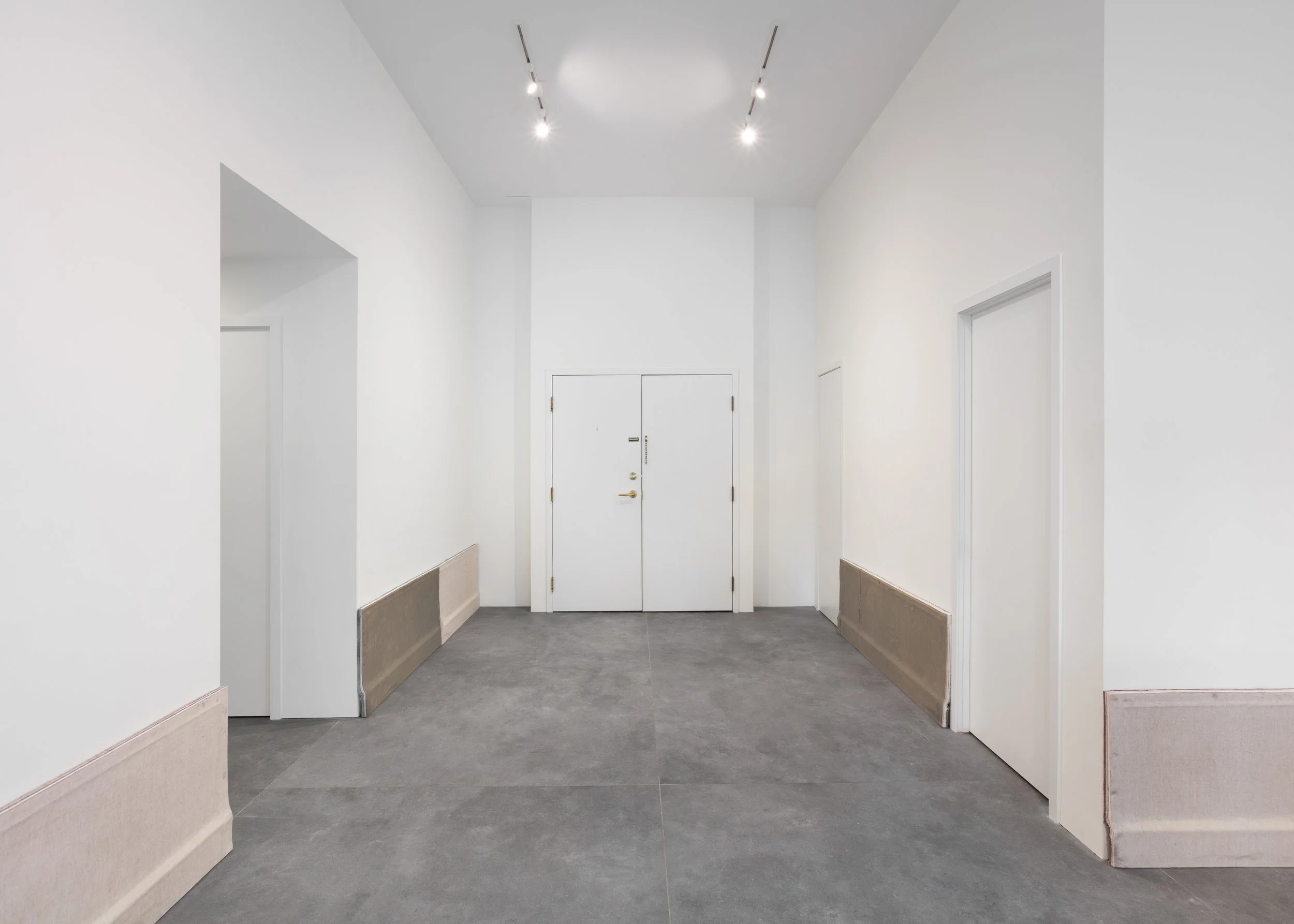
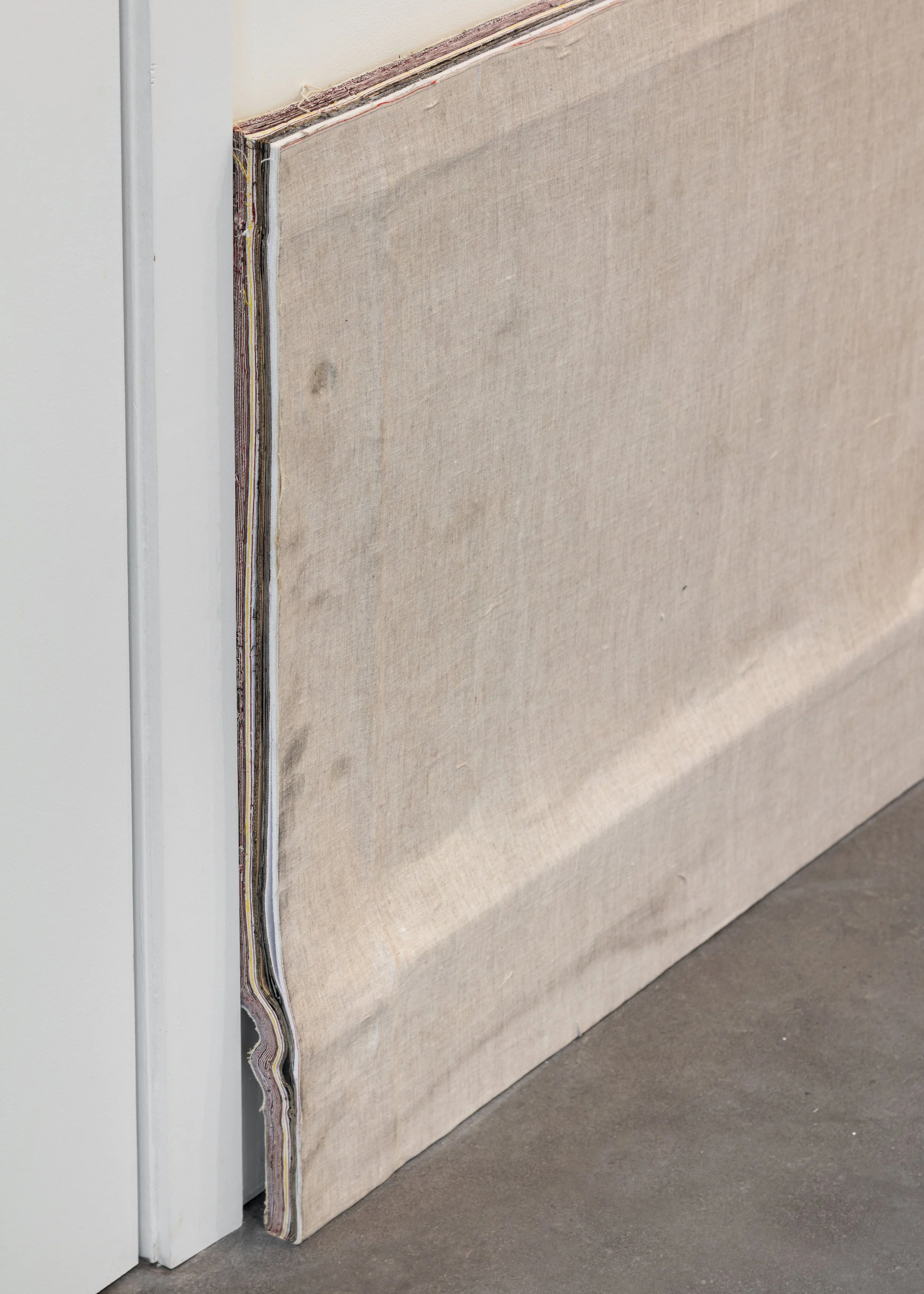
The mutual austerity of the gallery’s modern white interior and the work, designed to conform discreetly to its architecture, produces an atmospheric cool. Stepping inside, I was struck first by the surrounding emptiness. At the edges of the space, the ultra-slim, unassuming butterfly kisses (2026) hugs four walls, standing in for a baseboard. In shades of lacquered beige/taupe fabric and rising a little higher than my knees, the subdued line it cuts through the space triggers the queasy bodily discontent of a tripping hazard in the split second before I register it. From a distance, the sculpture’s plank-like panels appear solid and flat, except for a subtle protrusion along the floor. Viewed from the side, butterfly kisses reveals a curving gap molded around the shape of a baseboard. Only one sculpture really occupies the room: a flock of three or more (2026) stands where a dividing wall formerly split the repurposed apartment’s “open concept” floor plan. Its three black and undulating sections provide the initial point of contrast with the clean lines, hard angles, and light tones of the space and butterfly kisses. A flock of three or more echoes the architectural transformation of the space, but its placement and upholstered wood construction more obviously recall the soft surfaces of a furnished living room. The protrusions of its rib-like armature eerily suggest an animal flank.
Both works give form to something absent—furniture, a wall, its trim. But they also engender a more generalized sense of vacancy, transmuting negative space into a palpable and immersive thing. The dense layering of fabric of butterfly kisses and the thin linen surface and air-filled belly of a flock of three or more play a peculiar synesthetic trick. It’s one I’ve encountered before in Lepp’s manipulation of textiles: his thick wool panel works, made from tightly quilted squares cut from reused blankets, casting hushing spells over band practice emanating from a neighboring studio or chatter at an opening. The two sculptures in Butterfly Kisses likewise function as auditory, visual, and haptic synapses for the static of noise-cancellation and the goosebump-inducing bodily high of (good) painting.
How Is Where You Are, 2025-2026, installation view, Mercer Union. Commissioned by Mercer Union.
Courtesy of the artists and Franz Kaka. Photo: Vuk Dragojevic.
Finding and filling the contours of the mostly quiet, empty gallery, this sonic blankness proves highly conducive to spatial awareness. It also contributes to the overall defamiliarization of the space, which Lepp achieves by using other spatial intervention strategies reminiscent of institutional critique. Most curiously, in the process of drawing attention to an ordinarily unnoticed architectural feature, Lepp’s sculptural baseboarding implicates the gallery’s kitchen. Scanning the perimeter, I see this stretch of counter, appliances, and cupboards as impossibly two-dimensional, more continuous with the gallery than a discordant remnant of the apartment. By pulling attention to the outskirts of the room, butterfly kisses frames this vestigial kitchen as though it, too, were sucked flat against the wall—the proverbial “heart of the house” ironed into a sticker or sign.
The sculpture’s focus remains the semiotics of the baseboard. However neutral baseboards appear, they’re not without history—as the unfolding expository logic to Butterfly Kisses makes clear. They were initially implemented to seal the gap between floor and wall (protecting the latter) but ultimately became decorative. The equally fraught trend toward not using baseboards, while not explicitly addressed, receives a subtler form of acknowledgment. The negative space at the base of the sculpture recalls the economic and reactionary origins of modern interior design and the loose links between its rebellion against ornamentation and its rejection of the assertion of individuality in space. I mention this because it’s the discomforting reality of anonymized space that Butterfly Kisses comes closer to problematizing. Both sculptures engage what’s missing from the surrounding room. By charging their environment with a distinctly chilly first impression, they also blur literal emptiness toward a metaphor. Lepp smartly undermines the legitimacy of wall trimming conventions, but his apparent nostalgia for the human touch suspends any further revelation. Instead of the disaffected, deconstructive project suggested by the work’s slick profile, it delivers an objectless doubt, never more explicit than in the initial threat it makes to my equilibrium.
HaeAhn Paul Kwon Kajander, Sells the Time, 2025. 4 channel synchronized video, 4k video monitor, beaded curtain, 72 x 30 x 4 inches. Commissioned by Mercer Union.
Courtesy of the artists and Franz Kaka. Photo: Vuk Dragojevic.
As plentiful as the structural principles that underlie it may be, any interior is liable to be animated by the people and things that move through it and altered by their habit and caprice. There’s an elegant spatial analogy to how Lepp reflects this. While he marshals the room in its entirety to consider the space’s general taxonomic characteristics—like the character of domesticity that a kitchen adds to the gallery or hard, immovable fixtures like trim-less walls—the intimate details of his sculptures tell a more idiosyncratic story. Butterfly Kisses yields to an attentive approach, its cold and critical front gradually thawed by a choreography of kneeling down, peering over, walking around, and generally gaining in proximity. To concrete, granite, wood, stainless steel, and white walls, the works’ fabric surfaces introduce the flexibility, forgiveness, and warmth of cloth, cushion, and even flesh.
HaeAhn Paul Kwon Kajander, Bed with Blur, 2025. 4 channel synchronized video, 4k video projection, scanner with video tablet, wood, 24 x 66 x 192 inches. Commissioned by Mercer Union.
Courtesy of the artists and Franz Kaka. Photo: Vuk Dragojevic.
I once overheard a gallerist remark on the amount of dead skin that must be trapped in all those old wool blankets Lepp uses—a cheeky speculation that seems, in hindsight, to grasp something essential about the shadow of bodily closeness cast over so much of his work. Central to such a shadow are his laborious processes, whatever human DNA may be woven into his materials, and the come-hither curiosity their combination provokes. But there’s also a more elusive temporal compression at play, especially in Butterfly Kisses. To this end, writer Paula McLean opens her exhibition text by establishing what first clarified her understanding of the show: “[Jacob] described an old apartment he had lived in. . . . When he paused to get up from his work, his graphite-covered fingers would subconsciously touch parts of the walls. . . . He noticed these residual markings on the walls accumulated over time, revealing the habitual, intuitive relationship between his body, space and time.”
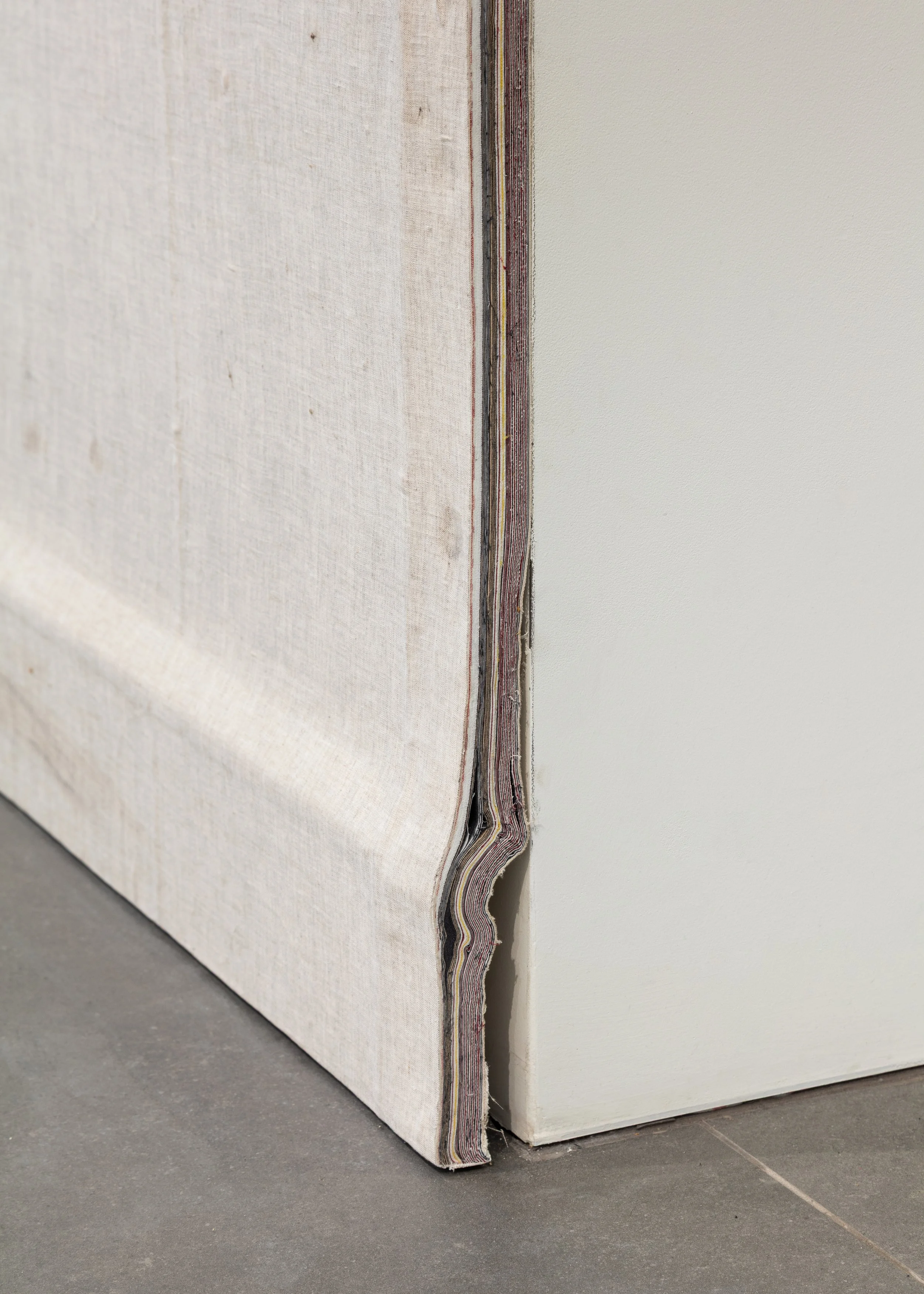
The construction of butterfly kisses echoes this gradual build-up. Seen from above or from the side at the point where the panel’s edge meets a corner, its multicolor cross-sections confess to a composition of layers and layers of fabric and wallpaper glue. The deceptively solid sculpture is deceptively slick, too. Cool-kid minimalism finally reveals itself as a foil for maximum care on the part of the artist. His clear expenditure of labor, presumably greater for the inconvenient choice of materials, suggests that the force of private emotional investment compounds the sedimentary layers of butterfly kisses (the line in his bio citing three generations of textile workers is more explicit). He cements pliant sheets of fabric into a hard-bodied sculpture with a formal contrast essential enough to endure with no context at all. Similarly, seen from up close, a flock of three or more reveals the artist’s hand. The frayed fabric edges, surface scuffs, stains, and nails all akimbo on the sculpture’s exposed backside evince a high-effort, low-polish approach that, like its biomorphic shape, exists at odds with the clean lines of the surrounding space.
How Is Where You Are, 2025-2026, installation view, Mercer Union. Commissioned by Mercer Union.
Courtesy of the artists and Franz Kaka. Photo: Vuk Dragojevic.
Many will be familiar with measurements etched inside of a doorframe: the intentional commemoration of a child’s growth over time. It takes a keen eye, a willing imagination, and perhaps a more Romantic temperament to similarly embrace a stubborn concentration of fingerprints or scuff marks. But pressed to its most literal limits, Butterfly Kisses might advocate such an embrace. Reveling in such oblique and mysterious expressions—the humane beauty of wear and tear, patterns etched by habit or accident and memorialized in the abstract—Butterfly Kisses never wholly abandons the lucidity with which it first estranges convention. Despite the progressive order in which I’ve described or implied the various dualities active in the show, cold never fully gives way to warm, nor hard to soft, and detail doesn’t override the immersive effect. It seems the integrity of every difference draws an interminable strength from the material tension between architecture and textile at the heart of the show. Staging moments of collision and slippage between the two, Butterfly Kisses leaves behind the frisson peculiar to encountering rigidity and flexibility as two sides of the same coin.
by Maya Burns
Maya Burns lives in Montreal. She has an MA in Contemporary Art Histories from OCAD University and a job at C Magazine.