Planetary Conditions
HaeAhn Paul Kwon Kajander’s immanent sets of contradictions
How Is Where You Are, 2025-2026, installation view, Mercer Union. Commissioned by Mercer Union.
Courtesy of the artists and Franz Kaka. Photo: Vuk Dragojevic.
Writing about “the West” and its relationship to the rest of the world currently feels rather trite and daunting—and yet it is perhaps this very triteness that makes it a worthy task. After all, the West’s historical domination, like its equally cliché counterpart, Capitalism, is inevitably the invisible first footnote in all of our narratives. I often think of my disagreement with Dean Kissick lambasting the sixtieth Venice Biennale on X as “anti-contemporary, desperately retrograde” for “pulling us back into history.” His points in his infamous Harper’s Magazine essay about art institutions and liberal orthodoxy, as well as biennial curators’ “missionary zeal in reverse” resulting in presentations of Indigenous art often being more cynical and performative than anything else, are nevertheless well taken. Bringing the ceremonial practices of the Amazonian Huni Kuin people into the bourgeois, spectacularly commercialized, imperial art world probably misses the larger historical dynamics of conquest and display within colonial institutions, etc. Is it ridiculous to purport to “reject the West” from inside its inherited and heralded institutions in metropolitan centers that have done anything but reject the West? Yes, but the impulse still speaks—tritely, dauntingly—to something worth acknowledging. Far be it from me to dismiss any artist’s foray into history to tell a previously sidelined or neglected story.
Where Kissick and I fundamentally disagree is on where and when art is at its best and what it does under these conditions. Most of Kissick’s criticism of contemporary art waxes nostalgic for what art was when he was a 20-something in the 2000s, fresh out of Courtauld and the Royal College of Art. Which is to say, a time before the art world came to recognize any of the “globalized” sphere of cultural production’s myriad contradictions. What Kissick overlooks are the material conditions. Frankly, how well we remember history is directly proportional to how we deal with the present. If we (in the West, within the empire, terminally online, whatever) prove over and over that we cannot learn the lessons of history, how can we possibly understand a present that by force of circumstance consistently traffics in eternal return? First as tragedy, then as farce, then as humiliation. Under these conditions it should be more embarrassing to be antihistorical than anticontemporary. What, then, does it mean to be simultaneously past- and future-minded?
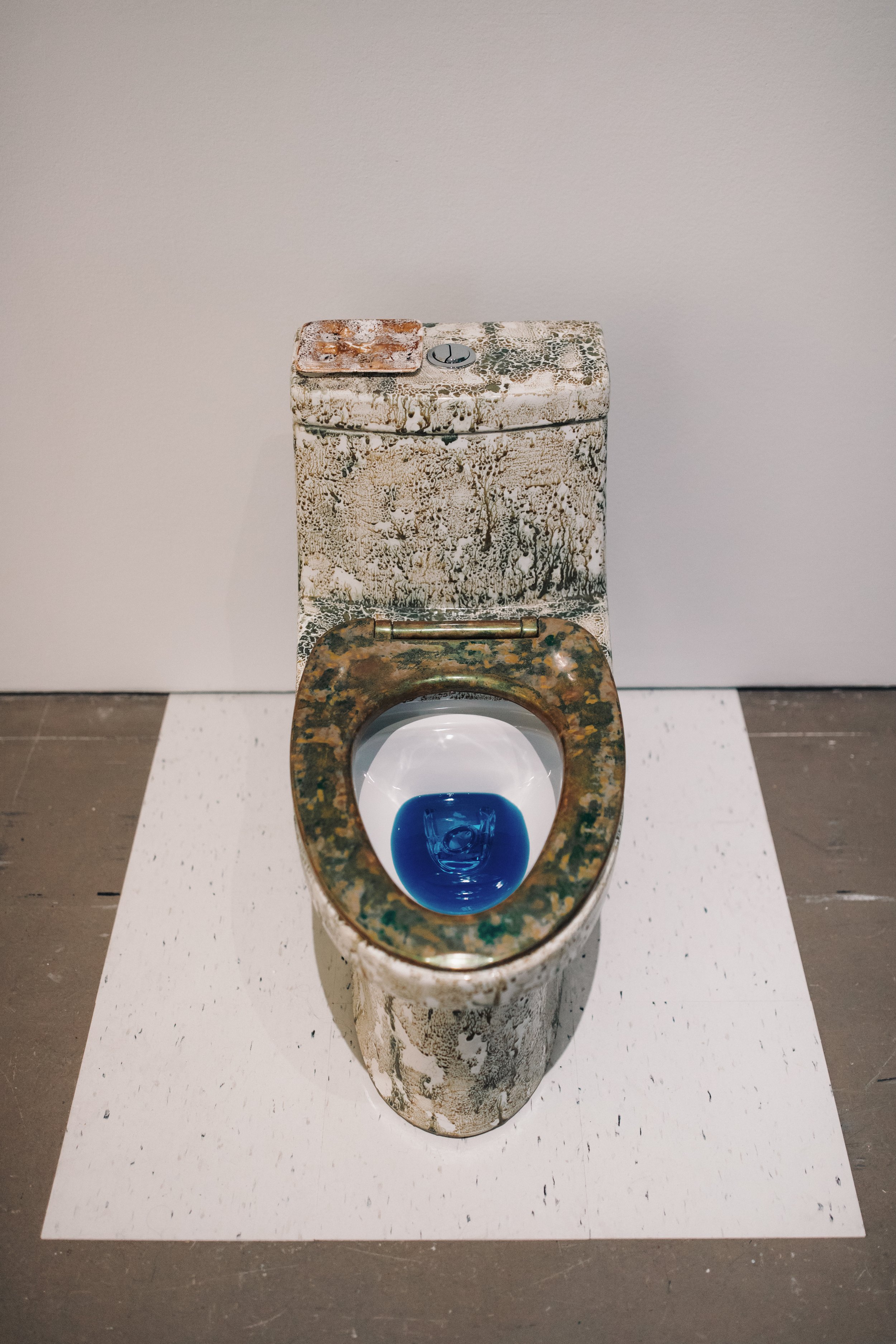
HaeAhn Paul Kwon Kajander, Tells the Time Reglazed Western toilet, 2025. Suunto compass, blue resin, LED light, ceramic, glass bowl with resin, 16 x 28 x 26 inches. Commissioned by Mercer Union.
Courtesy of the artists and Franz Kaka. Photo: Vuk Dragojevic.
Artist duo HaeAhn Paul Kwon Kajander broach this very subject with their first institutional solo exhibition, How Is Where You Are at Mercer Union. In their collaborative work, Kwon and Kajander bring together research into their South Korean and Finnish heritages, respectively; shared inheritances of technologies and Modernist utopian design principles; and histories of manufacturing and labour in both South Korea and Finland. In Post-Europe, philosopher Yuk Hui takes up the concept of Heimatlosigkeit: literally, the loss of home or homeland. The concept captures that existential state of being alienated or “uprooted” from one’s home in the modern world. This term marks 20th century philosophy vis-à-vis the long Americanization of all life, and has today become more pathological than ever before. The world Kwon Kajander reveal is one of Heimatlosigkeit, cohering primarily under the long arc of globalization.
In the tradition of expanded cinema, the artists separated a four-channel video across the gallery space, dispersing screens among several sculptural vignettes. These screens, moreover, are embedded within different objects. There is a surveillance dome reflecting a curved gaming monitor; a tablet inserted into a vintage fridge door; a screen encased in a scanner bed underneath a large projection; and a smartphone attached to an air sickness bag hanging from the back of an airline seat. Together, these consider the anthropological effects of the screen and the seductive powers of images. A network of material histories and tales of personal homes and collective nation-states culminates in questions about abjection, standardization, and how we all end up where we are.
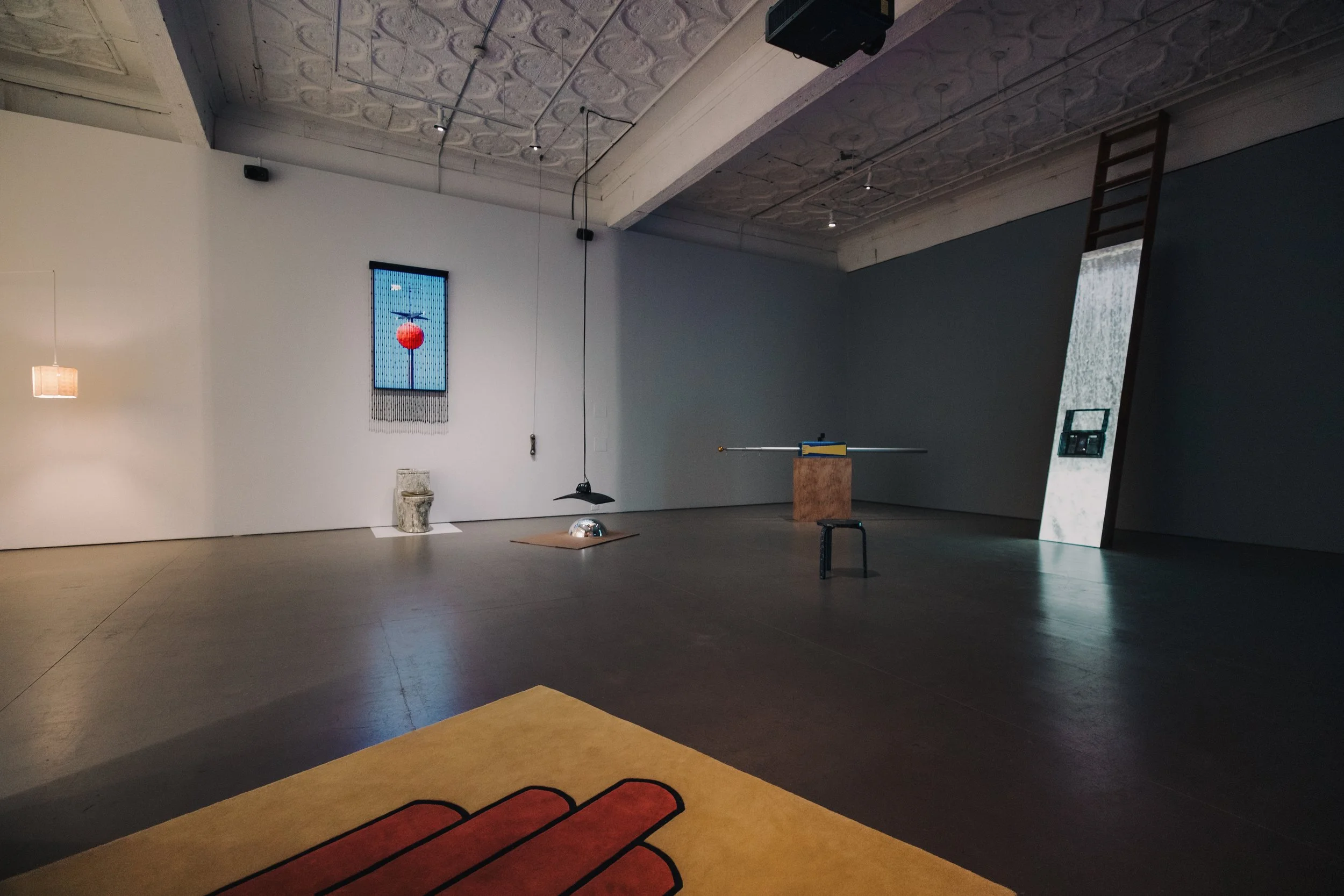
How Is Where You Are, 2025-2026, installation view, Mercer Union. Commissioned by Mercer Union.
Courtesy of the artists and Franz Kaka. Photo: Vuk Dragojevic.
The exhibition’s title evokes issues of place and even citizenship and suggests the coincidence of birthplace or the (often historically determined) forces of migration shape our experiences of the world. Ultimately the work is about geopolitics: one’s freedom of movement and, more discreetly, the relationship of one’s homeland, or adopted homeland, to the United States. In Post-Europe, Hui quotes a 1925 letter from Rainer Maria Rilke to the poet Witold Hulewicz lamenting the consumerist simulacra of life imposed by the burgeoning US empire:
For our grandparents a “house,” a “well” . . . even their own clothes . . . meant infinitely more, were infinitely more intimate—almost everything a vessel in which they found something human already there. . . . Now there are intruding, from America, empty, indifferent things, sham things, dummies of life [Lebensattrappe]. . . . Things living, experienced, and communing are going under and cannot be replaced. 1
Yuk Hui, Post-Europe (Urbanomic/Sequence Press, 2024), 14-15.
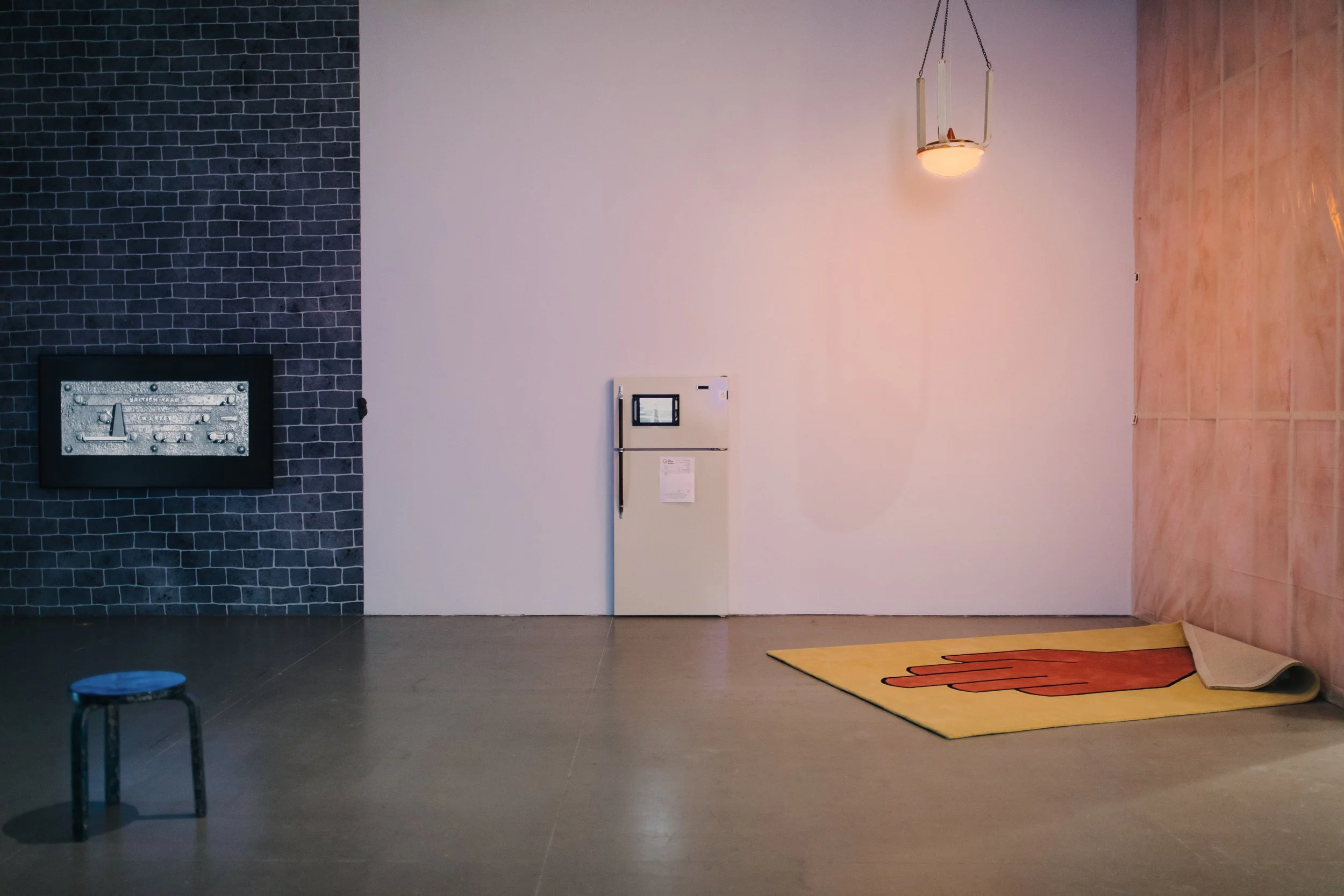
How Is Where You Are, 2025-2026, installation view, Mercer Union. Commissioned by Mercer Union.
Courtesy of the artists and Franz Kaka. Photo: Vuk Dragojevic.
Observing the early phenomenon of a uniquely American capitalist excess, Rilke identifies what would (rather quickly) become the postwar Americanization of Europe—and nearly everywhere else—via modern economic globalization. Under this later postmodern condition, no one finds themselves at home any longer. This sense of alienation and rootlessness—the relentless push of new, perpetually reinforcing conditions of extraction and production under the aegis of a globalized (that is, Americanized) consumer culture that appears equally strange to everyone everywhere—points toward a collective need to take up the notion of Heimatlosigkeit in philosophy and art.
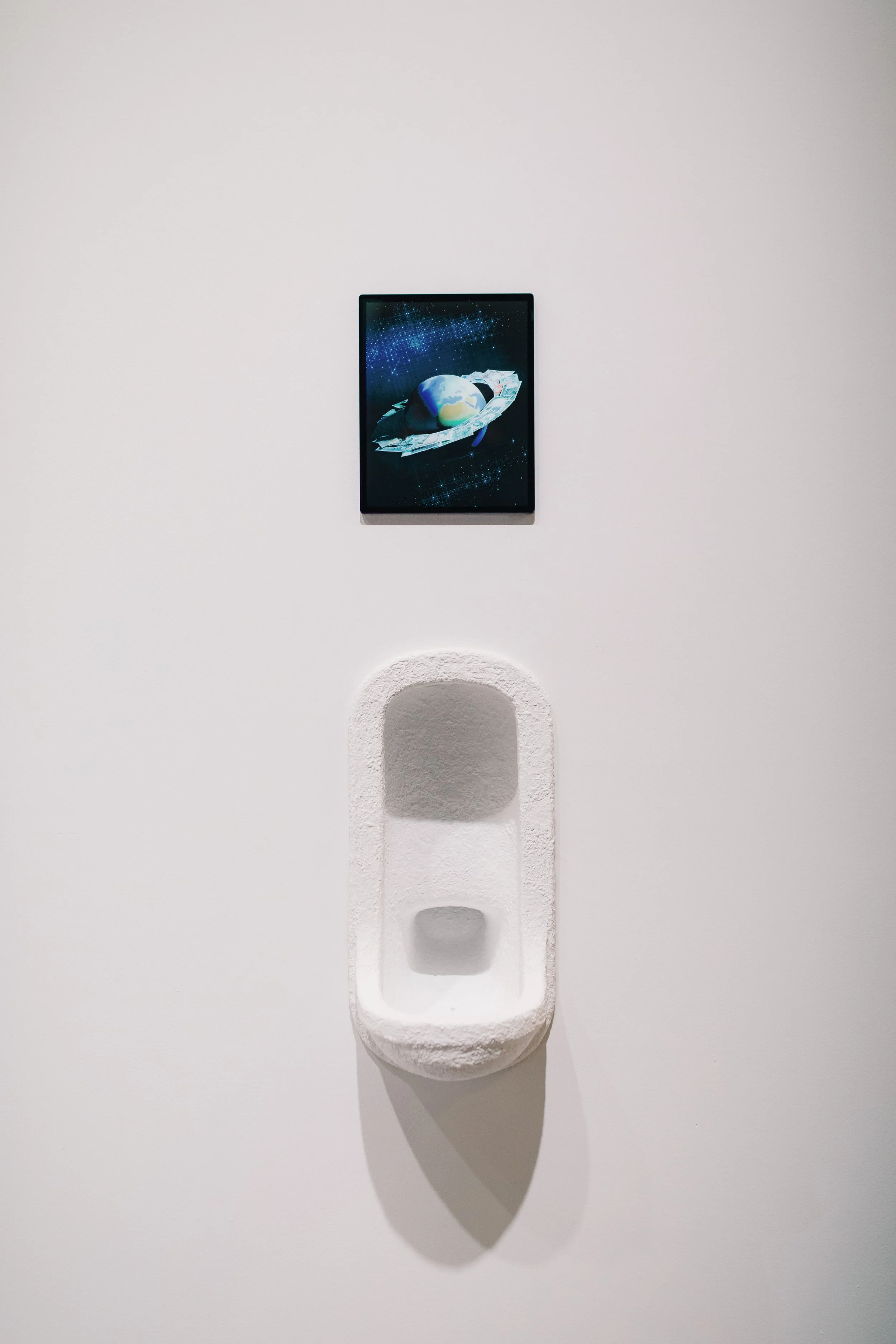
In an LED lightbox near the exhibition’s entrance is Humans Make Money (2025). Here, a series of banknotes in various currencies orbit Earth like the rings of Saturn in the corny style of 1980s finance futurism (the image was, in fact, taken from a Finnish bank advertisement). The lightbox hangs above The Other Way Around (2025), a Korean squat toilet that the artists sandblasted, reglazed, re-fired in a kiln, and mounted upside down on the wall. On the floor against the adjacent wall is a Western toilet, Tells the Time (2025), that the artists repeatedly sanded, polished, and lacquered with an array of greens and browns as though thoroughly sprayed with shit. Inside the bowl, encased in blue resin, is a Suunto compass, patented in Finland in the 1930s as one of the most precise compasses in the world and subsequently used by various militaries. The material and object interactions reveal a world of imported and exported standards for living where the familiar forms of the everyday, either in an Eastern or Western context, coalesce under a banner of universality.
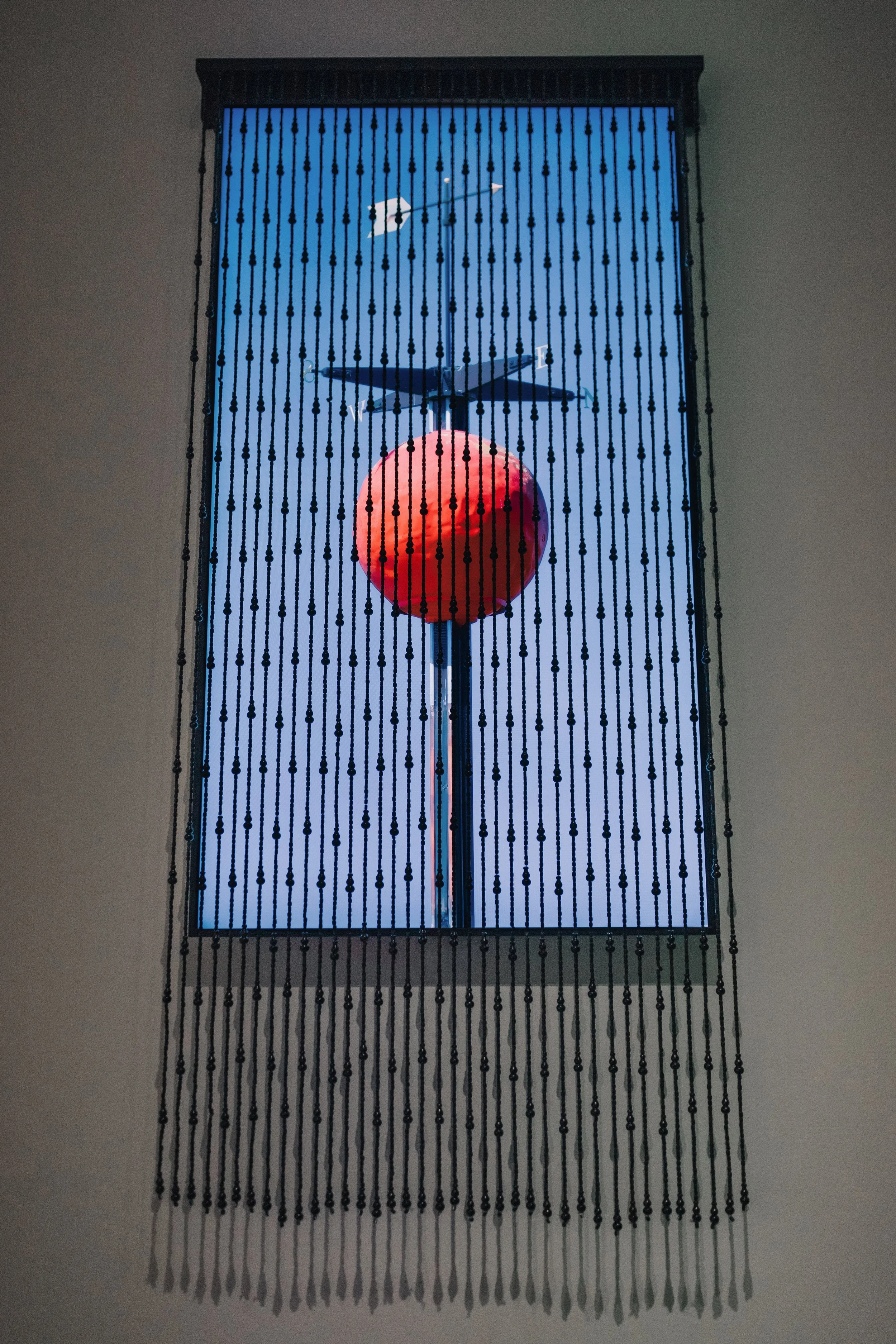
HaeAhn Paul Kwon Kajander, Sells the Time, 2025. 4 channel synchronized video, 4k video monitor, beaded curtain, 72 x 30 x 4 inches. Commissioned by Mercer Union.
Courtesy of the artists and Franz Kaka. Photo: Vuk Dragojevic.
Just above the Western toilet is the video Sells the Time (2025), which follows the time ball at Greenwich’s Flamsteed House, built between 1675 and 1676. We watch as the large red ball on a post with weathervane is slowly hoisted to the structure’s top and prepared for its daily drop at 1 pm, when it disappears from the screen with a dense thud. The time ball was designed as a publicly visible measurement of time, newly pertinent as an aide to shipping schedules during the prime of the British Empire’s adventurism into North America. Across the room a video mounted on a black-and-white-painted brick wall shows a close-up of the Public Standards of Length placard at Greenwich. Balanced on top is a metronome that sways and ticks monotonously until, at the work’s climax, it loses its balance and falls. These crude visualizations of time and quantity, both of which culminate in clumsy drops, speak to Western empires’ imperial desires for standardized systems of measurement and calculability.
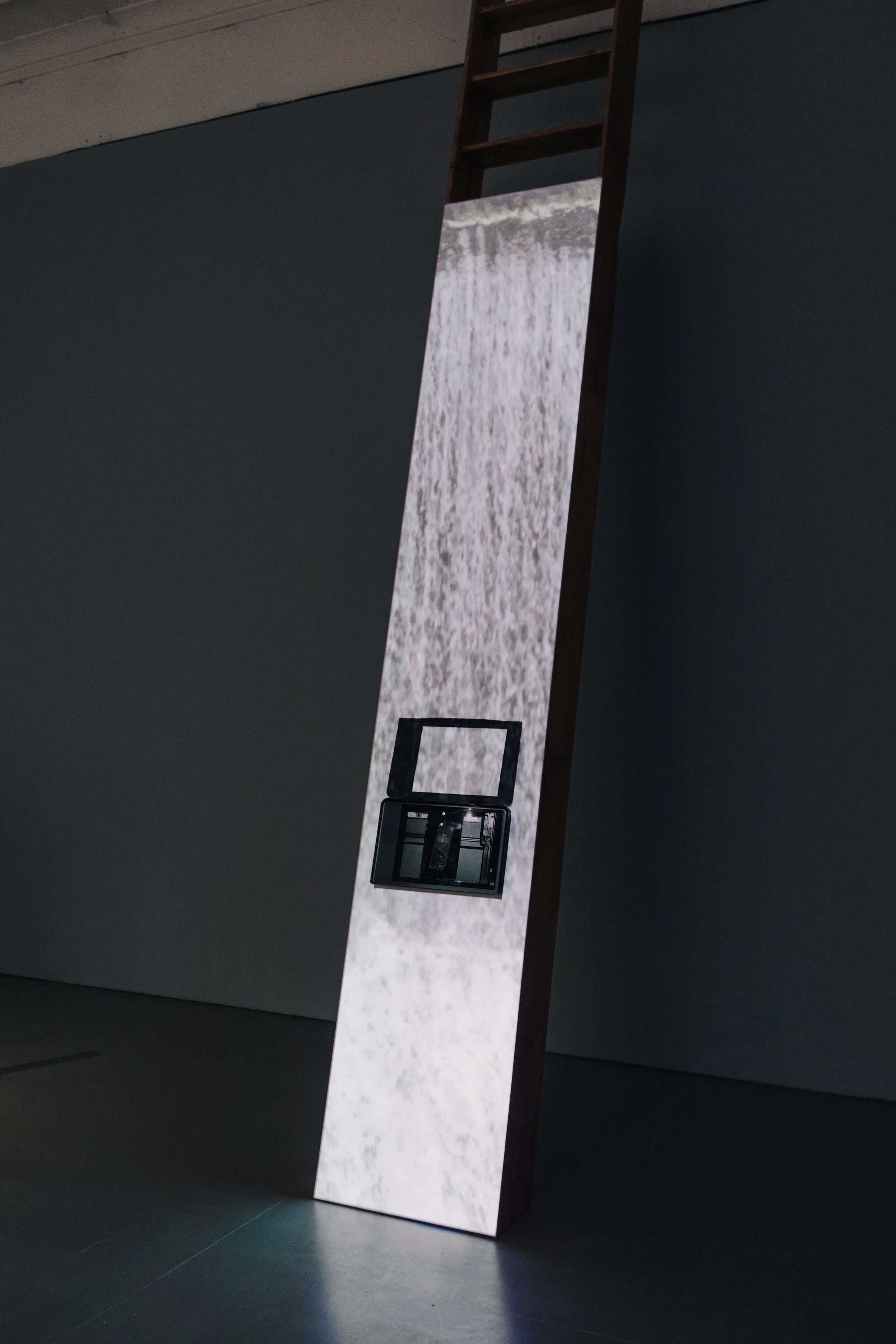
HaeAhn Paul Kwon Kajander, Bed with Blur, 2025. 4 channel synchronized video, 4k video projection, scanner with video tablet, wood, 24 x 66 x 192 inches. Commissioned by Mercer Union.
Courtesy of the artists and Franz Kaka. Photo: Vuk Dragojevic.
Bed with Blur (2025), a narrow screen resting against a floor-to-ceiling ladder, shows the Tammerkoski rapids and waterfall in Tampere, Finland. This was the site of the first Nokia plant; the waterfall originally provided the major source for the industrial production of toilet paper before the company pivoted to the exciting world of telecommunications. Affixed to the screen is a scanner bed, and underneath the glass is a Samsung Galaxy Tab. This, in turn, displays a recording of the first commercially available Nokia phone, filmed by the artists in Helsinki’s Museum of Technology. The many layers of imagery and technology create a strange sense of direction and misdirection. What’s clear is that there is something here about national industry and the power of agreements and corporate interests to limit various flows—of water, global trade, communication, etc. Today Nokia’s Tampere campus is its major R&D hub for system-on-chip development, cloud network management, augmented reality, and machine learning. As global connectivity, communications, and circulation of goods have largely conformed to US standards, the myths of “national” industry collapse under the weight of their demands. Allegorizing defecation invokes the binary of product and byproduct. This isn’t a huge stretch; after all, consumerism also implies the abjection of systematized excess—the “dummies of life” realm that Rilke identified.
Materially, Kwon Kajander’s main concern is for what they call “vernacular assemblages,” that is, the creative uses of objects they’ve observed on the streets of Seoul or in relatives’ homes. One driver of this material inventiveness is scarcity and especially its most extreme forms, such as that experienced during wartime. The need to make do with refuse and excess, inventing a lamp from a tin can, for instance, is the inescapable end point of supply chains, trade agreements, and poverty. Waste and production—the two poles that designate objects’ value—bump up against the subjective nature of those objects in relation.
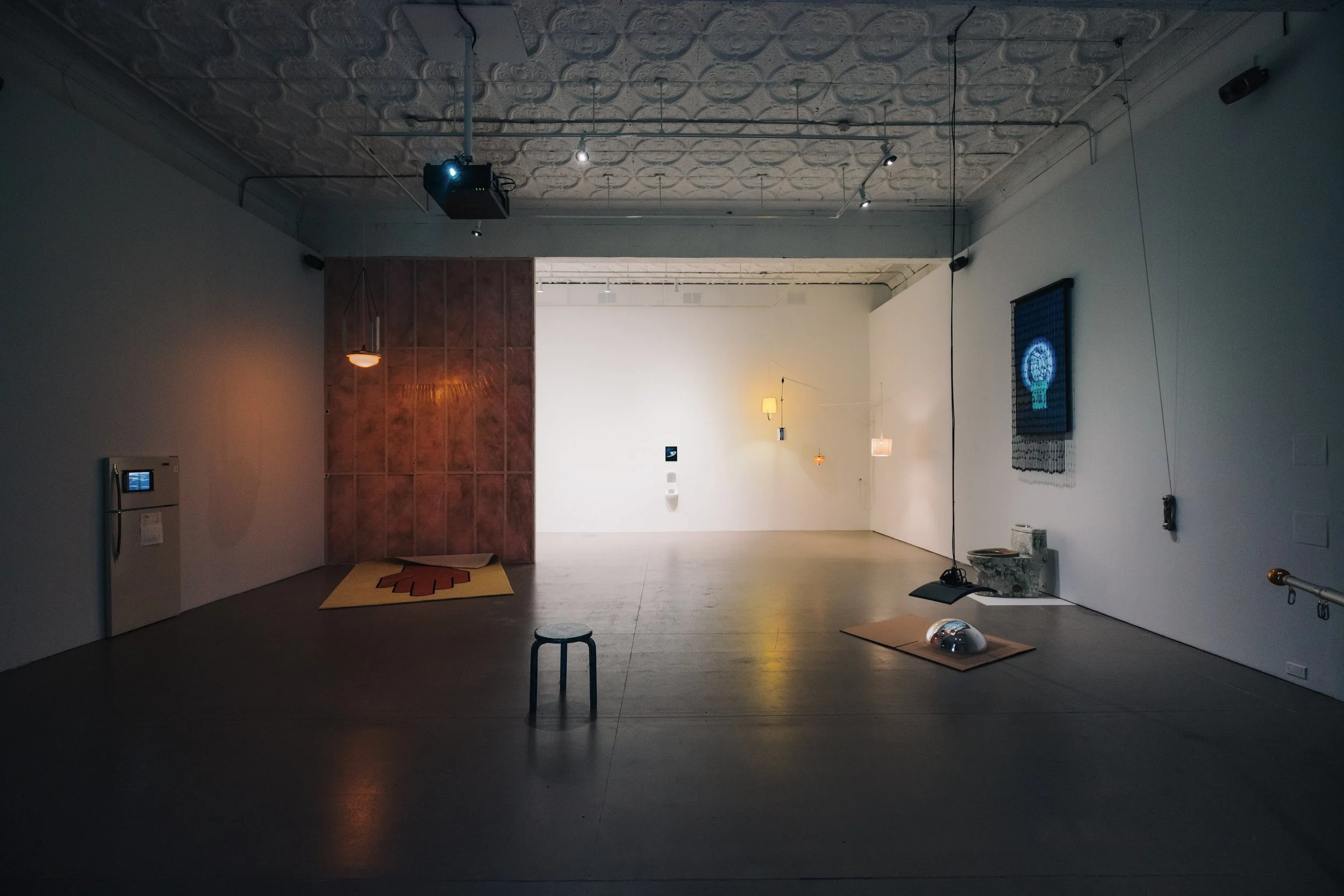
How Is Where You Are, 2025-2026, installation view, Mercer Union. Commissioned by Mercer Union.
Courtesy of the artists and Franz Kaka. Photo: Vuk Dragojevic.
At the end of the day, an inevitable Faustian bargain bubbles underneath the surface of a comfortable, Western life with readily available haute consumer goods. This is inseparable from regimes of neocolonial resource extraction, indentured servitude, and war-torn and decimated cities, and the vast histories of the subjugation that provisioned Western powers with the wealth to do what they want in the first place. Art also makes the bargain, because we all do. When artists re-perform unspoken (institutional) conditions, they invite us to consider our degree of submission to them and whether any degree of resistance is a distinction without a difference. How does art meaningfully respond to any sincere desire for a homecoming in the context of a Westernized world of technologically mediated, even enforced, dislocation? How Is Where You Are responds self-consciously from inside this exact situation, acknowledging the myriad negotiations of living, experiencing, and communing through and within the side effects of a techno-liberal world order.
To quote Fan Wu’s exhibition text: “Home, / a.k.a. how the mind converts illusion into truth.” If the West has firmly established itself as a planetary condition, then Earth is no longer home for many, and truth remains rather elusive. Borders, visas, and citizenship have little if anything to say about the human, as much as besuited consultants posting before-and-after TikToks about becoming yogis after three months in Bali might try to convince us otherwise. What they unknowingly reveal in their escapism is the breakdown of Americanization in denial. As artists chronicling shared experience, Kwon Kajander reveal something similar—but with an added wink and nudge and hope that there might be something to learn from all this.
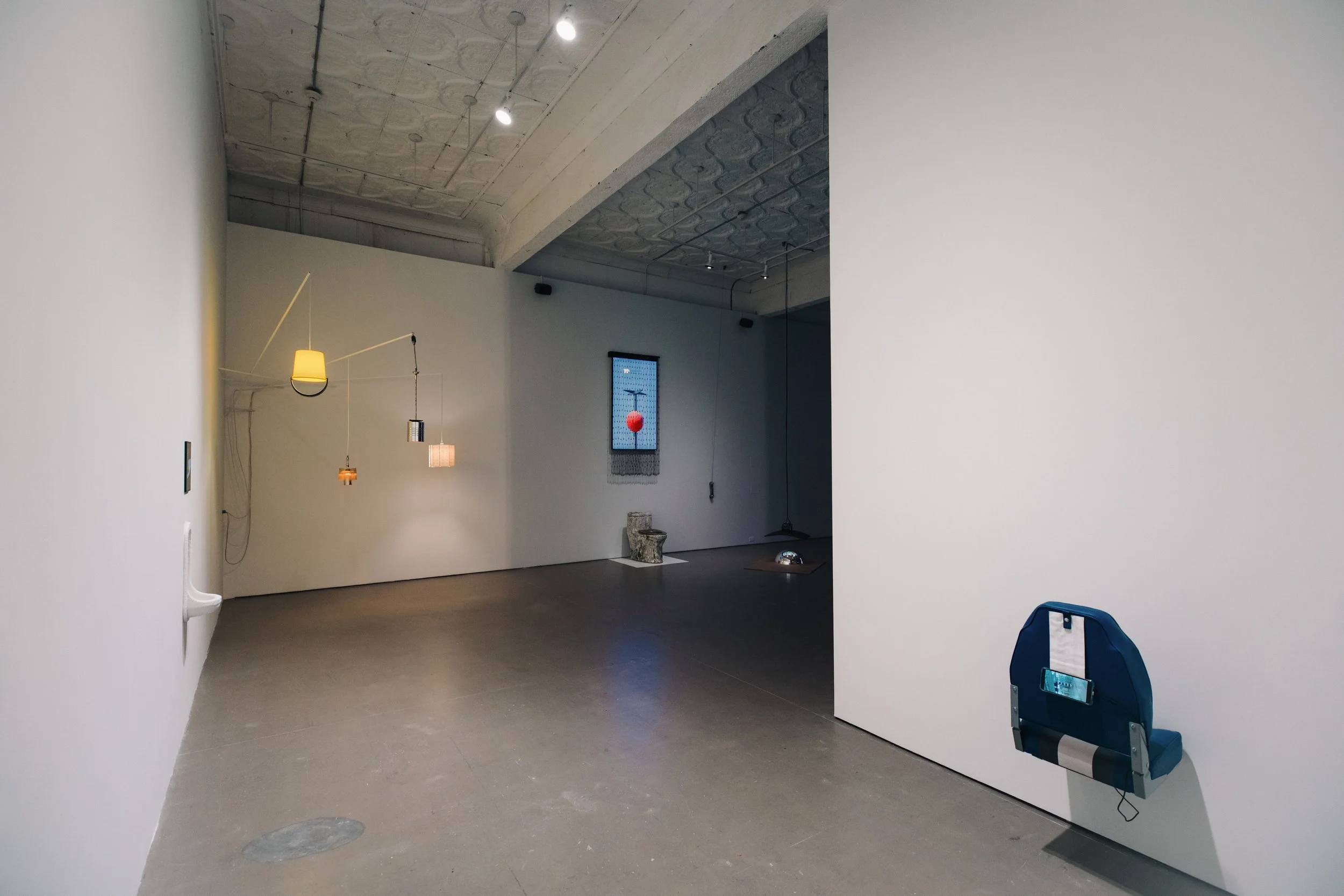
How Is Where You Are, 2025-2026, installation view, Mercer Union. Commissioned by Mercer Union.
Courtesy of the artists and Franz Kaka. Photo: Vuk Dragojevic.
by Angel Callander
Angel Callander is a writer, editor, and curator in Toronto, Canada. Currently she is a PhD student in Art History & Visual Culture at York University. Her writing can be found in C Magazine, Canadian Art, CBC Arts, Esse arts + opinions, PUBLIC, and BlackFlash among other publications, and in Imagining Futures of Experimental Media (Pleasure Dome, NIMAC & OddSide Arts, 2023), Architecture and the Smart City (Routledge, 2019), and Interface Critique (Kulturverlag Kadmos, 2016).